rss

Modular Diary – 087

Richard D. James on tuning and drift in his interview with Tatsuya Takahashi:

RDJ: …I guess some people like their Osc’s drifty and others not so. It changes with the context I guess. Also, if you’re doing FM you might want to keep them dead on, and for analogue lead sounds, really drifty. Anyway I think I mentioned it before, but the drift on the monologue sounds REALLY nice. It seems to move, but then never go out… Sounds to me like it gets reset/synced at some point…

TT: That’s bang on! So same thing in the minilogue and the volcas too: the oscillators are re-tuned when they’re not being used.

Mark Boyd (biminiroad) has posted a few patches on the Audulus forum exploring different approaches to simulating oscillator drift and detuning. His Drifting Gateable Quantizer doesn’t drift so much as introduce small pitch deviations that can be dialed in post-quantizer to get a pseudo micro-detuning effect. Simple (and light on CPU) but effective.

His Drift VCO takes a more complex approach: When the oscillator frequency is below 1000Hz, an adjustable amount of FM feedback (also scaled by the pitch) is sent to the oscillator’s input, and since the lower frequencies have more feedback, they are also more out of tune. Above 1000Hz (roughly two octaves above middle C) a slow sine LFO modulates the pitch in order to avoid FM noise. I’ve been taking a look at the patch and wondering how best to introduce something similar – a reset when there’s a pause in activity.

It’s interesting that now that we have the possibility of perfectly tuned oscillators we yearn for the beauty of slight imperfections. Certain of Jerobeam Fenderson’s visualizations in his oscilloscope tutorial come to mind – the spinning (around 5 mins into the video) introduced by an overtone having a slightly imperfect ratio, for example.

Modular Diary – 086

Following on STS’ Harmonium, jjthrash, creator of an Audulus Game of Life, has posted a Hymnotron. It’s based on the Dewanatron Hymnotron, which is basically an ingenious instrument for playing justly intoned chords. Taking a look at some of the other instruments the Dewans have built is a little like coming across the Ciat-Lonbard instruments for the first time. They certainly present a very specific (beautifully handcrafted) world of their own. They received some attention a few years back with articles in The New Yorker and New York Times (and a nice portrait on Rhizome) after Trent Reznor of Nine Inch Nails used their Swarmatron on the soundtrack for The Social Network.

The technique of stacking sine tones (and in the case of the Hymnotron adding harmonics through a process of wavefolding) reminded me of the Telharmonium, which I’d come across while taking a look at the Make Noise tELHARMONIC, and the still somewhat unusual appearance of triadic harmony in the modular world.

Modular Diary – 085

Robert Syrett suggested making some Halloween patches on the Audulus forum and I’d hoped to make a little patch with some typical ghostly sweeps based on Rob Hordijk’s fluctuation modulation. I unfortunately didn’t find the time, but did manage a quick µFluct module.

STS on the other hand has built a full-blown Halloween soundscape around his newly created Harmonium and µTuring modules.

Modular Diary – 084

I spent some time today playing around with STS’ Audulus Harmonium. I added a cosine output in order to be able to create the XY oscilloscope shapes that Jerobeam covered in his video, and rearranged the UI so that it would fit slide-over mode on the iPad. That works out quite nicely with the odd harmonics on the left and the even ones on the right. I’ve been using it in conjunction with MC Studio on the iPad, and enjoy being able to view both the regular waveform and the XY view at the same time.

Here’s a little video of how it works:

It’s interesting to note that the changes in phase don’t have any audible effect when listening with headphones but can be heard when listening ‘through the air’ via a pair of loudspeakers.

Modular Diary – 083

Earlier this year, inspired by a lecture by Just van Rossum, I took a look at the ways in which one might translate letter shapes to sound and view them on an oscilloscope. Via Oscistudio, the software I used to make those translations, I got to know a little of Jerobeam Fenderson’s oscilloscope music. He recently published the fourth in a series of video tutorials laying out the technical basis of this art form in a clear and accessible way.

STS has again been as productive as ever, this time with an Audulus Harmonium – an additive oscillator in which the volume and phase of the first twelve overtones of a sound can be individually adjusted: The perfect tool for making some oscilloscope music, should one be so inclined.

Modular Diary – 082

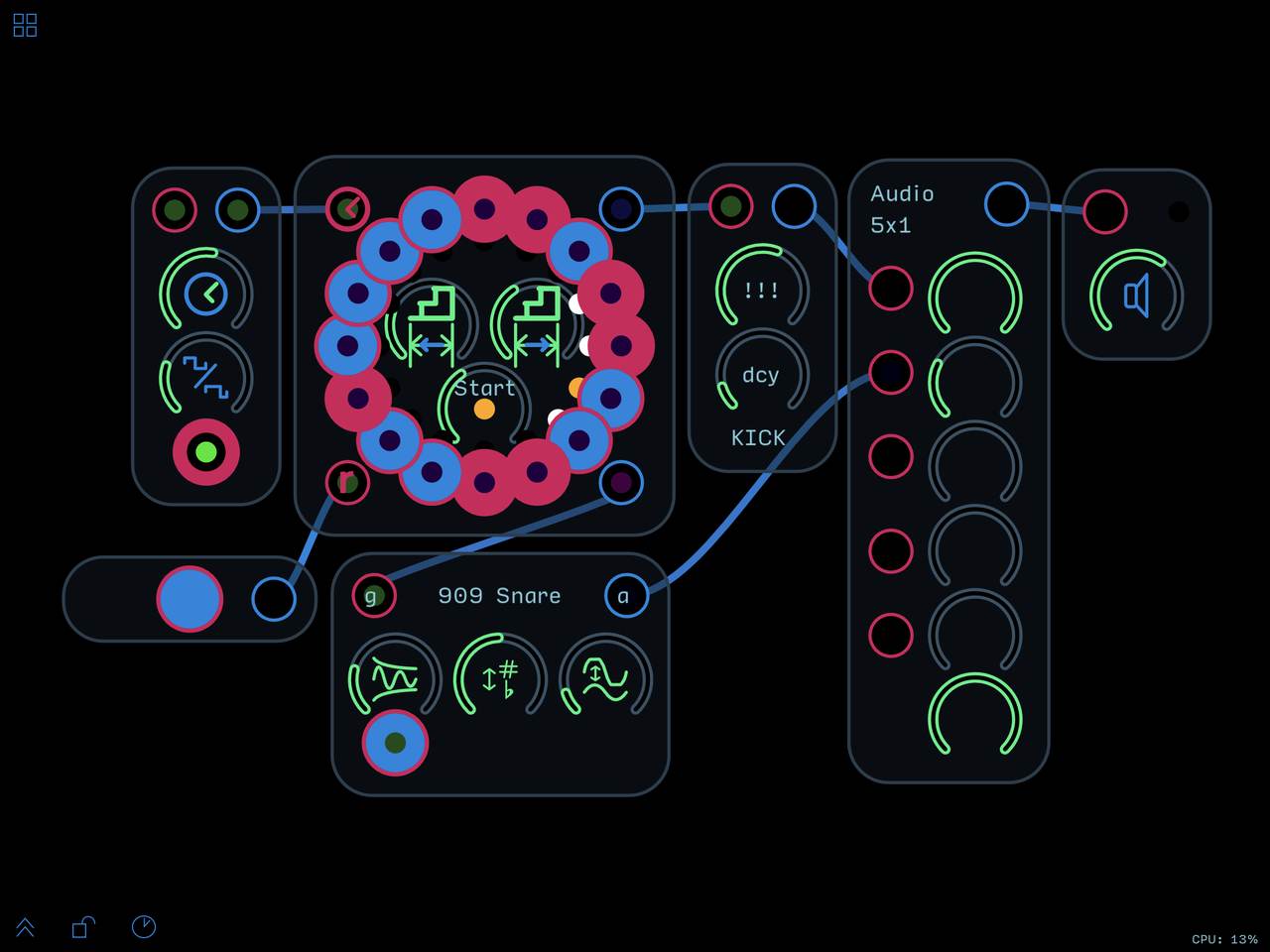
A while ago I was looking at a few examples of circular sequencers and wondering why there weren’t more following this form. RileyGuy has since posted his Audulus clone of the wonderful Euclidean Circles eurorack module, built referencing Biminiroad‘s 5 Step Gate-Trigger Shape Sequencer. Biminiroad posted a demo of an earlier version of that sequencer with the outputs triggering different aspects of a single snare module – which got me thinking of the Basimilus Iteritas Alter, a module that I’d still like to take a closer look at.

Buchla provided some of the inspiration for Bimini’s rotating shape sequencer, and I came across a video of Don Buchla himself demonstrating his Polyphonic Rhythm Generator. The video, titled How Complicated Could a Metronome Be?, is unfortunately a little difficult to watch due to some shaky filming, but fascinating nevertheless.

Modular Diary – 081

Thinking about the wide variety of elements that go into making a person: Alessio Santini talking with Darwin Grosse (on the Art + Music + Technology podcast) about how the discovery of Max changed the arc of his musical life – how he for many years put away his guitar as he focussed on his activities as a software developer, only to pick the guitar again, but with a very different perspective. That also got me thinking back to Robert Henke’s observations on the tension between finding it necessary to invest in learning how to build (program) things, and getting round to actually making art with them.

Modular Diary – 080

A little side note on octaves. I noticed at the end of Hordijk’s Rungler Demo at Modular Meets Leeds (at around 14min) that he actually has the Rungler (stepped) out set to cover a range of 9 octaves. I also noticed in a post of his on the electro-music forum that the Benjolin oscillators cover a range of 18 octaves! And that led to a discussion with stschoen on the Audulus forum, who explained the reasoning behind setting the oscillators in his Audulus Rungler to cover a range of 14 octaves:

As far as the oscillator range is concerned, I realized this morning that when I mentioned 14 octaves for my copy, I had taken 2Hz as the lower bound. The real bottom limit for the oscillators is 0.001 Hz, so the actual range is approximately 25 octaves, although I’m not sure that this has much meaning when applied to something running at sub-audio rates. I choose 2^14 as the upper limit for the oscillators since that’s slightly above 16K and that seemed high enough. 2^15 would have been 32K which is well above the Nyquist limit and so couldn’t be produced in any case at a 44.1k sample rate.

There was also further discussion on whether the rungler output should be set as a bipolar audio signal or a (standard) unipolar control signal, with STS eventually deciding to leave it as the latter since it could easily be adapted to an audio out by means of a simple expression, should the need arise.

I did notice in the Mallorca Rungler video though that it seems that the pulse output is also scaled to 9 octaves (in the video attenuated to about 4) and set about trying that out on the STS’ Audulus Rungler. It seems to help with creating a more ‘noisy’ noise when rungling at audio rates.

Modular Diary – 079

I did a little tryout of the mobile phone part of A Branch in the Path at Frankenstein’s Lab this evening. It’s a piece that I began shortly after discovering Audulus in December of 2015. Some of the very first patches I began building with it were based on the realisation that it was possible (and easy) to create feedback loops, and that, along with my interest in non-tempered tunings, led to the piece that became A Branch in the Path: Five interlocking overtone series set up so that the durations match the proportions of the series with (stepwise) movements up or down randomly chosen. Since the end of a duration triggers the next tone, with duration and pitch linked, one ends up with something similar to a Krell patch – only I didn’t know it at the time.

It’s not a performance patch, nor a kind of instrument. Audulus was primarily a tool used to explore the idea of moving around an overtone network, and use that material for both the instrumental parts (alto flute and bass clarinet) and the sound files that the audience set in motion while navigating the Branch in the Path website.

Modular Diary – 078

I remember a comment by Robert Henke that Max users should spend at least two months of the year playing with the patches they build. I suppose that could be a little of a danger with Audulus as well – that the play ends up being in the process of building, and not so much the sense of using the patch as an instrument. But something like the Blippoo is meant to be played with (or not), and so I spent a little time this evening doing exactly that – and felt much happier with it than I did yesterday. It is a little instrument that one needs to get to know, and the fact that one has to spend some time with it and sometimes learn how to coax things out of it ends up being part of the fun. I posted a little spot I reached with it this evening on the Audulus forum – with a dual version of STS’ All-Pass reverb.