rss

Modular Diary – 097

I’m beginning to realize that one of Audulus’ best features is its forum. Besides all the learning and exchange and building on each others patches, it’s also a great place for discovery: Via soporus/eponymic, the creator of some very impressive TR808 drum sounds, I discovered the Hyve – a touch synthesizer with an interface arranged so as to easily explore tone combinations with small finger movements: It includes both a piano-style keyboard layout and a hexagon grid somewhat reminiscent of the Snyderphonics Manta used by Walker Farrell on his latest album. Like the Hordijk Benjolin it too grew out of workshop situations in which one could build an instrument in an afternoon.

It’s delightfully simple. There are no envelopes to set or filters to adjust. Vertical movements on the keyboard shift octaves. Small thumb-pads enable glides. Pressure controls the amplitude, and horizontal movements placement in the stereo field – which makes for tremolo like modulations. Those simple parameters, along with 60-voice polyphony (!) make for a surprisingly expressive instrument.
Modular Diary – 096

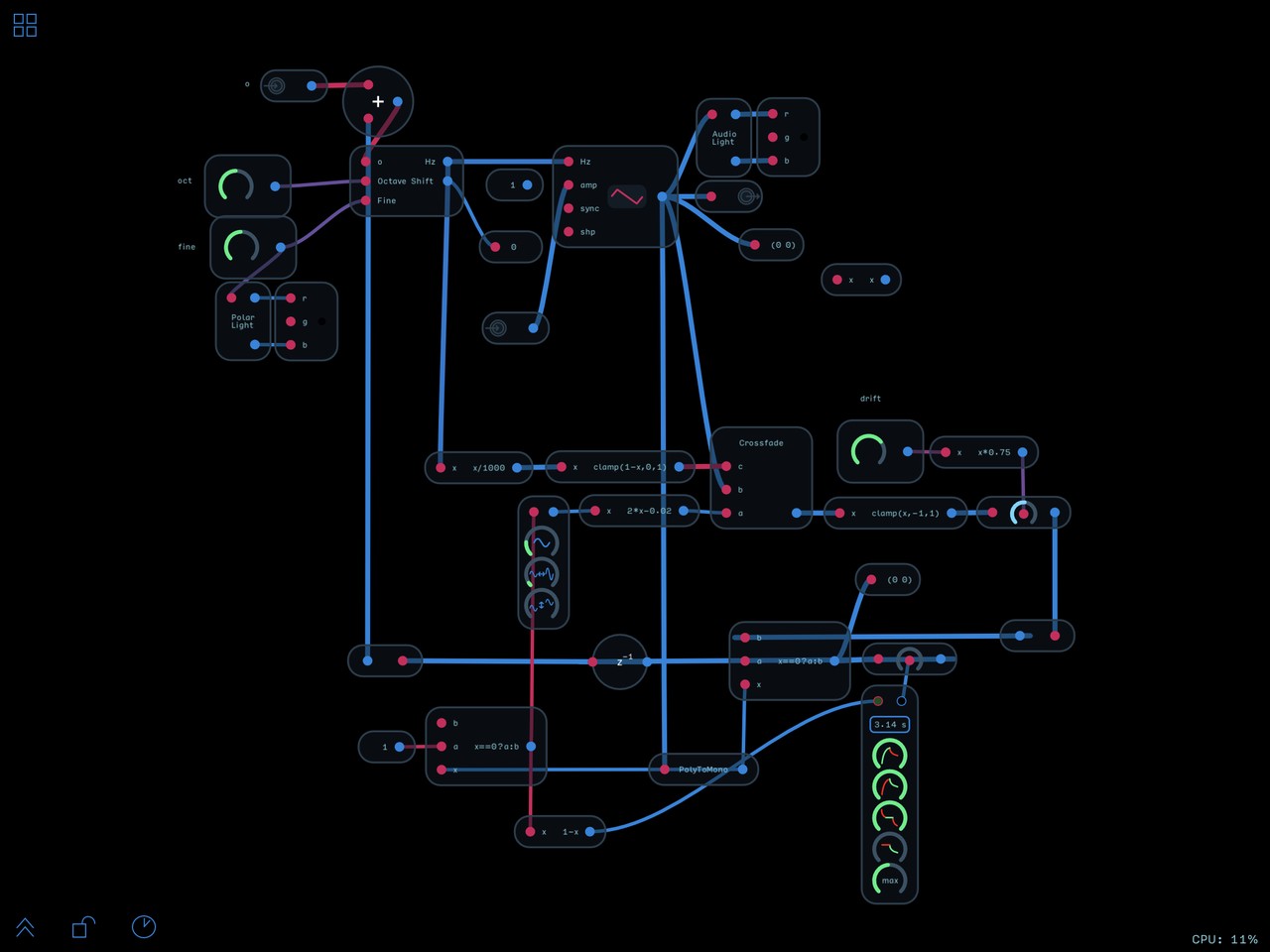
Following on yesterday’s thoughts on which models to use when introducing small pitch fluctuations with digital oscillators, I tried substituting the S&H in Mark Boyd’s Drifting Gateable Quantizer with his 1D Chaos module. I find the pitch fluctuations quite satisfying and more subtle than simply providing a micro-offset with a sample and hold value. Perhaps a little closer to the fluctuations one might find with a wind player than the slow drift of an analogue oscillator.

I’ve also been wondering about the stretching at the high and low extremes that occurs with analogue oscillators or when tuning a piano, for example. In the case of piano tuning that stretching makes sense in relation to equal temperament and the slightly inharmonic overtone structure of piano tones. With the relatively ‘pure’ starting point that is possible with digital oscillators, as well as the myriad of waveshaping and filtering possibilities that may follow, that kind of stretching doesn’t makes sense – unless one is deliberately setting out to imitate that kind of behaviour. There’s also the changing sensitivity of our ears at different parts of the frequency spectrum, but perhaps with digital oscillators a single kind of slightly chaotic fluctuation across the entire spectrum is the way to go.

Modular Diary – 095

Mark Boyd (biminiroad) recently teased a little strange attractor on Twitter – and presented it in full detail as part of the Audulus Tutorial Livestream on Chaos & 3D Modules. “A chaotic signal is not a random signal” as Rob Hordijk pointed out in his Leeds Rungler Demo. The tutorial goes on to explain how those chaotic signals can be used to trace paths through a 3D cube that can be applied to mixing, sequencing, and modulation.

It’s a wonderful tutorial covering a lot of material. For now I’m content to let some of the strange attractor chaos sink in – wondering how it might be applied as a modern approach to introducing slight fluctuations with digital oscillators, rather than simply modelling analogue drift.

Modular Diary – 094

Jerobeam Fenderson’s oscilloscope music, or the works described in the article on the Digital Harmony of Sound and Light that I looked at yesterday, aim at building an art form based on direct correspondences between sound and vision. I got to thinking Strange Continuity: Why our brains don’t explode at film cuts, an Aeon video that takes a look at why out brains process film cuts so easily, despite their recent appearance on the timescale of human evolutionary history. The argument is that film cuts work because they exploit the ways our visual systems have evolved to work – the filtering already in place to deal with the constant blinking and saccades that apparently render us functionally blind for a third of our waking lives without disturbing our sense of a continuous visual experience.

I was thinking of how the continuity of sound provides a complementary sense to help glue all those visual cuts together – and indeed that is often how film soundtracks work, the Aeon video included. Conversely film cuts opened up our acceptance for abrupt musical juxtapositions – Stravinsky for example. The similarity of film and tape and their modern digital (DAW) counterparts in contrast to modular patches that don’t typically include abrupt transitions. In his talk at Basic Electricity in Berlin Rob Hordijk contrasts the tradition of Musique Concrete with the large electronic studios of the 50s – the studios that can be seen as the starting point of modular synthesis.

Modular Diary – 093

The @reaktorplayer twitter account provides a seemingly endless stream of fascinating links on music theory and technology. There’s also a reaktorplayer website covering “thoughts, research and experimentation with electronic music, art and photography.” A recent tweet linked to a PDF on the Digital Harmony of Sound and Light that covers, from a slightly different angle, some of the theory that also underlies the oscilloscope music of Jereobeam Fenderson, for example.

The ‘differential dynamics’ illustrated in the article reminded me of Jerobeam’s DC-offset examples and the rose curve patterns – of which there are some nice animations in the Wikipedia article – have some similarities with the figures I was recently playing around with (again following Jerobeam’s example) using the modified STS Harmonium. For interest’s sake, the difference between the harmonium shapes and Lissajous figures is that both signals (should one restrict the number to two) have a sine and a cosine output, whereas with the Lissajous patterns one signal has a sine and the other a cosine phase.

Modular Diary – 092

I made some adjustments to Biminiroad’s Drift VCO with a reset as described in the Richard D. James interview: the oscillator is set back to its starting point when tones are no longer being generated. For frequencies above 1000Hz the LFO is reset, and for frequencies below that point the feedback loop is interrupted and fades back in when tones are generated again.

The drift cycle is around 50 seconds and it’s fun to hold a perfect fifth (e.g with middle C as the upper note) and listen to the beating increase and eventually reach a perfectly tuned interval before slowly starting to beat again. Due to the feedback loop the drift amount is slightly different for frequencies below 1000 Hz (see the explanation in a previous post) whereas the LFO rate is constant for the frequencies above that point. That means that at least for frequencies below the switching point one has the possibility of a slightly different drift for each note, without running into the complexities of post-quantizer bending.

Modular Diary – 091

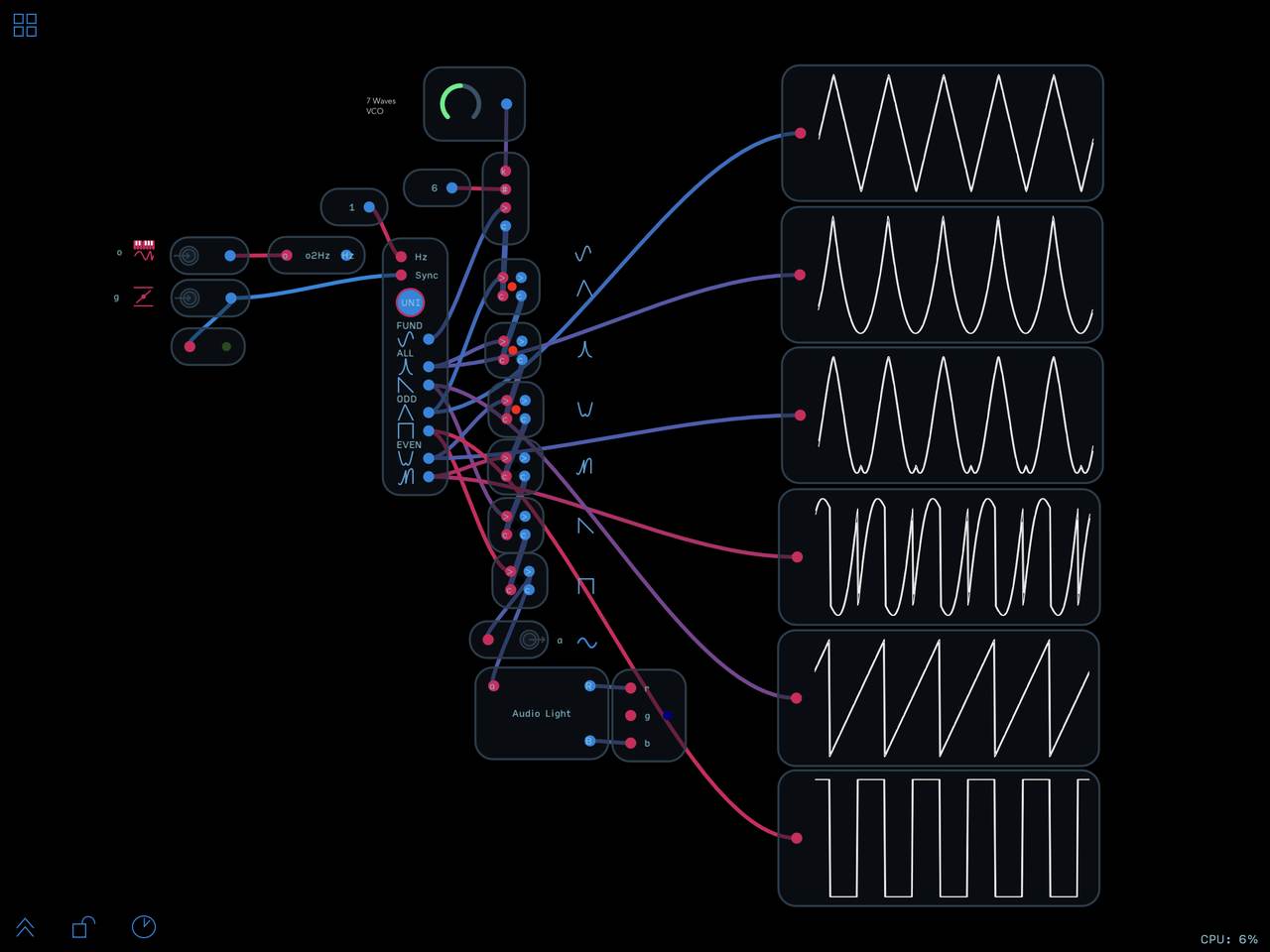
A little further down the waveform rabbit hole: I revisited Biminiroad’s morphing version of Robert Syrett’s 7 Waves VCO, and experimented a little with the order in which the waveforms are placed. Robert’s original setup had them organized in terms of all, odd, and even harmonics – with the inclusion of some new neighbouring waveforms invented by Don Tillman. I’ve rearranged them so as to provide the smoothest transitions – at least to my ears – when morphing between the waveforms. I‘ve placed the square wave last, not only because it provides better transitions for the sawtooth, but also because it does indeed (subjectively) seem to be louder, even though the sawtooth has greater overtone content. It seems that Jerobeam Fenderson was right in his explanation that it is the amount of (abrupt) change that catches our attention – the square has two vertical edges while the sawtooth only has one.

Modular Diary – 090

As I mentioned yesterday I was intrigued by the placement of the sawtooth between the triangle and square waves in the new Ableton Wavetable synth, and I spent a little time today exploring the results of changing the order of the oscillator shapes in one of the Audulus µVCOs. In the case of crossfading between oscillators, that placement, along with shifting the phase of the sawtooth to match the edge of the square, results in the octave harmonic of the sawtooth appearing before the fundamental when shifting between the sawtooth and the square. With the Wavetable synth the interpolations don’t appear to be the same as would occur when fading between set waveforms and I guess this is what opened up the possibility of arranging them in that order. When simply crossfading between waveforms a (co)sine–triangle–square–sawtooth ordering with all the waves sharing the same phase provides the smoothest transitions.

While a change from sine to triangle is fairly subtle, the square and sawtooth waves are more tricky when attempting to morph smoothly between waveforms. It’s an issue that Jerobeam Fenderson touches on in the third of his Oscilloscope Music tutorials. He explains the discrepancy between perceived loudness and the actual amplitude of the waveform in terms of our not hearing positions, but rather changes in positions – referring to the explanation of DC-offset in his second tutorial. The discrepancy might also be explained in terms of the higher overtone content of the sawtooth and square waves and the increased sensitivity of our hearing in the ranges in which the overtones of mid to lower tones appear.

Modular Diary – 089

In its current state there’s no easy way to implement wavetables in Audulus, but taking a look at Brian Funk’s tutorial/walkthrough/exploration of the Wavetable synth that will be included in Ableton Live 10, I was struck by how much has been achieved in Audulus recently on the waveshaping front – a lot of it thanks to the interest and efforts of Robert Syrett. Making wavetable waveforms without using wavetables, as he puts it.

A detail that intrigued me with the Ableton Wavetable setup was the order of the basic oscillator waves as sine–triangle–sawtooth–square, with the phase of the sawtooth shifted 90 degrees to match the edge of the square instead of the peak of the triangle, as one might expect. In the Audulus morphing oscillator included in the µCollection the sawtooth comes last and shares the same phase as the other waves.1

Something to take a closer look at and experiment with.


  1. In the Curvature micro the square is placed last. ↩

Modular Diary – 088

Robert Syrett has posted an updated version of the O-Toast, his Audulus clone of the Make Noise O-Coast. An attempt to make a version both more CPU efficient and closer in sound to O-Coast, as well as reflect his growth in understanding how to design things like looping function generators.

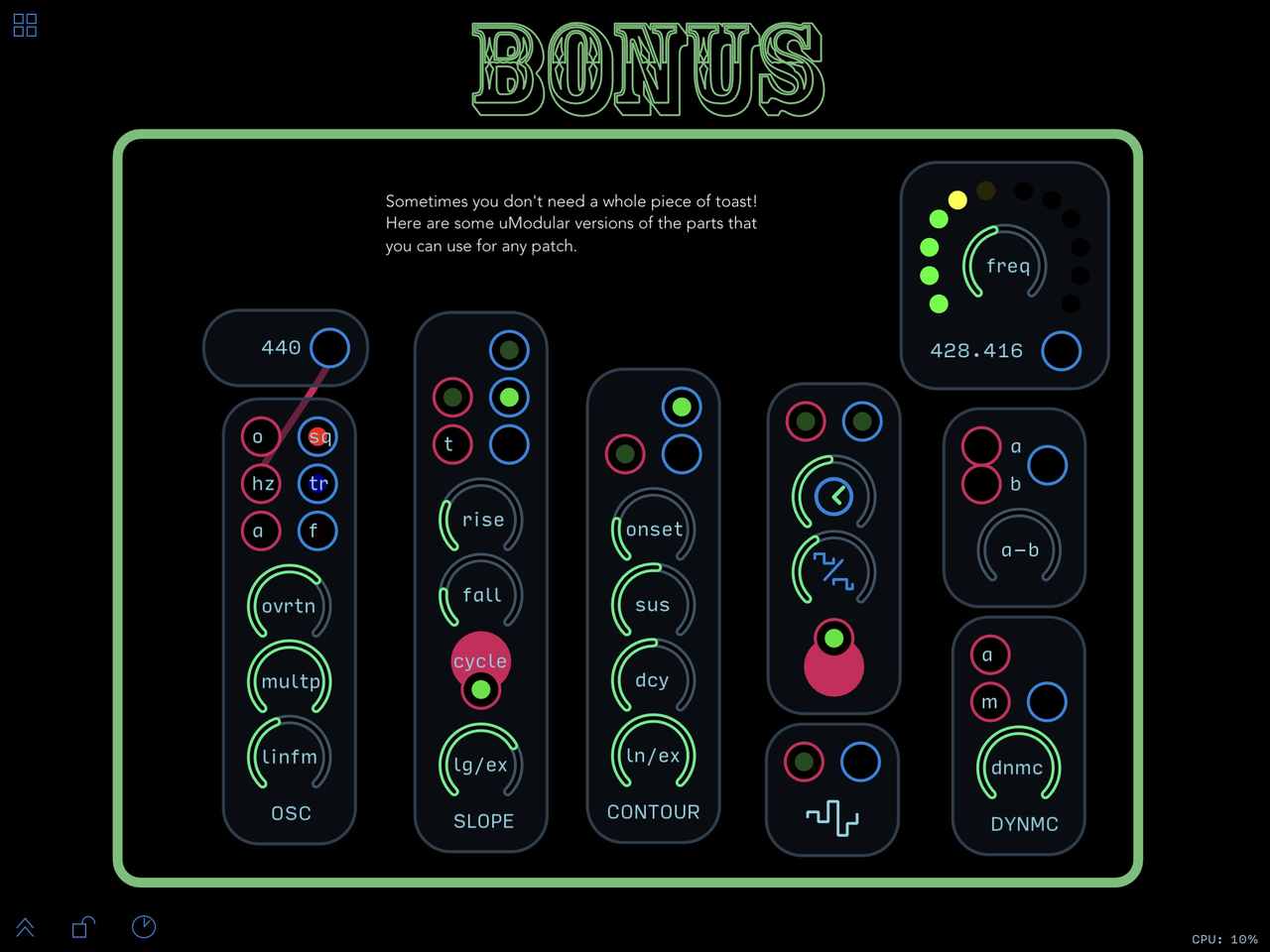
Along with the new 1-Toast, he’s also included µModular versions of the basic O-Coast building blocks, something that I think makes a lot of sense in the Audulus context. As he points out, there are also certain bits (such as the attenuverter) that are better out of the box – elements that benefit from being copied and used in multiple places.

Treating the component parts as separate modules is also a direction that Make Noise have taken with expansions on O-Coast core elements in their Contour and Dynamix modules.