rss

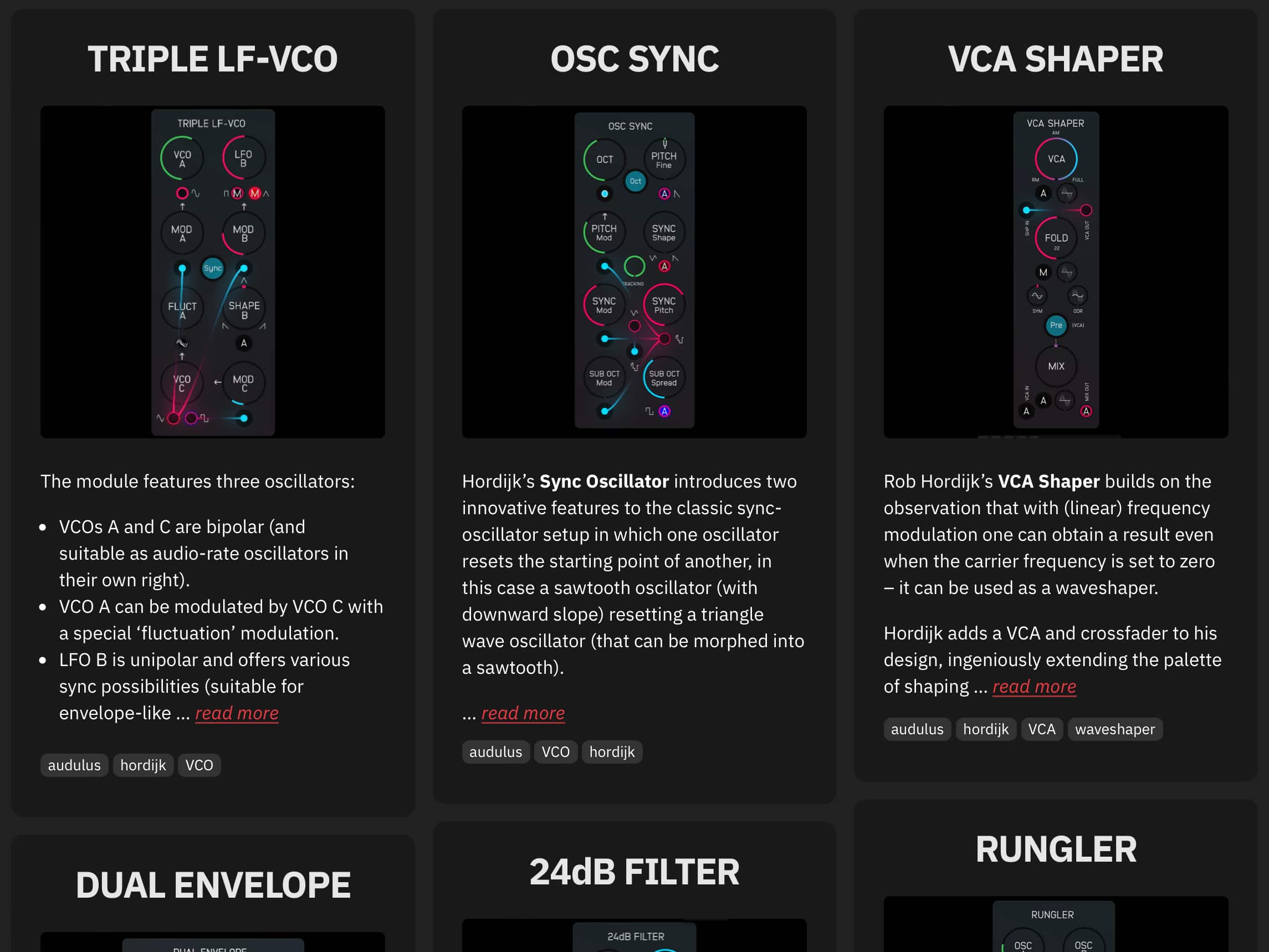
Over the course of the last decade, I’ve spent many hours piecing together modules in Audulus, a (free) modular audio environment for Mac and iOS. Those patches have been strewn across many threads on the Audulus Forum and Discord and I recently had the impulse to collect them all on my own website. In the process I’ve done some internal and external cleaning up of the modules and their documentation, and in some cases, created new versions. While only around halfway through, I thought I’d share what I’ve reached thus far: rudigermeyer.com/audulus

View/Reply on Mastodon · 3

Over the course of the past few months I’ve been passing Audulus files back and forth with a certain Future Aztec Man, working on a single basic patch, expanding it and taking it in different directions. (Audulus is a music app, an environment in which one can create digital modules and ‘patches’.)

The first results of our efforts are now available as two tracks, two interpretations of that patch, on Bandcamp.

A shoutout to Jerry Smith, whose modules have played a large role in being able to structure the tracks and at the same time embrace random procedures that bring up different results each time they are run. Given the generative aspect, the recordings released here might be viewed as snapshots of milestones along way.

FAM has also written an academic paper on the nature of an Audulus patch in relation to “the work of art in the age of mechanical reproduction”, arguing that the ubiquity of digital devices and easy availability of the software places access to the ‘originals’ of these tracks within the reach of many. Following this line of thinking the first five purchases on Bandcamp will include the Audulus patch files. He’s also written a short essay on the artwork.

Check out the Audulus Discord for further discussions.

1

One thing is having all the ratios of the Partch 43-tone scale nicely presented with this keyboard layout but how does one get a handle on the ratios between the ratios?

In his book Genesis of a Music Partch himself points out that it’s easy to calculate the ratio between two ratios by simply inverting the smaller of the two and using that to multiply the other. So in the case of 4/3 and 3/2 we would have 3×3=9 and 4×2=8, which gives us the ratio of 9/8, which we know is the major whole tone that we have between a perfectly tuned fourth and fifth.

With some of the more complex ratios, e.g. 81/80:32/31, things can get a little more complicated and so I’ve set up a spreadsheet to do the work for me, also including a representation of the interval in terms of cents using the following formula: 1200*log(n/d)/log(2) where n/d is your ratio.

And to make things a little more fun I’ve set up a small device using the Audulus 4 beta that uses the same principles to display both the ratio and the cents of any two notes played on the keyboard in real time.

Modular Diary

A little over a year ago I set about recreating Rob Hordijk’s modular system in @Audulus. You can follow that journey in podcast form here: huffduffer.com/rudigermeyer/tags/modular-diary, or here: rudigermeyer.com/notes/2019-03-01-12-00-49