rss

Modular Diary – 040

Two little diversions that sprang out of playing around with my Audulus Scale Bender:

The first patch uses the bender without a quantizer in front of it, with an LFO sweeping across the range of an octave. (There’s also a range control that can be used to centre in around a particular section of the octave, should one wish.) The bender glides up and down following the LFO, but on approaching the next tone falls back and retriggers from the previous semitone. There’s a quantizer placed after the scale bender to help visualise what’s going on.

I also discovered something I hadn’t thought of. Sweeping through a pitch range without all the steps of the quantizer activated creates a rhythmic pattern – and if the pitch range doesn’t match the number of notes exactly that can lead to interesting rhythmical unevenness. Different waveforms can also be fun as a rhythmic/melodic source. The patch includes the phase and frequency modulated waveforms I was experimenting with a week ago, and I can imagine some Rungler chaos being interesting too.
Modular – Diary 039

Looking at new experimental modules it’s amazing how often Don Buchla’s name comes up as the source of inspiration. His Source of Uncertainty as source for the Turing Machine, the Wiard Woggle Bug, the Make Noise Wogglebug, an Audulus Wuzzlebuzz, and the Erica Synths Wogglebug, for example. There’s also his dual oscillator Complex Waveform Generator and outside in approach to interface design that has found resonance in recent years.

This year marks the 50th anniversary of the Morton Subotnick’s seminal Silver Apples of the Moon, a piece which he describes as “a pretty complex piece for my first one and I worked six days a week minimum, 10 to 12 hours a day for 13 months making that.” It was created using the Buchla 100, the instrument Subotnick comissioned Buchla to create for the San Francisco Tape center in 1963.

It’s a year ago and a day, that Don Buchla passed away.

Modular Diary – 038

I managed to complete my adaption of the Audulus scale quantizer into a scale bender. Input values within each equally tempered semitone can be shifted up or down by up to 50 cents. It’s no longer a quantizer so if the cent setting should deviate from equal temperament then it’s necessary to place a quantizer in front of it. Without a quantizer (or equally tempered keyboard) the input values are simply offset by the cents setting – i.e a glide within the range of a particular semitone will also glide. That could perhaps be put to some fun uses.

In the demo patch I’ve uploaded to the Audulus forum one can shift between an automated and a manual quantizer preceding the scale bender.

Modular Diary – 037

I’ve been trying to get my head around the inner workings of the Audulus scale quantizer to see if there’s a way to incorporate a knob for each step so as to enable microtonal deviations, but have been finding it difficult to decipher completely. I’m thinking that it might be best to split the quantizer and microtonal adjustments into separate modules. The quantizer can stand as it is1 and feed the quantized values of the chosen steps on to the next module to be bent one way or the other.

In the mean-time I’ve put yesterday’s patch up on the forum.


  1. That also makes it possibile to choose between the quantizer with buttons or the version with knobs (which can in turn be automated by external sources). ↩

Modular Diary – 036

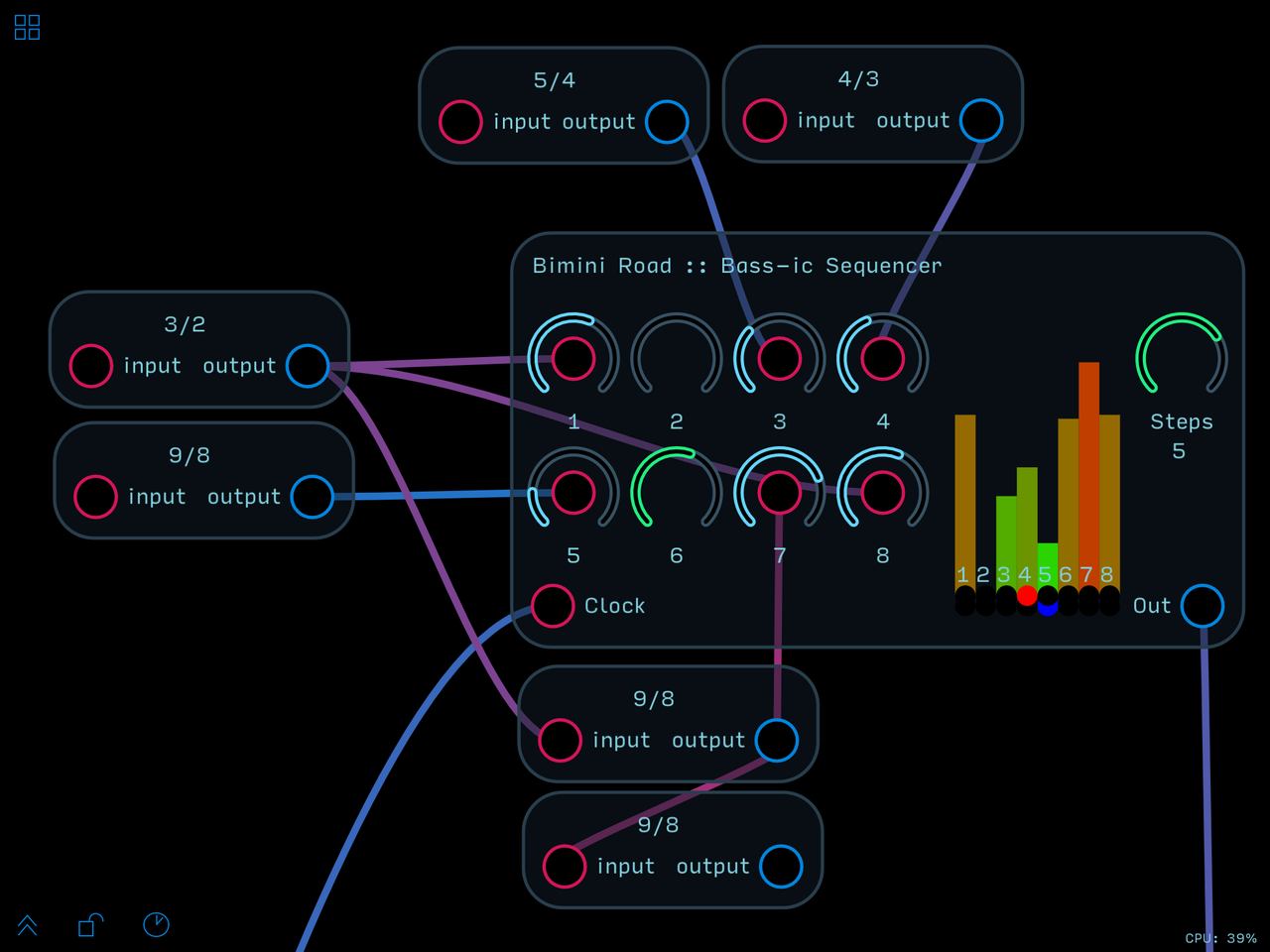
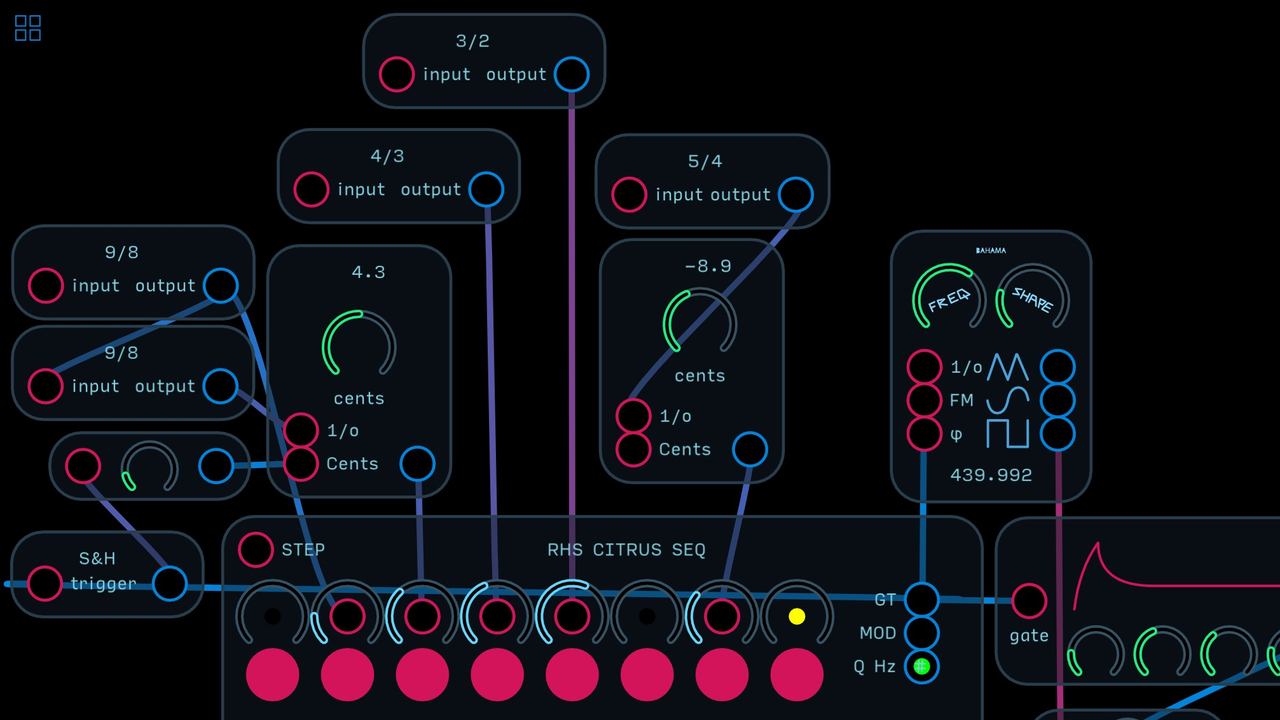
I managed to get started on adapting the Audulus scale quantizer so that each step can be individually adjusted. The first step was to build a little module to enable pitch adjustments within a range of 50 cents up or down. With that in place alongside the little ratio modules that I mentioned in a previous post, it’s already possible to easily set up non-tempered (partially structured) pitch sequences on the fly by attaching them directly to the sequencer pitch knobs. I like to think of it as a set of resistors that can be plugged in as a form of micro-preset, a little like on the old Buchla Music Easels.

Building the ratios and cent adjustments into the scale quantizer means that the alternative scales could also be used in contexts without a sequencer – when using a keyboard for example – and would also collect all the bits instead of having them loosely flying around. That said, there’s something that appeals to me in the clarity and flexiblity of having the ratios and adjustments clearly displayed and easily reconfigurable.

From another angle there were two interesting posts in the Audulus forum this morning covering similar ground: Jimbo’s Microtonal scale modulater and STSchoen’s impressive Audulus recreation of the note quantizer from the very interesting collaborative open source ornament & crime module. Here’s Todd Barton’s introduction to it.

Modular Diary – 021

I‘ve been taking a look at putting together a quantizer for custom tunings in Audulus – there’s been a little activity on that front in the forum. I have in mind something that builds on the small ratio modules that I was using to tune a sequencer in a previous post. Something very flexible that can be changed on the fly with the possibility of additional ‘hand-tuned’ deviations from the basic ratios. A kind of hybrid between systematic and empirical tuning.

Since it’s taking me a little time to figure it all out here’s a little experiment with changing the tuning on the ARP ODYSSEi from Equal to Analog while running a simple sequence. The deviations are subtle but nevertheless quite noticeable (often a little flat in relation to equal temperament) – at some point it could be interesting to measure them precisely and put together a little list that could be used in other contexts.1

Here’s the unadorned sequence – two cycles in equal temperament followed by two with the analogue tuning:

ARP Equal Analogue

And a longer jam trying out the analogue tuning at different transpositions as well as playing with the length of the sequence.

ARP ODYSSEi Analogue Sequence

  1. See, again the Richard D. James interview with Tatsuja Takahashi. ↩

Modular Diary – 015

It seems to me that a large part of the increase in activity on the Audulus forum during the last half year has been due to recreations of hardware modules/instruments. The hardware models seem to provide a useful grounding – something to kick against in the open space of the software platform. In the absence of owning any hardware syths at the moment I’ve also found the fixity of app recreations – the Moog, Ripplemaker and VCS3 apps that I’ve looked at, a useful counterpart to the openess of instruments/devices created in Audulus. I do keep coming back to Audulus though – it still ends up being the place to get on with some real building after diving into the behaviour of the other apps.

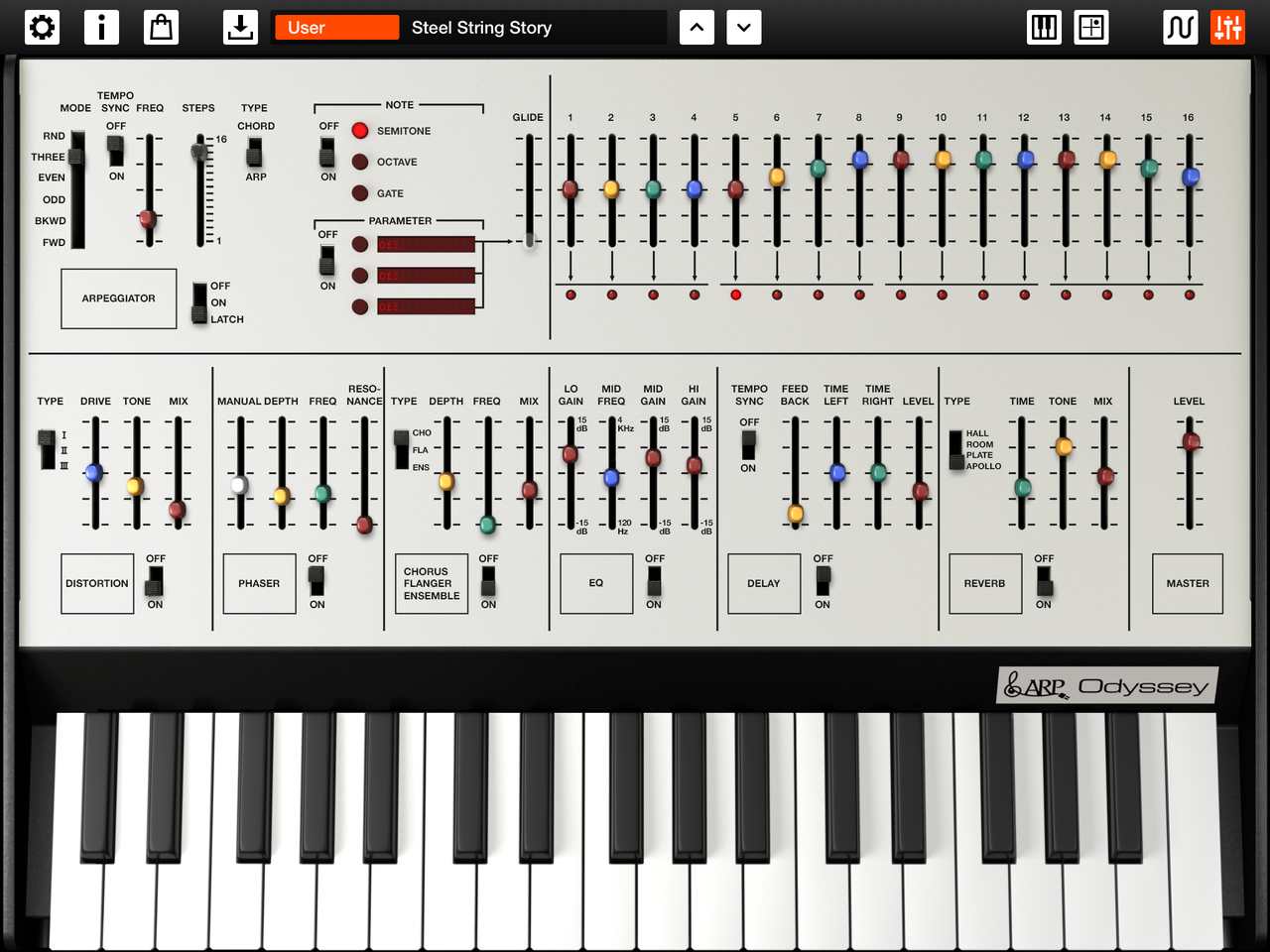
A few weeks ago I had the Korg 2015 version of the ARP Odyssey under my fingers on a visit to a music shop, and now the Korg ODYSSEi also has it’s place on my iPad. While not exactly a modular synthesizer it has a wealth of routing options that make it extremely flexible, while at the same time practical to use as an instrument. GForce have created their own software version of it – the Oddity – and also provide a wonderful introduction to the original as part of their synth archive. As they mention in the video this can be a bit of an in-your-face punk instrument. The opposite of the distant spaciness of the (i)VCS3.

The iPad ODDYSEi sounds great, and especially with the white Rev. 1 face is a visual pleasure as well. The fader interface design1 (there are no knobs on this synth) seems well suited to an iPad touch-screen. I was delighted to find that the analogue tuning has been modelled as well. One can shift between pure equal temperament and the analogue version if it and clearly hear the differences. Richard D. James talks about layering similar differences between equal temperament and the analogue tuning of the Roland SH101 in his interview with Tatsuya Takahashi.


  1. With handy tooltips too. ↩

Modular Diary – 013

A quick look at a few hardware sequencers that I’ve come across during the last few months:

Starting off with Mylar Melodies’ wonderful tour of the Intellijel Metropolis. (And Robert Syrett’s Audulus recreation of it.)

A step back to classic analogue sequencing (in a modern form) with the Doepfer MAQ16/3.

The Korg SQ-10, another classic given modern form as the Korg SQ-1 (here coupled with the Make Noise O-Coast).

Aphex Twin’s Cirklon.

And a step out of linear time with the Make Noise René.

Modular Diary – 012

With Audulus, as with most modular systems, the sequencer ‘control voltages’ are typically quantized before being passed on to an oscillator. I was keen to try out tunings with pure ratios and at first thought of piecing together a just intonation quantizer. However, since the sequencer knobs are fluid, it occurred to me that I could simply put together a small collection of ratio modules and connect them freely to the knobs. In this way some steps might be purely tuned while others could be set empirically.

The modules have an inbuilt reference pitch of 440Hz – that means that the 3:2 ratio will produce a pitch a perfect fifth above 440Hz. If the input is connected to a keyboard (or other) source the ratio will take that input as it’s starting point. The modules can be strung together so that the output of the 3:2 module can be connected to the input of a 9:8 module for example – producing a just second above the pure fifth.

Here’s an Audulus patch (very much a tryout, with the inclusion of all kinds of other bits and pieces I was experimenting with) demonstrating the approach.

Audulus Basic Sequencer Tryout

Modular Diary – 011

The arpeggiator of the Model 15 App is a step into getting an idea of how early analogue sequencers were set up: A voltage control knob for each step of the pattern. For pitch those voltages would typically be passed through a quantizer before being routed to an oscillator, but they might just as well be used to control velocity or filter cutoff, for example, perhaps with a parallel row for controlling gate times.1 It’s quite a different world from the piano roll visualizations one is accustomed to with DAWs, and encourages a different way of thinking – a different approach to creating and using sequences.

When I first started using Audulus I was somewhat puzzled by some of the sequencer modules included with it. I’ve since come to better understand (and appreciate) the old analogue models on which they are based. The great thing with Audulus is that all knobs can be linked to any other form of control – that means that the knob for each sequence step can potentially be controlled by an LFO or Random generator, to pick two examples. The sequencer can not only send out a set of control signals, but also be modulated itself.


  1. The Korg SQ-10 is a good example. Here’s a video with the SQ-10 controlling the MS-20 filters. ↩