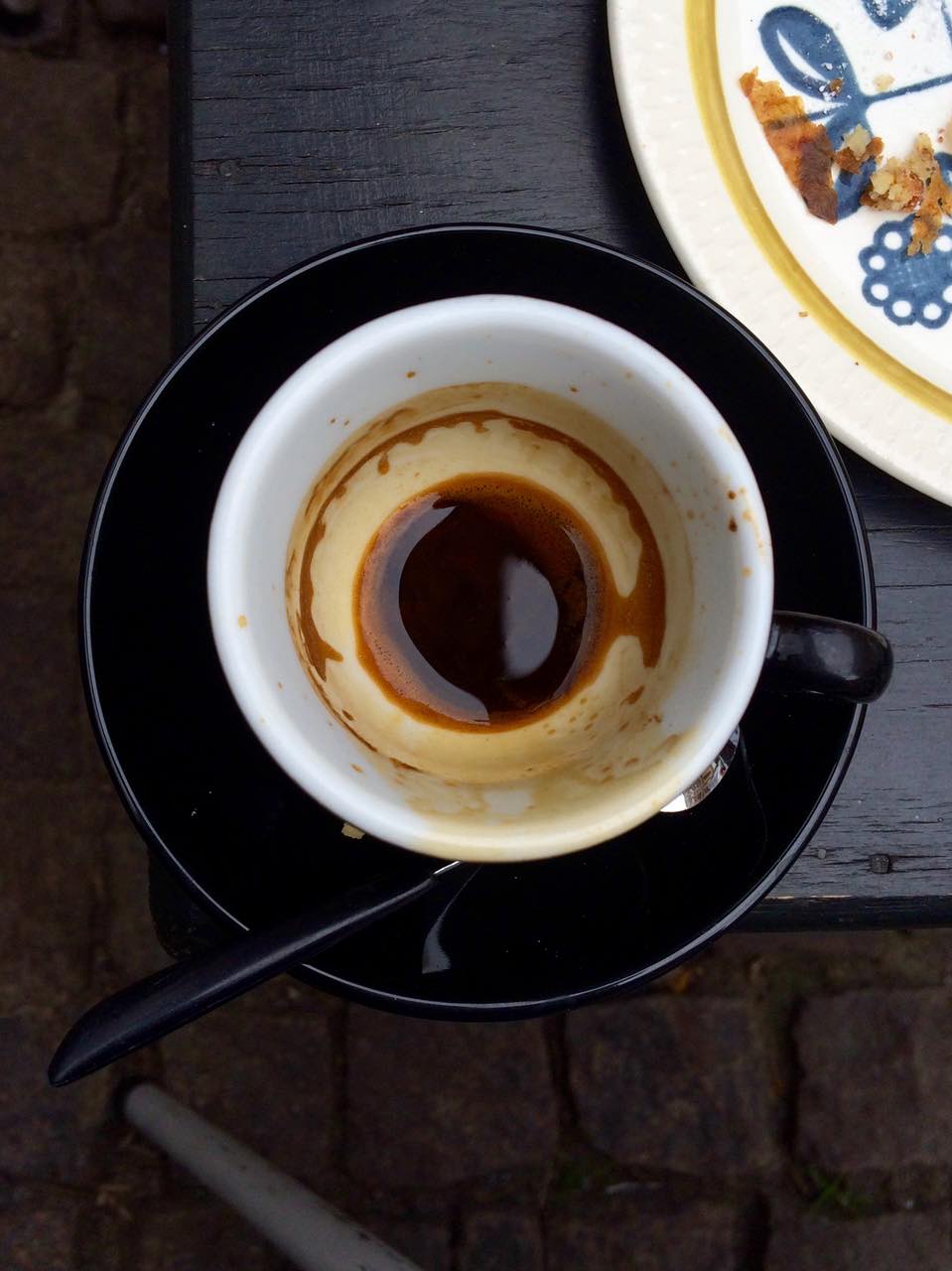
Ristretto at Sort Kaffe & Vinyl, along with a really good almond croissant.
Meyers is still my favourite though.

Ristretto at Sort Kaffe & Vinyl, along with a really good almond croissant.
Meyers is still my favourite though.
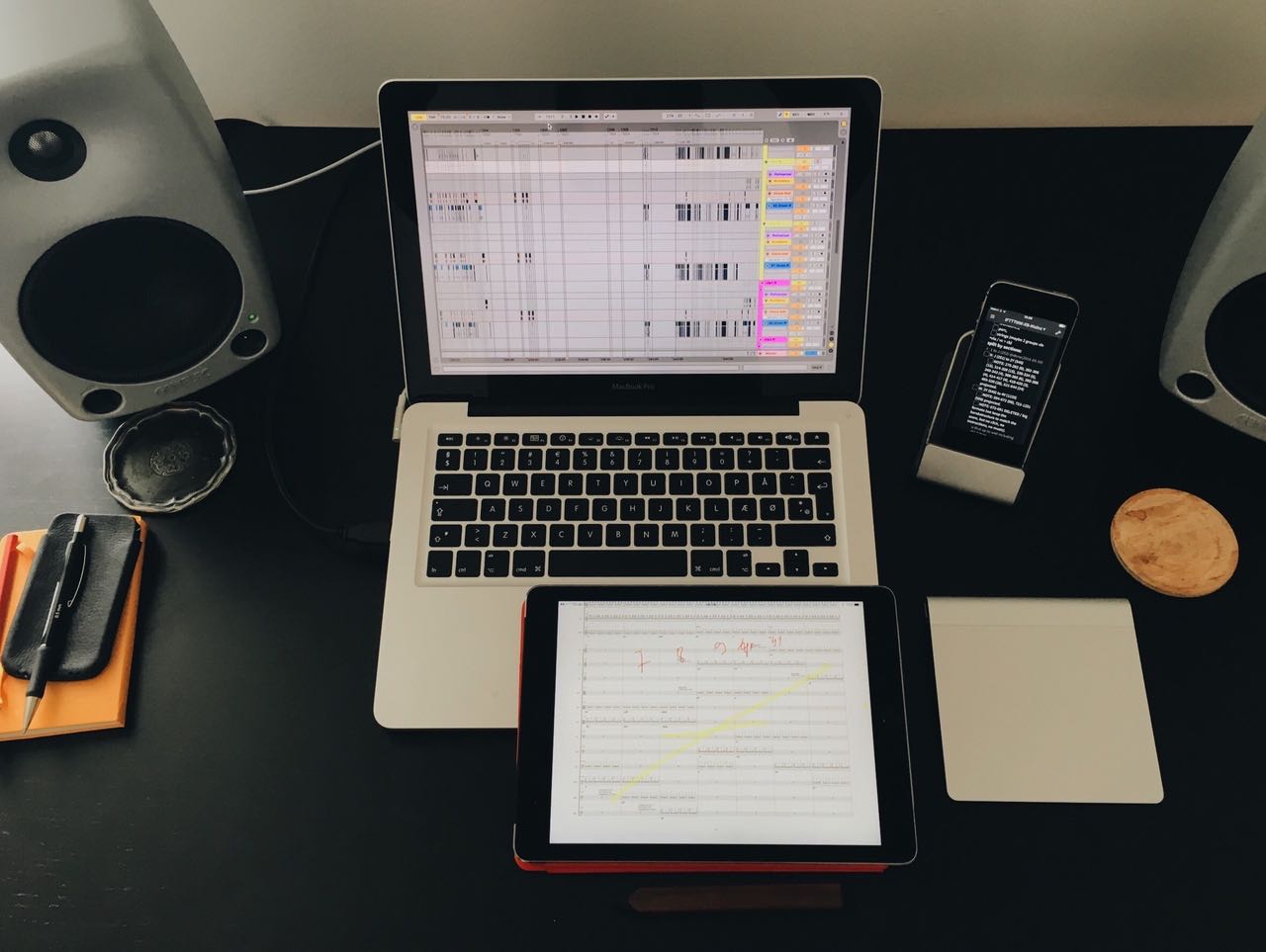
A snapshot of my desk as I’ve had it set-up during the last two months. Ableton Live on my old MacBook Pro, forScore and Slack on my iPad and a Taskpaper in Editorial on my iPhone. I’d sold my 27” iMac just before commencing this project and having that large screen would have come in handy. On the other hand I’ve been enjoying this multiple screen/device set-up: A specific function for each.
The huge screen of the iMac had once been a dream, but in recent years I’ve come to feel that it’s too much. Even when using Launchbar for a lot of navigation, the app menus somehow always seemed a long way off. Great at the office, but I often prefer the manageable size of my iPad to having all that light coming at me – especially late at night when writing texts such as these.
Erik Spiekermann once made a connection between the size of books, screens, and our hands. The iMac is a pretty large canvas but it’s not always that one wants to be standing in front of one. The multiple device route helps cover all bases, as well break down to smaller modules when you need to.
Podcaster Myke Hurley recently shocked the world by mentioning how he preferred using his iPad Pro for many tasks – even using it while sitting in front of the glorious 5K screen of his Retina iMac. Inspired by his discussions with CGP Grey, he now has a dual iPad set-up – Pro and ‘Baby Pro’, though perhaps not as rigorously divided according to function as CGP. They’ve discussed it all on Cortex and Connected.
@CONSTELLATIONS
⠀
⠀⠀⠀⠀⠀⠀⠀⠀⠀⠀•
⠀⠀⠀⠀⠀⠀⠀⠀⠀⠀⠀╲
⠀⠀⠀⠀⠀⠀⠀⠀⠀⠀⠀⠀⠀•
⠀⠀⠀⠀⠀⠀⠀⠀⠀⠀⠀╱⠀\
⠀⠀⠀⠀⠀⠀⠀⠀⠀╱⠀⠀⠀⠀\
⠀⠀⠀⠀⠀⠀⠀╱⠀⠀⠀⠀⠀⠀⠀\
⠀⠀⠀⠀⠀╱⠀⠀⠀⠀⠀⠀⠀⠀⠀⠀•
⠀⠀⠀╱
⠀⠀•
⠀/
•
⠀╲
⠀⠀⠀•
⠀
and @artonaline
⠀
⠀
⠀
⠀
⠀
⠀
⠀
⠀
⠀
⠀
⠀
⠀
⠀
⠀
⠀
⠀
⠀
⠀
⠀
⠀
⠀
⠀⠀⠀⠀⠀⠀⠀⠀⠀⠀⠀⠀⠀🚶🏻
⠀⠀⠀⠀⠀⠀⠀⠀⠀⠀⠀⠀🕳
⠀⠀
pop up in my Twitter feed every once in a while. Refreshing to come across all that space again after a long period of silence from whoever it is that creates them.
Perhaps even more welcome since they’ve arrived during an extended work period in which I’ve longed for a little whitespace in my life.
Why Do We Work So Hard? That’s the title of an article in The Economist’s 1843 magazine from a few weeks back.
A look at identity, community, purpose, and not least the role of technology in today’s work landscape – one in which top professionals earn the most, but also work the longest hours. Pay is tied to commitment and responsibility – aspects we sometimes imagine we’d like to be free of, but which are also closely connected with work satisfaction.
At the end of the day we can sit back and admire our work – the completed article, the sealed deal, the functioning app – in the way that artisans once did, and those earning a middling wage in the sprawling service-sector no longer do.
A revealing look at the “sharing-economy” of that sprawling service-sector is offered in the Instaserfs series on Benjamen Walker’s Theory of Everything podcast. The lower number of hours that lower paid jobs bring with them probably means that a number of those jobs have to be patch-worked together.
When it comes to the downsides of such a life, both at the top and bottom – less time for family, social or leisure activities – the professionals at least have the possibility of losing themselves in solving the “puzzles on which other people depend”.
It is a cognitive and emotional relief to immerse oneself in something all-consuming while other difficulties float by. The complexities of intellectual puzzles are nothing to those of emotional ones. Work is a wonderful refuge.
Last week I missed out on IndieWebCamp, this week it’s SPOR Festival I won’t be attending.
I can however follow the Misheardpedia live stream: a work created for the festival in which Wikipedia articles are (machine) translated from text to speech and then back again, gradually building up a new archive of (misheard) knowledge with all the artefacts the process entails. Sound-art, net-art, and hacktivism is how it’s creators describe it.
Mandy Brown recently published an article on our age of bots interpreting speech and text – one way or the other. She considers current trends in replacing graphical interfaces with language-based ones as a kind of manifestation of Walter Ong’s secondary orality:
…text that works like spoken language, even though it’s written, made ever more strange by being filtered through the uncanny valley of a bot’s impression of that language. Maybe this is a tertiary orality, even—an orality removed first by text, then by bots.
Yesterday I mentioned Cory Doctorow getting freaked out by the W3C’s moves to include DRM as an open standard. He’s now taken action, and suggested a smart compromise. In an open letter to the W3C (as a representative for the EFF) he clearly lays out the concerns touched on in the O’Reilly podcast and, based on a precedent concerning patents, suggests a way forward.
After yesterday’s look at the issues surrounding podcasts and proprietary formats, today a listen to Cory Doctorow’s concerns regarding the future of the open web. While one can choose which (indie) software to use when subscribing to RSS feeds (be they of web pages or podcasts) Cory is concerned that when it comes to web browsers the options are shrinking. He’s concerned that with the new W3C proposal to add DRM as a web standard only the handful of big browser players have a future, not to mention the bunch of security vulnerabilities that come with the DRM can of worms. He spells it all out on the O’Reilly Hardware Podcast.
Alongside the daily festival of articles that flow in on my RSS readers (Unread on my iPhone and iPad, Reeder on my Mac) I’ve gotten heavily into listening to podcasts during the last few years. RSS is the technology that makes it all possible, and the great thing about it is that it’s an open format. I can choose exactly which feeds to subscribe to and easily change to another set of apps should I wish.
Overcast is the app I use for listening to podcasts. Marco Arment, it’s creator, recently published a response to an article on the New York Times in which he takes a strong stance against wishes in certain circles to turn podcasts into something more proprietary – read: data, tracking, monetization. Frederico Viticci sums up some of what’s at stake in his follow-up on MacStories:
I want podcasting to be a spoken extension of the written web – available to everyone, indexed with an open format, unbound by agreement terms and proprietary file formats. I want to know that, 30 years from now, I’ll be able to look up one of my podcast episodes from 2016 like I can look up a 2009 blog post on my server today.
And Jason Snell and Myke Hurley, holding similar views, discuss the whole kerfuffle in the podcast medium itself.
Wrapping up the thread on mindfulness.
Normally I think of mindfulness in terms of attention and presence, but on a podcast I was listening to last week it was framed as “knowing what’s going on in one’s mind without being carried away by it”.
That could also be put as “being able to hold out on discomfort in order to see what’s going on”. Eric Meyer’s lesson in The Manual touched on something similar – putting aside temporary discomfort in order to do something remarkable. I was wondering about what happens when that temporary discomfort slides into becoming a somewhat permanent state.1
I guess the thing is to make sure to reach the point of insight before being numbed by the discomfort.
Joni Mitchell once compared her use of unresolved chords to unresolved emotional states that might last for several days. ↩
SoundCloud – Part Three: Exit Strategies
I recently wrote about (slowly) making the transition to hosting all my audio on my own site. That’s in principle simple enough – there aren’t any great technical hurdles. It’s more a question of getting round to doing it.
One thing I will miss though, is the social aspect. SoundCloud remains a good way of keeping track of some of the people creating the far-from-mainstream music that I’m interested in. I’m not so much looking for an alternative SoundCloud as a way of keeping those contacts alive.