rss

Modular Diary – 050

A few weeks ago I tried measuring the pitch deviations of the Analog tuning in the Korg ODYSSEi app using a little patch built in Audulus using the ZeroCross node. It turned out that those measurements were increasingly inaccurate as I progressed up the frequency range, and in the end I turned to another app to map the deviations. Puzzled at the time, I should have taken a closer look at the Audulus docs first, since they provide a thorough explanation of why accuracy decreases as the frequency increases.

The reason for this margin of error has to do with sample rate. At a sample rate of 44.1kHz (the default for Audulus in standalone mode), the ZeroCross node has 44,100 samples per second to evaluate the zero-crossings of a 1Hz wave, whereas it only has 4.41 samples per second to evalute the zero-crossings of a 10,000Hz wave.

Those sample rate considerations also have important implications when creating waveforms digitally. The docs provide, with copious examples, a thorough explanation of what is going on with the Osc and Phasor nodes. A fine, and it seems ever-evolving, resource.
Modular Diary – 045

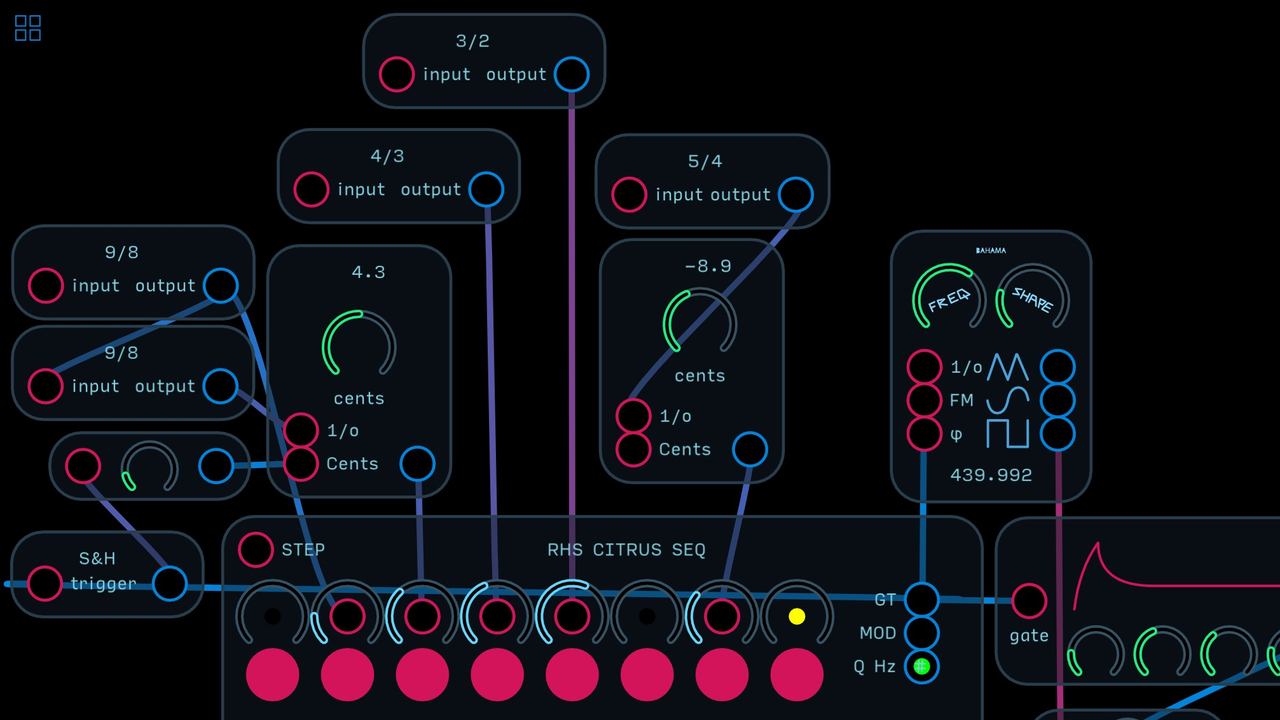
I’ve now added an extra set of external inputs to my Audulus Scale Bender so that scales can easily be constructed using a few additional micro-modules. With three or four of the ratio micro-modules, for example, one already has a number of possibilities at hand, and they can also be stacked on top of each other – i.e. the result of one ratio can provide the base for the next. One can also provide a specific (c.v.) base value for a scale (or ratio) – if none is provided the micro-modules default to A = 440 Hz.

Looking at the video for the latest C.V. Toolkit update I was inspired to also include a micro-module for fraction based intervals. As a start I’ve only included one for the octave divided into seven equal parts, but that could easily be adapted for other fractions.

I’ve also included a quick demo with a Pythagorean scale as an example and, with Mozambican Timbila music in mind, one with the octave divided into seven equal parts.

Modular Diary – 042

A little more on tuning systems: On the Audulus front STS has been doing some fine work on his o_C Scale Quantizer, and Jimbo refining his Microtonal Scale Modulater. I also updated my Detuner with some internal fixes and a reset input that takes all the LFOs back to their starting point.

I don’t have any of the modular gear needed to make use of it, but I found it interesting to see the multitude of ways for editing microtonal scales (cents, ratios, and fractions, as well as Hz values) that Spektro Audio have added to the latest version of their C.V. Toolkit.

Taking a look through my tuning bookmarks I also came across Todd Mudd’s delightful and thorough Just Intonation Toolkit. It’s great to compare how the different tuning systems feel.

And finally, some of the microtonal scales Aphex Twin created for the Korg Monologue.

Modular Diary – 041

I calibrated the knobs of my Audulus Scale Bender to have a range of -50 to +50 so that one can easily type in precise cent values manually. I’ve now added external 1/o inputs so that the bending can be controlled from external sources.

To test that out I put together a quick Detuner with three LFOs running at slightly different speeds and ranges. It still needs some work, but demonstrates the basic idea.

Modular Diary – 040

Two little diversions that sprang out of playing around with my Audulus Scale Bender:

The first patch uses the bender without a quantizer in front of it, with an LFO sweeping across the range of an octave. (There’s also a range control that can be used to centre in around a particular section of the octave, should one wish.) The bender glides up and down following the LFO, but on approaching the next tone falls back and retriggers from the previous semitone. There’s a quantizer placed after the scale bender to help visualise what’s going on.

I also discovered something I hadn’t thought of. Sweeping through a pitch range without all the steps of the quantizer activated creates a rhythmic pattern – and if the pitch range doesn’t match the number of notes exactly that can lead to interesting rhythmical unevenness. Different waveforms can also be fun as a rhythmic/melodic source. The patch includes the phase and frequency modulated waveforms I was experimenting with a week ago, and I can imagine some Rungler chaos being interesting too.

Modular Diary – 038

I managed to complete my adaption of the Audulus scale quantizer into a scale bender. Input values within each equally tempered semitone can be shifted up or down by up to 50 cents. It’s no longer a quantizer so if the cent setting should deviate from equal temperament then it’s necessary to place a quantizer in front of it. Without a quantizer (or equally tempered keyboard) the input values are simply offset by the cents setting – i.e a glide within the range of a particular semitone will also glide. That could perhaps be put to some fun uses.

In the demo patch I’ve uploaded to the Audulus forum one can shift between an automated and a manual quantizer preceding the scale bender.

Modular Diary – 037

I’ve been trying to get my head around the inner workings of the Audulus scale quantizer to see if there’s a way to incorporate a knob for each step so as to enable microtonal deviations, but have been finding it difficult to decipher completely. I’m thinking that it might be best to split the quantizer and microtonal adjustments into separate modules. The quantizer can stand as it is1 and feed the quantized values of the chosen steps on to the next module to be bent one way or the other.

In the mean-time I’ve put yesterday’s patch up on the forum.


  1. That also makes it possibile to choose between the quantizer with buttons or the version with knobs (which can in turn be automated by external sources). ↩

Modular Diary – 036

I managed to get started on adapting the Audulus scale quantizer so that each step can be individually adjusted. The first step was to build a little module to enable pitch adjustments within a range of 50 cents up or down. With that in place alongside the little ratio modules that I mentioned in a previous post, it’s already possible to easily set up non-tempered (partially structured) pitch sequences on the fly by attaching them directly to the sequencer pitch knobs. I like to think of it as a set of resistors that can be plugged in as a form of micro-preset, a little like on the old Buchla Music Easels.

Building the ratios and cent adjustments into the scale quantizer means that the alternative scales could also be used in contexts without a sequencer – when using a keyboard for example – and would also collect all the bits instead of having them loosely flying around. That said, there’s something that appeals to me in the clarity and flexiblity of having the ratios and adjustments clearly displayed and easily reconfigurable.

From another angle there were two interesting posts in the Audulus forum this morning covering similar ground: Jimbo’s Microtonal scale modulater and STSchoen’s impressive Audulus recreation of the note quantizer from the very interesting collaborative open source ornament & crime module. Here’s Todd Barton’s introduction to it.

Modular Diary – 029

I’ve touched on my interest in alternate tunings in some previous posts. While taking a look at Keith Robert Murray’s site after coming across his explanation of linear FM, I discovered that he has a Eurorack arpeggiator module that also enables custom tunings. Equal divisions of the octave from 2–60 can be defined, and it is also possible to specify a custom tuning for each semitone.1 He explains it all in this video as well as demonstrating the fun one can have when combining alternate tunings with an arpeggiator.

Now all that would be missing for my taste would be the ability to define tunings according to ratio, and perhaps being able to combine the custom settings for individual notes with the ratios (or divisions other than EDO-12) as a starting point. Nevertheless some inspiration for creating something along similar lines in Audulus.


  1. Originally intended for making adjustments for non-standard or uncalibrated oscillators. ↩

Modular Diary – 025

I went back and listened to the tryouts of the self-made TTSH that Jesper Pedersen posted on SoundCloud a while ago.1 (The Two Thousand Six Hundred is an unusual DIY clone of the ARP 2600.)

It’s interesting to think that while preceeding it by a year, the modular 2600’s production run is more or less parallel to that of the Oddysey. It’s a very particular sound those ARP instruments have!

In contrast to the punch of the first sequencer tryout that Jesper posted there’s also a warm drone and a more mellow sequence with some nice intonation and modulation details that appear as it progresses.


  1. “I began building hardware to take a little pause from software” he comments in the comments. ↩