rss

Modular Diary – 017

The interesting thing with modular systems is that things can be fed back into themselves. The O-Coast Krell that got me started with all of this is a good example. The generative aspect puts one in a very different position from the prog rock ‘keyboard wizard’ of the 70s. The person ‘playing’ the modular is potentially both listener and performer.1

Oscillators and filters can be feedback loops within themselves – which can then be connected together to form larger systems in which everything feeds back into everything else. Cicuits such as Rob Hordijk’s Rungler, Benjolin and Blippoo Box embrace the chaotic behaviour that can arise, with the player more in the role of steering the direction of the sound than using it as a form of ‘expression’.

Nicky Case recently presented a wonderful talk at The Long Now Foundation: Seeing Whole Systems. He visualises differences between linear cause and effect thinking, and complex systems in which everything influences everything else, covering examples from nature and social constellations to health and economics. He suggests some tools (and has also written games and apps) that might help us learn how to steer and play the chaos.

And that’s exactly what a lot of modular people are doing.


  1. See Walker Farrell’s thoughts on his own back and forth bewteen generative systems and improvisational input in the Cycling 74 interview with Zeos Greene. ↩
Modular Diary – 016

The ARP Odyssey marks is an interesting point in the development of sythesizers with some of the flexibility of the modular systems it grew out of and the fixity of a portable performance instrument that became the norm. I’ve been thinking about the development of synthesizers over the years – the gradual change from modular systems that lent themselves to ever-evolving textures to banks of presets and large libraries of relatively short sounds. The Art + Music + Technology episode with E-Mu’s Dave Rossum provides a good example of this arc – and the spiral back to the beginning that we’ve now reached.

Benge’s 20 Systems presents 20 pieces of music created with 20 different synthesizers, one from each year between 1968 and 1988. Starting with the Moog Modular 1968, moving through ARP, Serge, Roland, Oberheim, and Yamaha in the 70s, and ending with the Fairlight and Synclavier, amongst others, in the 80s. I was thrilled to receive the CD as a gift when it first came out nearly a decade ago, feeling that it nicely mirrored the first 20 years of my own life. It too provides a good trace – a journey in sound of the arc from evolving textures to precise presets.1


  1. See also Junkie XL’s historical overviews of his classic synth collection. ↩

Modular Diary – 015

It seems to me that a large part of the increase in activity on the Audulus forum during the last half year has been due to recreations of hardware modules/instruments. The hardware models seem to provide a useful grounding – something to kick against in the open space of the software platform. In the absence of owning any hardware syths at the moment I’ve also found the fixity of app recreations – the Moog, Ripplemaker and VCS3 apps that I’ve looked at, a useful counterpart to the openess of instruments/devices created in Audulus. I do keep coming back to Audulus though – it still ends up being the place to get on with some real building after diving into the behaviour of the other apps.

A few weeks ago I had the Korg 2015 version of the ARP Odyssey under my fingers on a visit to a music shop, and now the Korg ODYSSEi also has it’s place on my iPad. While not exactly a modular synthesizer it has a wealth of routing options that make it extremely flexible, while at the same time practical to use as an instrument. GForce have created their own software version of it – the Oddity – and also provide a wonderful introduction to the original as part of their synth archive. As they mention in the video this can be a bit of an in-your-face punk instrument. The opposite of the distant spaciness of the (i)VCS3.

The iPad ODDYSEi sounds great, and especially with the white Rev. 1 face is a visual pleasure as well. The fader interface design1 (there are no knobs on this synth) seems well suited to an iPad touch-screen. I was delighted to find that the analogue tuning has been modelled as well. One can shift between pure equal temperament and the analogue version if it and clearly hear the differences. Richard D. James talks about layering similar differences between equal temperament and the analogue tuning of the Roland SH101 in his interview with Tatsuya Takahashi.


  1. With handy tooltips too. ↩

Modular Diary – 014

One of the recent guests on Darwin Grosse’s Art + Music + Technology podcast was E-Mu Systems Dave Rossum. Along with tracing the beginnings of the E-Mu Modular he also mentions the modular sequencer developed for the system. The idea of a sequencer broken into smaller component modules intrigued me, but I haven’t been able to find much information on it on the web.

What I did find was a video of Benge demonstrating it.

Benge also provides a grand tour of basic sequencer techniques demonstrated on Moog, ARP, Roland, Serge, and Buchla modular systems, as well as a little diversion with the VCS3.

Following up on Benge’s sequences I came across this thorough demonstration of classic Berlin School sequencing with a Doepfer MAQ16/3 and a Synthesizers.com Q960 (a recreation of the Moog 960).

While Benge uses a quantizer after the 960 Martin Peters tunes his sequencers by ear/hand – and that’s the possibilty that intrigues me. Hand (micro)tunings, and the possibility of setting up special tunings for a sequence without having to account for a complete system as one would be inclined to when thinking in terms of a keyboard.

Modular Diary – 013

A quick look at a few hardware sequencers that I’ve come across during the last few months:

Starting off with Mylar Melodies’ wonderful tour of the Intellijel Metropolis. (And Robert Syrett’s Audulus recreation of it.)

A step back to classic analogue sequencing (in a modern form) with the Doepfer MAQ16/3.

The Korg SQ-10, another classic given modern form as the Korg SQ-1 (here coupled with the Make Noise O-Coast).

Aphex Twin’s Cirklon.

And a step out of linear time with the Make Noise René.

Modular Diary – 012

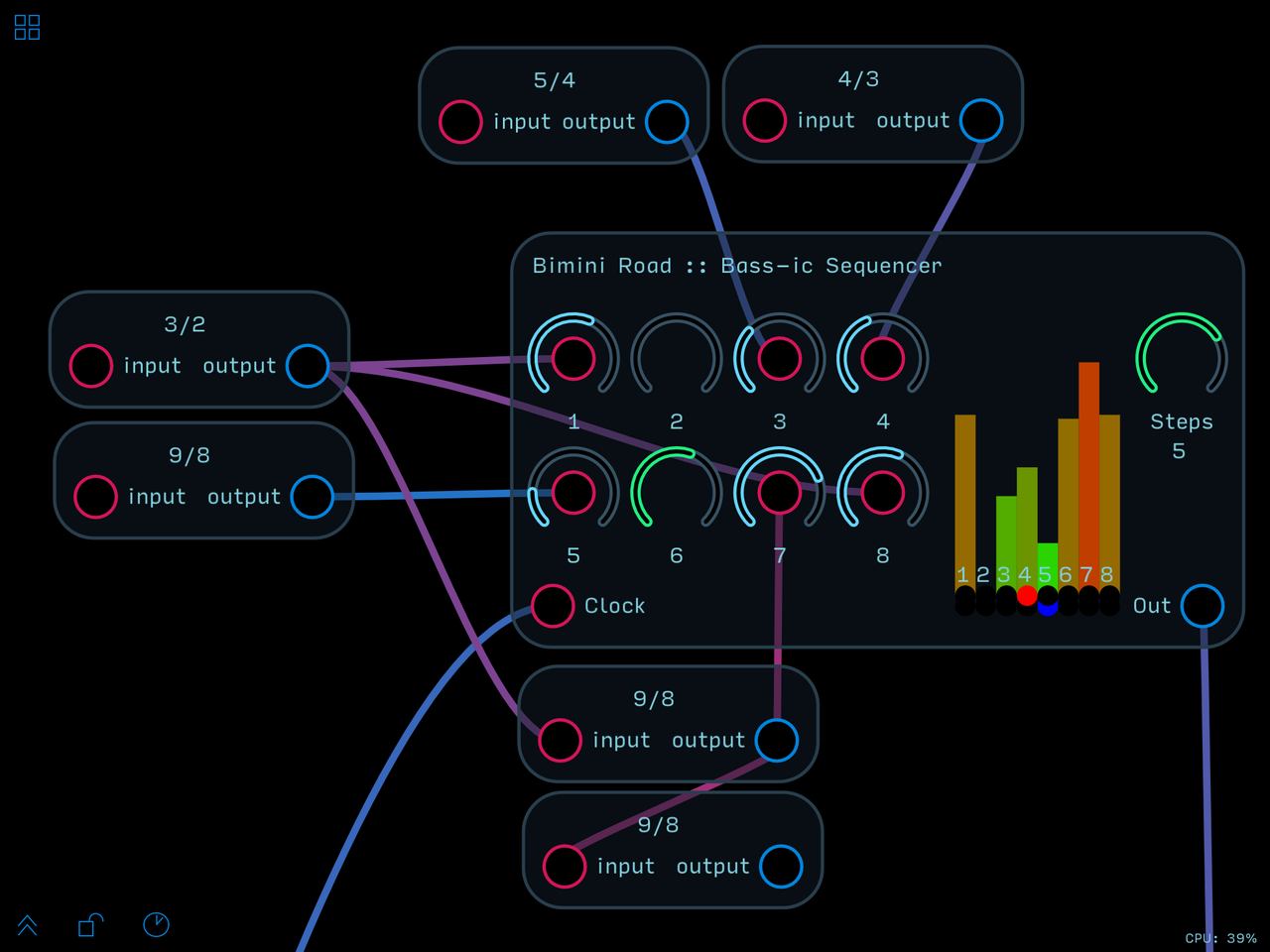
With Audulus, as with most modular systems, the sequencer ‘control voltages’ are typically quantized before being passed on to an oscillator. I was keen to try out tunings with pure ratios and at first thought of piecing together a just intonation quantizer. However, since the sequencer knobs are fluid, it occurred to me that I could simply put together a small collection of ratio modules and connect them freely to the knobs. In this way some steps might be purely tuned while others could be set empirically.

The modules have an inbuilt reference pitch of 440Hz – that means that the 3:2 ratio will produce a pitch a perfect fifth above 440Hz. If the input is connected to a keyboard (or other) source the ratio will take that input as it’s starting point. The modules can be strung together so that the output of the 3:2 module can be connected to the input of a 9:8 module for example – producing a just second above the pure fifth.

Here’s an Audulus patch (very much a tryout, with the inclusion of all kinds of other bits and pieces I was experimenting with) demonstrating the approach.

Audulus Basic Sequencer Tryout

Modular Diary – 011

The arpeggiator of the Model 15 App is a step into getting an idea of how early analogue sequencers were set up: A voltage control knob for each step of the pattern. For pitch those voltages would typically be passed through a quantizer before being routed to an oscillator, but they might just as well be used to control velocity or filter cutoff, for example, perhaps with a parallel row for controlling gate times.1 It’s quite a different world from the piano roll visualizations one is accustomed to with DAWs, and encourages a different way of thinking – a different approach to creating and using sequences.

When I first started using Audulus I was somewhat puzzled by some of the sequencer modules included with it. I’ve since come to better understand (and appreciate) the old analogue models on which they are based. The great thing with Audulus is that all knobs can be linked to any other form of control – that means that the knob for each sequence step can potentially be controlled by an LFO or Random generator, to pick two examples. The sequencer can not only send out a set of control signals, but also be modulated itself.


  1. The Korg SQ-10 is a good example. Here’s a video with the SQ-10 controlling the MS-20 filters. ↩

Modular Diary – 010

Perhaps the most interesting aspect of the Richard D. James interview is his approach to tunings – thinking back over the Aphex Twin catalogue it becomes clear just how much they are an integral part of his sound(s). I was especially intrigued by his mixing systemised tuning with notes that are empirically chosen. And his thoughts on how sequencer patterns can can evolve when combined with custom tuning set-ups.

I’m still surprised by the extent that the modular world, having largely emancipated itself from keyboard thinking, seems to largely stick to equal temperament with it’s quantizers. Perhaps there’s been a greater focus on timbre, and the there’s the challenge of keeping voltage controlled oscillators in tune over a wide range, but as is clear with Aphex Twin, timbre and tuning are related.

Individual oscillators can of course be tuned exactly as one wants to. I experimented a little with the Moog Model 15 App, with the tooltip coming in handy when trying to nail pure intervals between the two oscillators. It’s also possible to set up equal distance scales (with divisions other than twelve) by attenuating the keyboard/input voltage.1 Arpeggiator pitches are quantized but it is possibile to use the fluid velocity output to control the pitch of the oscillators – the only catch is that one can’t zoom in on the arpeggiator controls as one can with the modules.


  1. Moog includes a 15 note EDO microtonal organ preset that does this. ↩

Modular Diary – 009

I’ve been thinking of how YouTube seems to have turned out as the channel for sharing modular stuff. Of course one important aspect (in the absence of being able to save patches) is being able to see the modules and how they’re patched together. Another is the many demonstrations of modular gear – almost small performances in themselves.1

Warp records recently published a wonderful (long) interview between Richard D. James (Aphex Twin) and Tatsuya Takahashi, one of the Korg engineers he worked with on the Korg Monologue. Amongst the many topics they cover is Richard’s fascination with synth demos:

I’m a secret nerd-fan of synth demos, mainly vintage ’80s ones currently! Some amazing music has been made as equipment demos, unsung heroes. I collect synth demos. Well, ones that I like. It’s kind of an unclassified music genre…

On can trace that fascination on a gradual scale from his Korg demo to last year’s Cheetah EP – focussed entirely on an obscure 90s synth of the same name.


  1. Mylar Melodies, for example. ↩

Modular Diary – 008

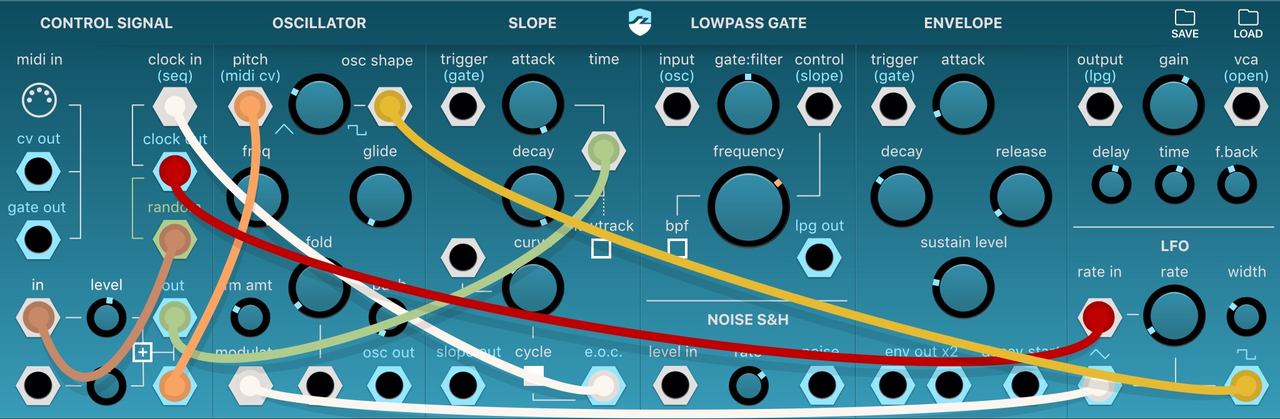
Time for some music. Looking though some soundfiles on my iPad I came across this tryout recorded shortly after getting the Ripplemaker. It’s a simple Krell patch – the workings of which are nicely explained in one of the Make Noise O-Coast patch of the week videos.1 I don’t remember exactly how it was set up, but I think it’s probably close to the patch in the screenshot – recorded in AUM with the AUFX:Space Big Plate reverb.

Ripplemaker Krell

  1. There are also some nice links in the notes worth exploring. ↩