rss

Modular Diary – 040

Two little diversions that sprang out of playing around with my Audulus Scale Bender:

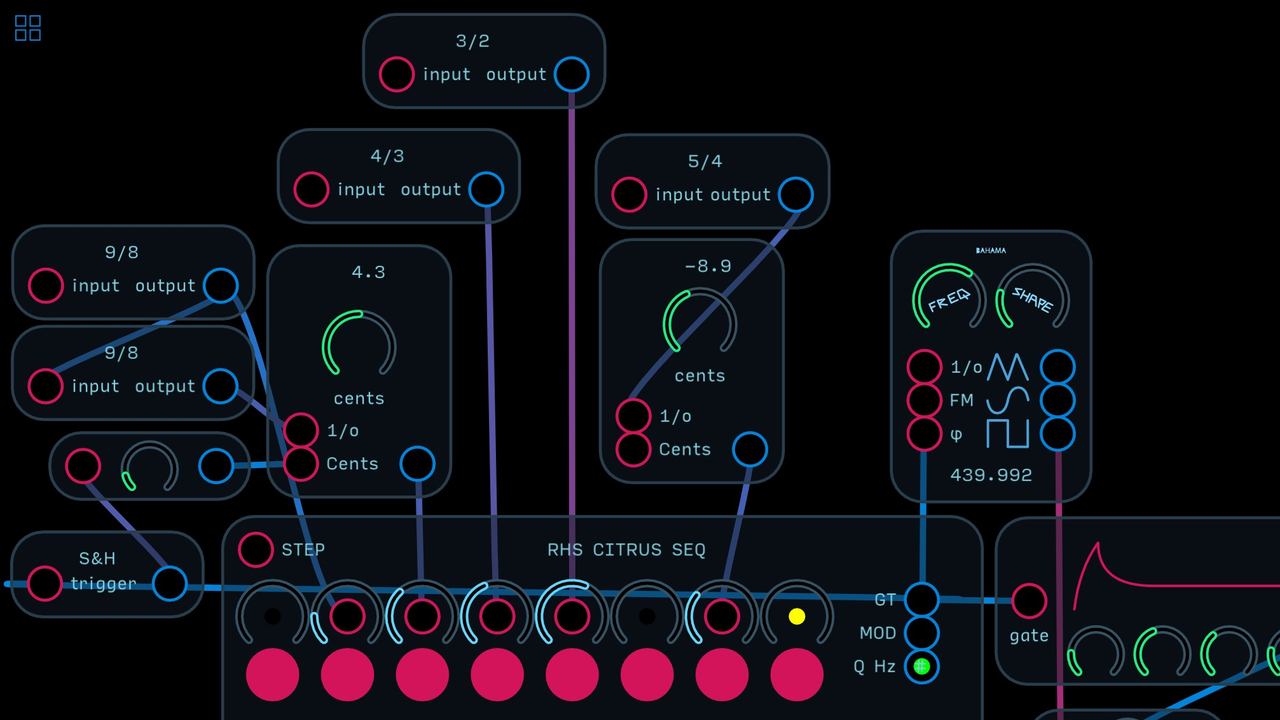
The first patch uses the bender without a quantizer in front of it, with an LFO sweeping across the range of an octave. (There’s also a range control that can be used to centre in around a particular section of the octave, should one wish.) The bender glides up and down following the LFO, but on approaching the next tone falls back and retriggers from the previous semitone. There’s a quantizer placed after the scale bender to help visualise what’s going on.

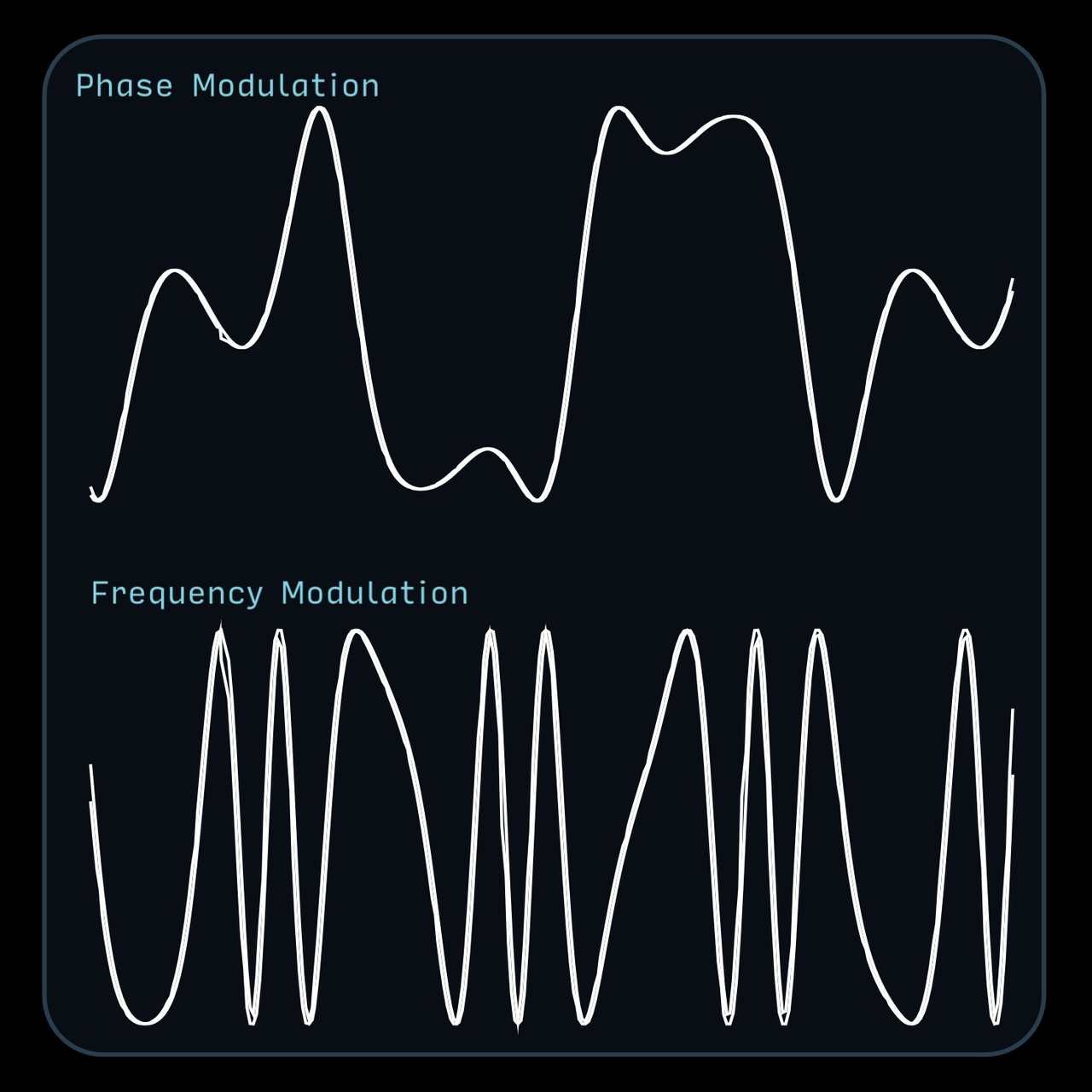
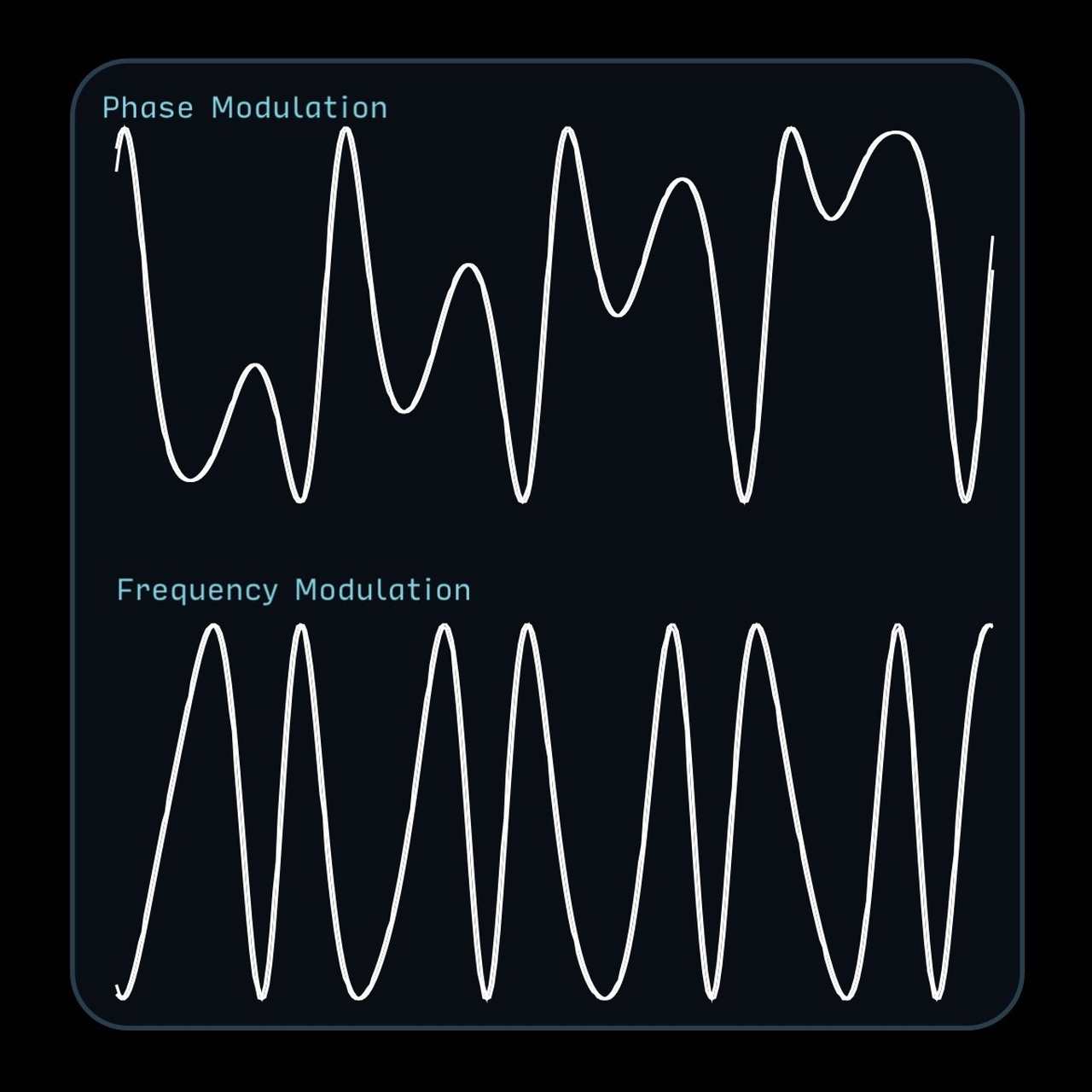
I also discovered something I hadn’t thought of. Sweeping through a pitch range without all the steps of the quantizer activated creates a rhythmic pattern – and if the pitch range doesn’t match the number of notes exactly that can lead to interesting rhythmical unevenness. Different waveforms can also be fun as a rhythmic/melodic source. The patch includes the phase and frequency modulated waveforms I was experimenting with a week ago, and I can imagine some Rungler chaos being interesting too.
Modular – Diary 039

Looking at new experimental modules it’s amazing how often Don Buchla’s name comes up as the source of inspiration. His Source of Uncertainty as source for the Turing Machine, the Wiard Woggle Bug, the Make Noise Wogglebug, an Audulus Wuzzlebuzz, and the Erica Synths Wogglebug, for example. There’s also his dual oscillator Complex Waveform Generator and outside in approach to interface design that has found resonance in recent years.

This year marks the 50th anniversary of the Morton Subotnick’s seminal Silver Apples of the Moon, a piece which he describes as “a pretty complex piece for my first one and I worked six days a week minimum, 10 to 12 hours a day for 13 months making that.” It was created using the Buchla 100, the instrument Subotnick comissioned Buchla to create for the San Francisco Tape center in 1963.

It’s a year ago and a day, that Don Buchla passed away.

Modular Diary – 038

I managed to complete my adaption of the Audulus scale quantizer into a scale bender. Input values within each equally tempered semitone can be shifted up or down by up to 50 cents. It’s no longer a quantizer so if the cent setting should deviate from equal temperament then it’s necessary to place a quantizer in front of it. Without a quantizer (or equally tempered keyboard) the input values are simply offset by the cents setting – i.e a glide within the range of a particular semitone will also glide. That could perhaps be put to some fun uses.

In the demo patch I’ve uploaded to the Audulus forum one can shift between an automated and a manual quantizer preceding the scale bender.

Modular Diary – 037

I’ve been trying to get my head around the inner workings of the Audulus scale quantizer to see if there’s a way to incorporate a knob for each step so as to enable microtonal deviations, but have been finding it difficult to decipher completely. I’m thinking that it might be best to split the quantizer and microtonal adjustments into separate modules. The quantizer can stand as it is1 and feed the quantized values of the chosen steps on to the next module to be bent one way or the other.

In the mean-time I’ve put yesterday’s patch up on the forum.


  1. That also makes it possibile to choose between the quantizer with buttons or the version with knobs (which can in turn be automated by external sources). ↩

Modular Diary – 036

I managed to get started on adapting the Audulus scale quantizer so that each step can be individually adjusted. The first step was to build a little module to enable pitch adjustments within a range of 50 cents up or down. With that in place alongside the little ratio modules that I mentioned in a previous post, it’s already possible to easily set up non-tempered (partially structured) pitch sequences on the fly by attaching them directly to the sequencer pitch knobs. I like to think of it as a set of resistors that can be plugged in as a form of micro-preset, a little like on the old Buchla Music Easels.

Building the ratios and cent adjustments into the scale quantizer means that the alternative scales could also be used in contexts without a sequencer – when using a keyboard for example – and would also collect all the bits instead of having them loosely flying around. That said, there’s something that appeals to me in the clarity and flexiblity of having the ratios and adjustments clearly displayed and easily reconfigurable.

From another angle there were two interesting posts in the Audulus forum this morning covering similar ground: Jimbo’s Microtonal scale modulater and STSchoen’s impressive Audulus recreation of the note quantizer from the very interesting collaborative open source ornament & crime module. Here’s Todd Barton’s introduction to it.

Modular Diary – 035

Following on Hordijk’s fluctuation modulation, here’s a demo that I saw a while ago that’s been popping into my head, on how to program the lead sound for Vangelis’ Blade Runner theme. There’s a section on vibrato that starts around 4′23″.

I also took another look at the effects of uni and bipolar waveforms on linear FM in Robert Syrett’s Audulus Bahama oscillators – unipolar FM alters the perceived pitch (which makes sense for audible frequencies 1 since the modulation is only in an upward direction) while bipolar waveforms keep it centered. I noticed that the Moog Model 15 App has AC and DC frequency modulation inputs as well. In that case it’s simply a question of how strong the (exponential) effect is.

I was also curious to take a look at how the Model 15 App handles sync. Hard sync is as one would expect, but the weak (soft) sync is quite sublte and beautiful in the way that it gradually matches up the phase of the waveform while attempting to preserve its shape.

And finally a look at the Make Noise DPO which very much takes both linear and exponential FM into timbral texture territory. Robert Syrett has made an Audulus version of that as well.


  1. For LFOs I guess this isn’t a problem. ↩

Modular Diary – 034

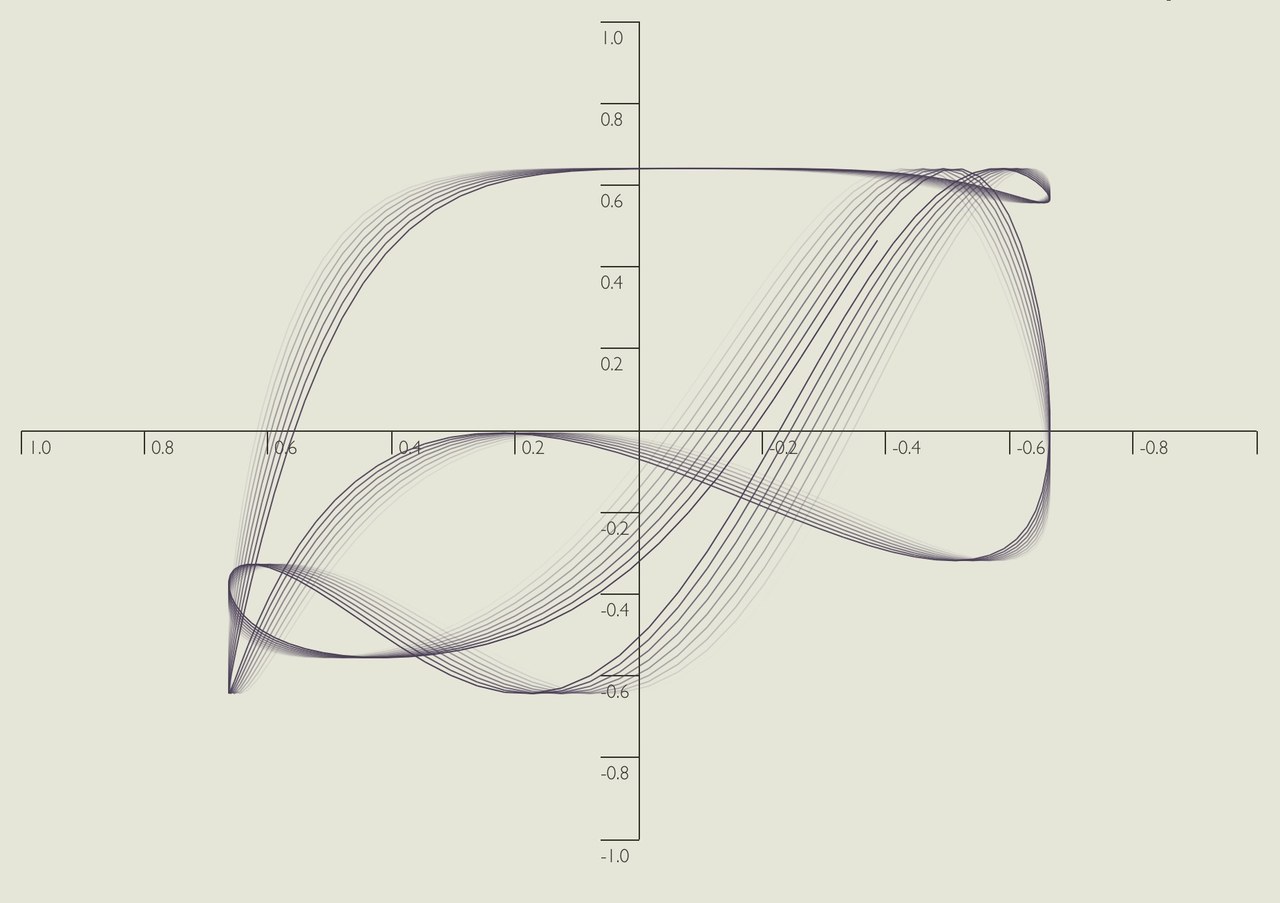
Phase Art: The picture above is of the Wikipedia 3:2 phase modulation example 1 and corresponding comparison with frequency modulation as displayed by an oscilloscope in X-Y mode.2 This is a mode typically used for testing phase relationships between signals and is well known as the method for displaying Lissajous curves – a sine wave on the X axis and a cosine wave on the Y creates a perfect circle, for example.

What I hadn’t realized is that a phase modulated signal against the same (unmodulated) reference frequency could create the kinds of shapes above. (The frequency modulated signal against the same unmodulated reference frequency produces a rotating oval.3) In this case the phase and (linear) frequency modulated signals are presented simultaneously, resulting in the bands of lines that look something like a staff in music notation.


  1. In this case 750:500 Hz ↩

  2. In this case the Goniometer in the MC Studio app.  ↩

  3. Playing with the linear frequency index (the degree to which it approaches exponential frequency modulation) alters the number of lines present and their proximity. The more exponential the curve, the more one approaches familiar Lissajous territory. ↩

Modular Diary – 033

Further down the phase/frequency modulation rabbit hole: I’ve played around a little more with the PM vs FM patch (uploaded to the Audulus forum) and got the levels set to recreate the Wikipedia phase modulation gif. The Audulus LFO waveforms are unipolar and I experimented at little, comparing the results with using a bipolar modulating waveform on the linear1 and exponential FM inputs.

I’ve also been looking at how the shapes change depending on whether the modulating frequency is higher or lower than the one it is modulating. The characteristic phase shapes (with amplitude sub-peaks within them) appear when the modulating wave is higher than the carrier, having a much stronger effect in this area than linear or exponential frequency modulation.


  1. This results in a folding effect similar to the phase modulation amplitude sub-peaks in the picture above. ↩

Modular Diary – 032

It’s interesting how one can keep circling around a topic, slowly covering all it’s aspects and letting them sink in.

I’ve been taking a look at frequency modulation again – specifically the difference between phase and frequency modulation that I touched on in a previous post. Phase modulation (as used in the Yamaha DX synthesizers) has the same (linear) effect as linear frequency modulation, but while mathematically equivalent, the two sound very different. I came across a thread in the Audulus forum that I’d somehow overlooked before, in which Robert Syrett provides an example patch that helps clarify the differences.

Here’s my own slightly altered version of his patch that I’ve been playing around with. I haven’t quite managed to match the nice phase gif from the Wikipedia phase modulation article, but that can be explored further on another day.

Modular Diary – 031

Having made a start on recreating Rob Hordijk’s fluctuation waveform I’ve now been trying to clarify for myself the sync aspect of this type of modulation – the way the modulated signal syncs with the modulating signal.

Hard sync is fairly easy to understand but soft sync, which is what is at play in Hordijk’s fluctuation can have many different forms. The Hordijk info site explains the fluctuation soft sync as follows:

The “fluctuation” modulation is a combination of AM and FM which soft syncs to the harmonics of the modulating signal.

Hordijk himself provides a little more detail in his Waveshaping & Fluctuation masterclass:

…when you come to the extreme points then it sort of forces it to zero again, but only if it is within a certain distance and that means that it basically tries to sync on harmonics, but traditional soft sync in an oscillator actually syncs on higher harmonics, but this actually syncs, soft syncs on subharmonics, so the modulating oscillator needs to be higher than the fluctuated modulator, oscillator, which with normal soft sync would be the other way around, so it’s not really soft sync, so I cannot call it soft sync, so I had to give it another name and I thought well maybe Fluctuation is a nice name, and so I call it Fluctuation…

Hordijk’s explanation brings up something else that I’ve had to clarify for myself – what exactly it is he means by subharmonics. The possible definition of subharmonics as “integral submultiples of the fundamental (driving) frequency” offered by the Wikipedia article seems to help here. I simply take it to mean that since the modulating oscillator is higher than the one it is causing to fluctuate, the modulated oscillator syncs at subdivisions of the modulating frequency, rather than multiples.

Now how does one do that in Audulus?