rss

Modular Diary – 070

I thought it would be fun to go back to the beginning and make an Audulus patch of the Putney-Revox setup that initially got Rob Hordijk going with his Blippoo/Benjolin/Rungler circuits.

I remembered that Robert Syrett had put together a VCS3 inspired oscillator a while back and thought that I’d use that as a point of departure. My first tryout is the basic setup with two oscillators and two delays. It’s fascinating how much one can get out of such a simple patch, especially when bringing the waveshaping into play.

I made a second version with a square wave on the second oscillator so as to get a little closer to the differences between the two VCS3 oscillators, also spending a some time with the iVCS3 app taking a look and listen to what exactly is going on with them.

A next step could have been to try and recreate the VCS3 oscillators more accurately, but then I noticed Robert Syrett’s recent µWaveBender and thought I’d try out a quick version with the (anti-aliased) Audulus node oscillators and the µWaveBender. The principles of the original in an updated form.
Modular Diary – 069

Thinking about different types of sequencers and how they affect the music one makes with them: The difference between the slow precision of the Orthogonal devices ER-101 that I was looking at a few days ago and the playfulness of the Klee, for example.

I got to looking up a little about the Klee Sequencer after Rob Hordijk mentioned it in the wonderful modular tutorial that he gave in Leeds recently. That video covers much of the same ground dealt with in the Basic Electricity presentation given in Berlin in 2015, shedding light on many of the same topics from slightly different angles.

The interesting thing is that Hordijk actually favours simple sequences, preferring to work a little magic through various kinds of modulation, particularly the use of envelopes. Compare for example the section beginning around 13 minutes in the Leeds video, to the section beginning around 7 minutes in part 2 of the Berlin video.

Modular Diary – 068

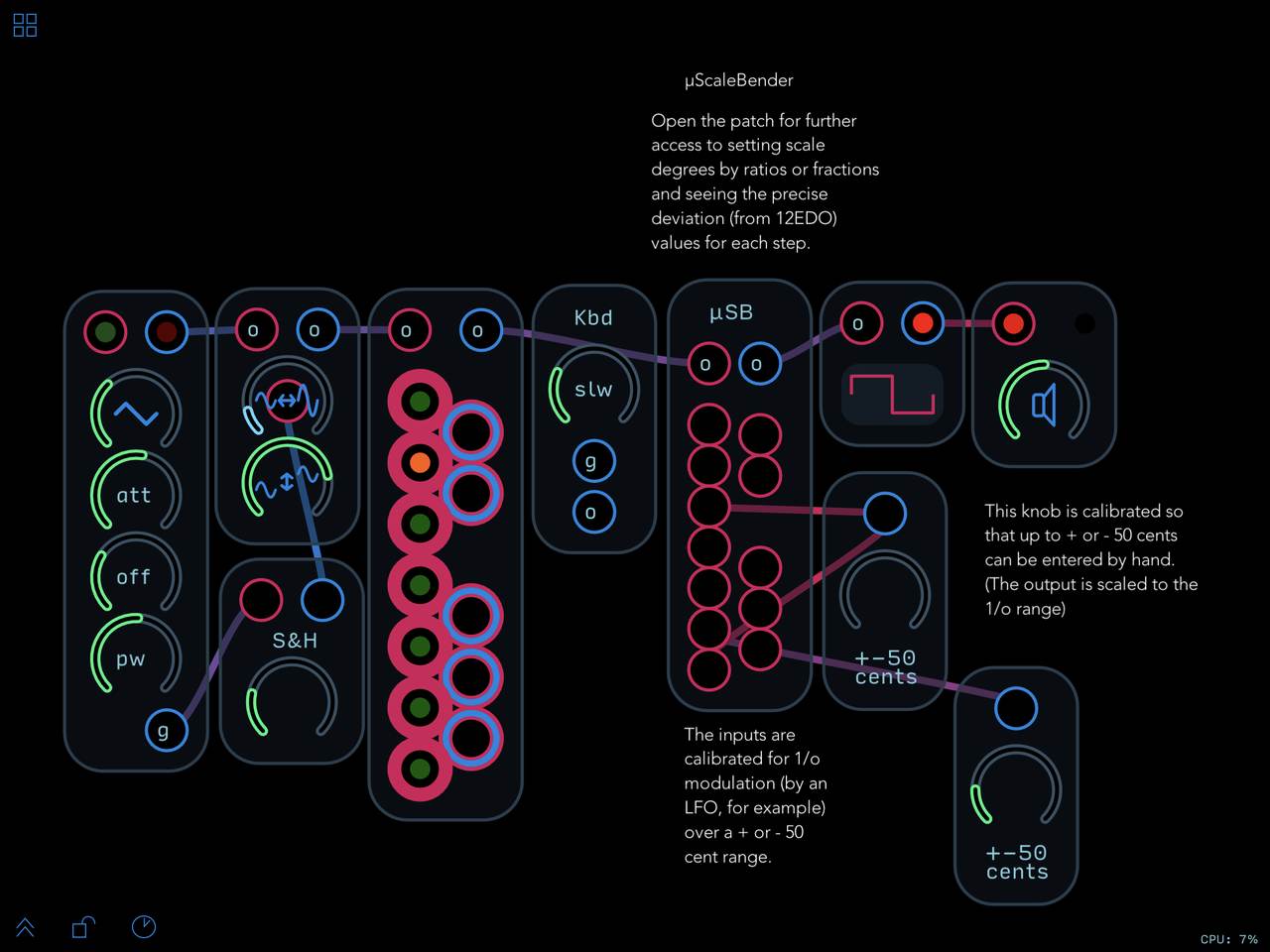
I’ve taken another shot at a micro version of my Audulus scale bender. I decided to do away with the knobs and only provide the 1-volt-per-octave inputs on the front panel, along with a knob on the side (easily duplicated) that can be connected to the particular step(s) one would like to bend. The knob is calibrated so that one can set precise deviations by hand within a range of + or - 50 cents, with its output scaled to 1/o so that it can be connected directly to the inputs. One can still open up the patch and set ratios or fractions under the hood as well as see a numerical display of the precise deviations for each step. It feels a little more elegant than my previous attempt.

Modular Diary – 067

Jjthrash on the Audulus forum:

Since I’ve been able to generate Audulus patches with code, I figured I would wire up some mux nodes and phase through them very fast to make a wavetable of sorts.

Audulus is a visual programming environment, but since the format is basically a human readable plain text file,1 it is in principle possible to program Audulus patches without using the Audulus app. Which is exactly what jjthrash has done – both with his version of Conway’s Game of Life and the wavetable tryout mentioned above.

Audulus’ beautiful visual programming UI is perfectly suited to creating modular synthesis type patches, but there are situations in which certain tasks which can be achieved far more easily with conventional programming. It seems as if the two can exist alongside one another to some degree.


  1. The human readable format has recently been condensed. Opening up older patches in a text editor reveals a friendly layout with space and indentations, all of which have been removed in the newer version – with the advantage of much smaller file sizes. Patches tend to be small enough on their own, but when downloading entire patch collections the kilobytes start to add up. ↩

Modular Diary – 066

Sitting in a room, somewhere in the world, making something.

After looking through some of the snapshots documenting the early days of building Serge systems, I for some reason got to thinking of the Orthogonal Devices website that I bookmarked a few months ago. Perhaps it’s the picture of the tree on the about page that helped establish it in my mind as a place where someone is quietly going about making something with a very particular character and focus.

Mantra: To create tools (as in pencils and violins) for self-expression.

Looking at the videos on the page for the ER-101: Indexed Quad Sequencer is an exercise in what at first seems like excruciating patience. But while taking a look at How far can I get in 10 minutes? I found that my attention remained very much on what I was hearing as I watched the programming actions on the screen and gradually got accustomed to the world of hardware and sound as it unfolded.

Modular Diary – 065

A little further down the Serge paper-trail: Yesterday while looking for images of the early ‘paperface’ systems I came across the serge.synth.net site which collects a wide range of documentation including an early 1976 manual which I found particularly interesting, partly because of the graphic symbols that help to clarify the various functions on the modules, and partly because of the wealth of information it offers on modular synthesis in general. As with the Buchla Easel manual that I mentioned a few posts back, both a fascinating insight into the early years of modular synthesis, as well as a fine, still relevant, way to learn about the basic principles today.

I’m not sure of what other sources that might be at play, but looking at the current Make Noise graphics I see a trace of the early Serge systems. Not only visually but also in the move towards treating elements in terms of function – an envelope used as an oscillator or viewed as a waveform, for example – rather than parameter.

Modular Diary – 064

The unlabelled look of the ever growing Audulus µModular collection got me thinking of the early Serge modular synthesizers.

Originally, the module configuration for Serge systems could be selected by the user. …These were originally arranged by applying paper graphics to the metal panel… Early systems could have custom graphics—or no graphics—depending upon the whims of the artist.

Serge adopted a series of geometric designs denoting signal types, input, outputs, and triggers. Colored 4 mm sockets were used for most connections - blue, black, and red jacks for (unipolar) control voltages, bipolar signals (NOT necessarily AC coupled) and pulse/gate signals respectively, although these were not rigidly enforced. Later, other colors were introduced, e.g. yellow for triggers.
—Wikipedia

Ben Edwards (aka Benge) used one of these early ‘paper’ systems for his Works On Paper, the second track of which is a favourite among the modular pieces that I’ve come across during the last few months. Here are are some images of his system. And here some images of someone getting creative with theirs.

Modular Diary – 063

I finally got round to a first take on creating a micro version of my Audulus Scale Bender. The main idea was to have the set of ratio inputs readily available under the hood – that one could open up the module and quickly change the configuration should one want to.

Choosing what to include on the front panel and how to set it up in a way that’s both compact and clear turns out to be quite a challenge though and I’m not sure if I’ve found the most elegant solution, but at least it’s a start.

The general absence of text in the µModule UIs paradoxically means that there’s a need for some explanatory text along with (or inside) them. A clear set of general conventions for the collection helps balance that out though.

Modular Diary – 062

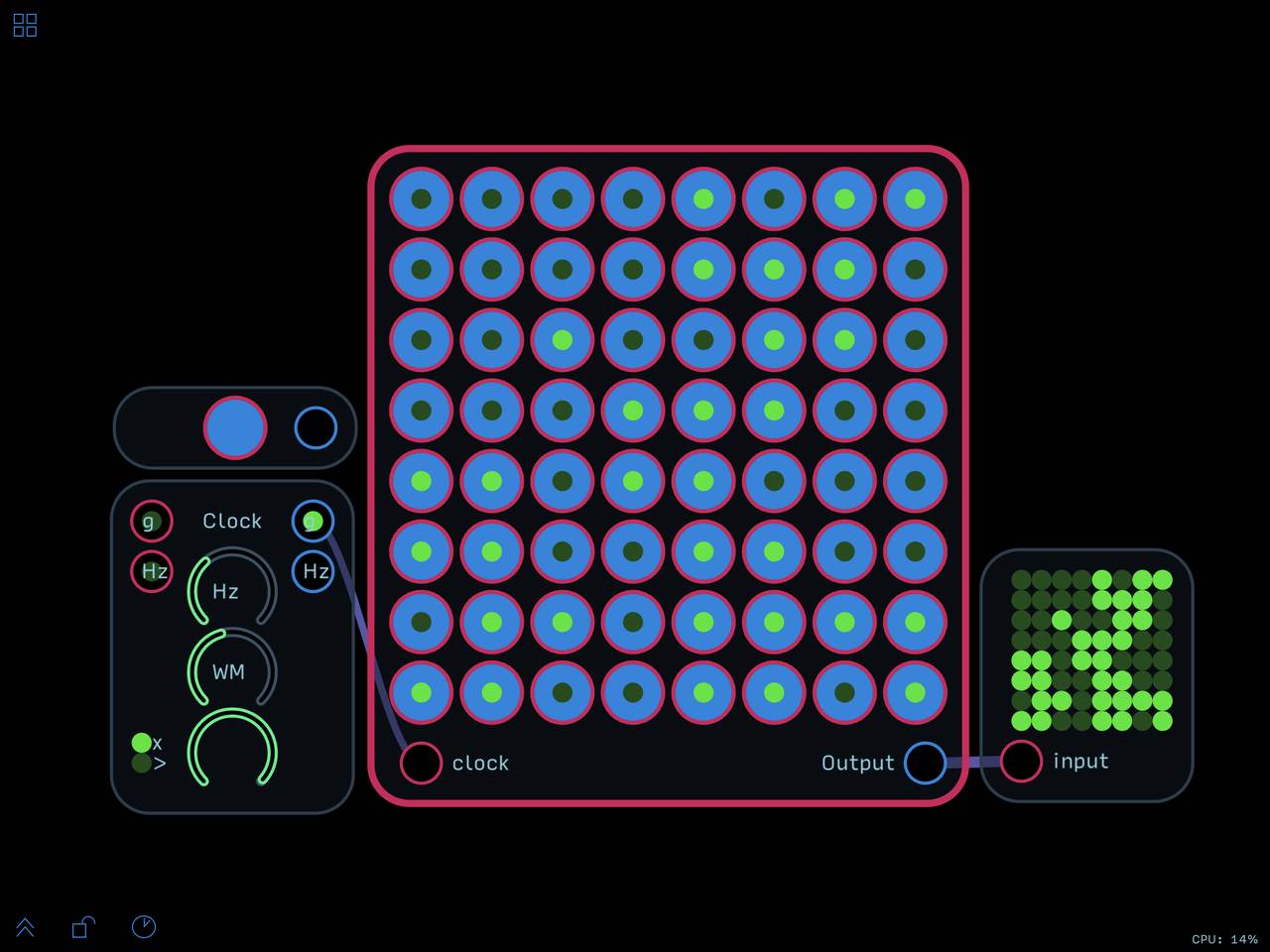
A Sunday side-track: Conway’s Game of Life on Audulus.

There’s a good Wikipedia article on the Game of Life, a cellular automaton devised by John Horton Conway in 1970, in which one creates an initial pattern and watches how it evolves according to a set of basic rules governing transitions for each step in time:

  1. Any live cell with fewer than two live neighbours dies, as if caused by underpopulation.
  2. Any live cell with two or three live neighbours lives on to the next generation.
  3. Any live cell with more than three live neighbours dies, as if by overpopulation.
  4. Any dead cell with exactly three live neighbours becomes a live cell, as if by reproduction.

Depending on the pattern that one uses to seed the game, the transformations fall into an number of categories: The most basic are static Still Lives, Oscillators (with different periods), and gliding Spaceships, all of which can be combined to form more complex patterns, while others might be chaotic in nature. Certain patterns reach a static state or cease entirely after a specific number of transformations, while others evolve continuously.

Jjthrash has been working on an Audulus patch of the game and while he hasn’t yet implemented a form of output I’ve found it fun to tryout different patterns and watch their evolution.

A number of musical applications of the game have already been made, some of them covered in a few articles on Synthtopia. Quincy is one of them with some good video introductions on how the patterns can be put to musical use. I’m looking forward to having these generative sequencing possibilities available within the Audulus sound world.

Modular Diary – 061

I’ve been working my way through the µModular thread on the Audulus forum, trying to catch up with all that’s been added during the last few days. It’s wonderful to have so many modules available in a single, easy to overview, patch and be able to pick out a filter or an amp as one would colours on a palette.

One little detail the caught my eye was STSchoen’s novel approach to a set of µQuantizer ‘presets’ in which a decimal number is converted to a binary representation of a scale. I had to look up how those conversions work – fortunately there are some online converters.