Modular Diary – 057

Thinking further on the difference between analogue circuits and digital implementations of them, and how experiments in one form of technology can be carried over into another, I found it fascinating to hear Rob Hordijk tell a little about the origins of the Blippoo/Benjolin type circuits in a video that I hadn’t come across before:

…around the year 1980 we had these EMS Putney synthesizers and we had these Revox R-77 tape recorders and with with the Putney synthesizer you could make a really nice, always changing patch, by routing, by using two of the oscillators of the Putney and using the Revox as a delay, because the Revox had three heads, a recording head and a playback head and you could record and a little while later on the playback heads you could get a signal back and because it had two tracks you could make two delays, so what you would do you would feed the output of one oscillator in the left input of the of the tape deck, then the output of that left channel on the tape deck would go into the frequency modulation input of the second oscillator, the output of the second oscillator would go into the second track of the of the Revox and the output of the second track of the Revox would go back into the frequency modulation of the first oscillator, so you would have a cross modulation system and the Revox would introduce some time delay, so the cross feedback would be delayed, and this delay sort of makes the system completely chaotic and totally unpredictable and it could just go on for hours and constantly do different things, so I remembered that and I thought that is something interesting to do in the Benjolin…
Modular Diary – 058

Mark Boyd has posted an Audulus Digital-Analog Hybrid Guide on allthesynths.info with some thoughts on the advantages of mixing the limitlessness of software with the focus and sound that hardware might offer.

Interestingly Darwin Grosse recently interviewed Make Noise Music’s Walker Farrell on a recent episode of his Art + Music + Technology podcast, also discussing, amongst other things, what it is that computers might offer in modular contexts.

Modular Diary – 059

Mark Boyd started a µModular Collection (tiny modules that are simple to use and as light as possible on CPU) on the Audulus forum a few days ago and the thread has exploded with the addition of more than 100 modules within the space of a few days. I think it might be a real game changer, especially when using Audulus on an iPad where space is limited (focussed). Robert Syrett’s comment in the thread that the little modules made him think of Sushi got me thinking of an iA Writer post a few weeks ago describing the raw and the cooked aspects of developing their app over the course of the seven years since it was first introduced. With the Audulus µModules the space and processing constraints seem to have sparked a process of creative distillation of many of the inspiring modules that having been appearing on the forum recently.

That also got me thinking back to another aspect of the Rob Hordijk video that I recently came across – how he attempted to reduce the number of controls on his Benjolin as much as possible while still maintaining a high degree of functionality and variation.

Modular Diary – 60

The Rob Hordijk Benjolin Workshop video that I’ve referred to in recent posts also helps clarify the lineage of the Rungler and his Blippoo/Benjolin ‘patches in a box’. At the end of the video he explains how it was the Blippoo Box that was an attempt to most closely recreate the Revox–Putney (VSC3) cross-modulation setup:

…in the analog modular system there’s also a Rungler module that actually has five different modes and there’s different sort of things because you can make all sorts of variations on this shift register idea… this [the Benjolin] is basically the simplest that you can get, it is basically also just one delay, actually when I built the Blippoo Box before this one, the Blippoo Box has two shift registers because that was really sort of a copy of that Putney Revox idea, but for the Benjolin I thought well if I can do it with one chip and and the amount of op amps and transistors and the potmeters on the board and you should be able to build it in an afternoon, …let’s try to do the simplest and most interesting thing.

One thing that comes across in this and other of Rob Hordijk’s workshops is his enthusiasm for the elegance of a particular cicuit. How a simple setup can open up for a rich palette of results. The impetus for the form of his cicuits is often closely tied to their analogue implementions, and many of those forming factors may no longer binding when creating digital versions, beautiful as they may be.

Modular Diary – 061

I’ve been working my way through the µModular thread on the Audulus forum, trying to catch up with all that’s been added during the last few days. It’s wonderful to have so many modules available in a single, easy to overview, patch and be able to pick out a filter or an amp as one would colours on a palette.

One little detail the caught my eye was STSchoen’s novel approach to a set of µQuantizer ‘presets’ in which a decimal number is converted to a binary representation of a scale. I had to look up how those conversions work – fortunately there are some online converters.

Modular Diary – 062

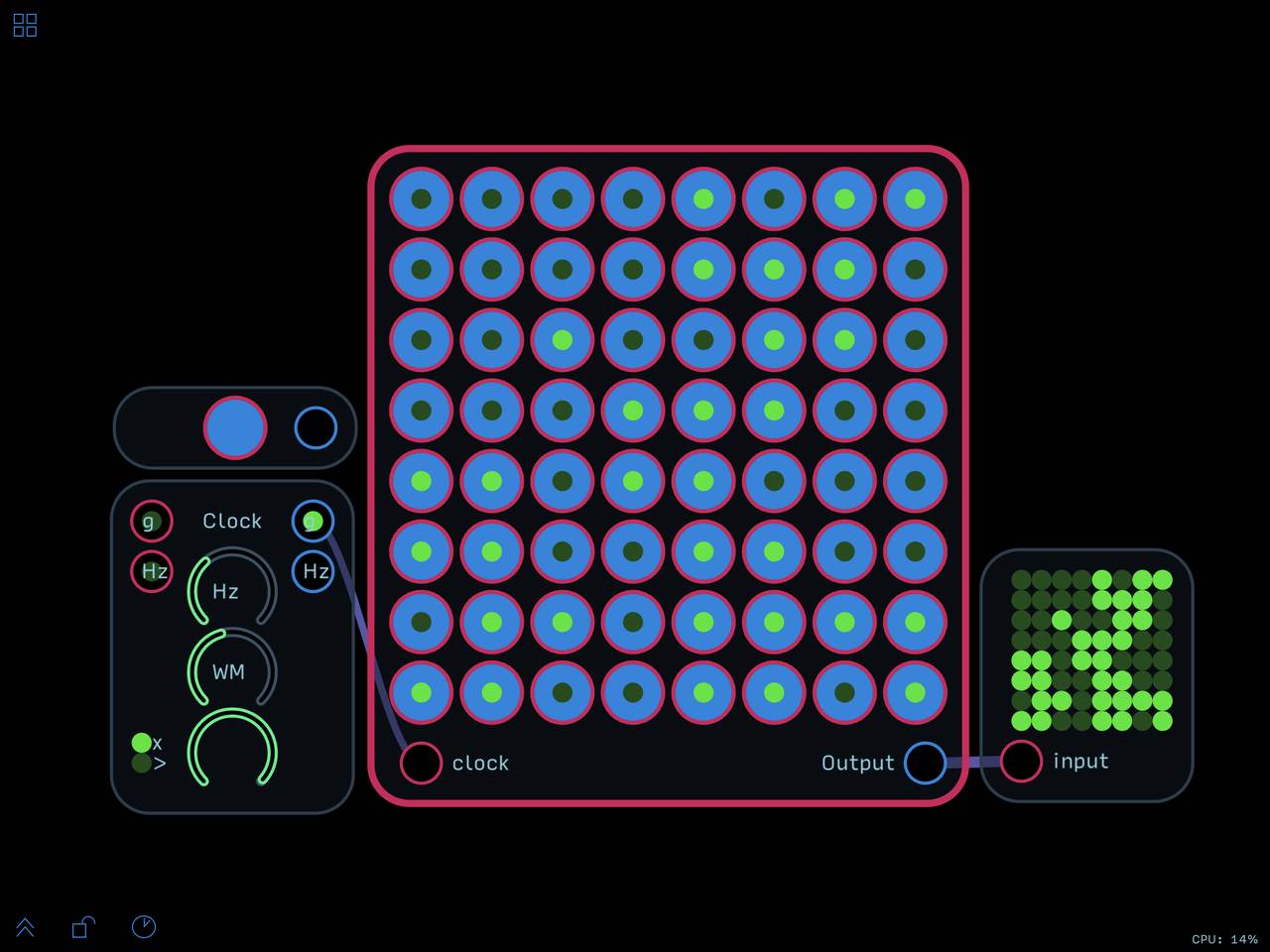
A Sunday side-track: Conway’s Game of Life on Audulus.

There’s a good Wikipedia article on the Game of Life, a cellular automaton devised by John Horton Conway in 1970, in which one creates an initial pattern and watches how it evolves according to a set of basic rules governing transitions for each step in time:

  1. Any live cell with fewer than two live neighbours dies, as if caused by underpopulation.
  2. Any live cell with two or three live neighbours lives on to the next generation.
  3. Any live cell with more than three live neighbours dies, as if by overpopulation.
  4. Any dead cell with exactly three live neighbours becomes a live cell, as if by reproduction.

Depending on the pattern that one uses to seed the game, the transformations fall into an number of categories: The most basic are static Still Lives, Oscillators (with different periods), and gliding Spaceships, all of which can be combined to form more complex patterns, while others might be chaotic in nature. Certain patterns reach a static state or cease entirely after a specific number of transformations, while others evolve continuously.

Jjthrash has been working on an Audulus patch of the game and while he hasn’t yet implemented a form of output I’ve found it fun to tryout different patterns and watch their evolution.

A number of musical applications of the game have already been made, some of them covered in a few articles on Synthtopia. Quincy is one of them with some good video introductions on how the patterns can be put to musical use. I’m looking forward to having these generative sequencing possibilities available within the Audulus sound world.

Modular Diary – 063

I finally got round to a first take on creating a micro version of my Audulus Scale Bender. The main idea was to have the set of ratio inputs readily available under the hood – that one could open up the module and quickly change the configuration should one want to.

Choosing what to include on the front panel and how to set it up in a way that’s both compact and clear turns out to be quite a challenge though and I’m not sure if I’ve found the most elegant solution, but at least it’s a start.

The general absence of text in the µModule UIs paradoxically means that there’s a need for some explanatory text along with (or inside) them. A clear set of general conventions for the collection helps balance that out though.