Modular Diary – 050

A few weeks ago I tried measuring the pitch deviations of the Analog tuning in the Korg ODYSSEi app using a little patch built in Audulus using the ZeroCross node. It turned out that those measurements were increasingly inaccurate as I progressed up the frequency range, and in the end I turned to another app to map the deviations. Puzzled at the time, I should have taken a closer look at the Audulus docs first, since they provide a thorough explanation of why accuracy decreases as the frequency increases.

The reason for this margin of error has to do with sample rate. At a sample rate of 44.1kHz (the default for Audulus in standalone mode), the ZeroCross node has 44,100 samples per second to evaluate the zero-crossings of a 1Hz wave, whereas it only has 4.41 samples per second to evalute the zero-crossings of a 10,000Hz wave.

Those sample rate considerations also have important implications when creating waveforms digitally. The docs provide, with copious examples, a thorough explanation of what is going on with the Osc and Phasor nodes. A fine, and it seems ever-evolving, resource.
Modular Diary – 051

STS has been quick to update his Audulus clone of the Turing Machine – now also a Mk.II. He pinpointed the cause of the audio rate clocking problems that I’d run into and took the opportunity to redesign the shift register (which now uses 30–40% less CPU cycles than before) as well as implement some other improvements.

I’ve played around a bit with the audio rate clocking – specifically trying out waveshaping with the volts expander and changing the pulse width on the pulse out, as in the last section of the MTM video. It seems to be working very nicely.

I’ve posted the patch on the Audulus forum.

Modular Diary – 052

Looking through a (physical) folder dating back to my student days many, many years ago, I came across a 40 page printout of tuning systems.1 Some of the scales are expressed as ratios, others in cents. It seems quite comprehensive: Ancient Greek scales, Indian modes, Werckmeister, Rameau, lute and bagpipe tunings - even Xenakis’s Byzantine Liturgical modes. Wendy Carlos is in there too.

Here’s a scan of the printout. I ran a quick OCR on it so it should be searchable to some degree.


  1. Unfortunately I can’t credit the person who put the list together – all I know is that I probably picked it up while taking some classes at the Akademie für Alte Musik while studying in Bremen in the late 90s. ↩

Modular Diary – 053

While playing around creating drone-like textures with STS’s Turing Machine, I got to thinking of Pugix’s Audulus Quantussy drones that I came across in the forum a few weeks ago. He has a nice post on his website explaining it all along with some sound examples.

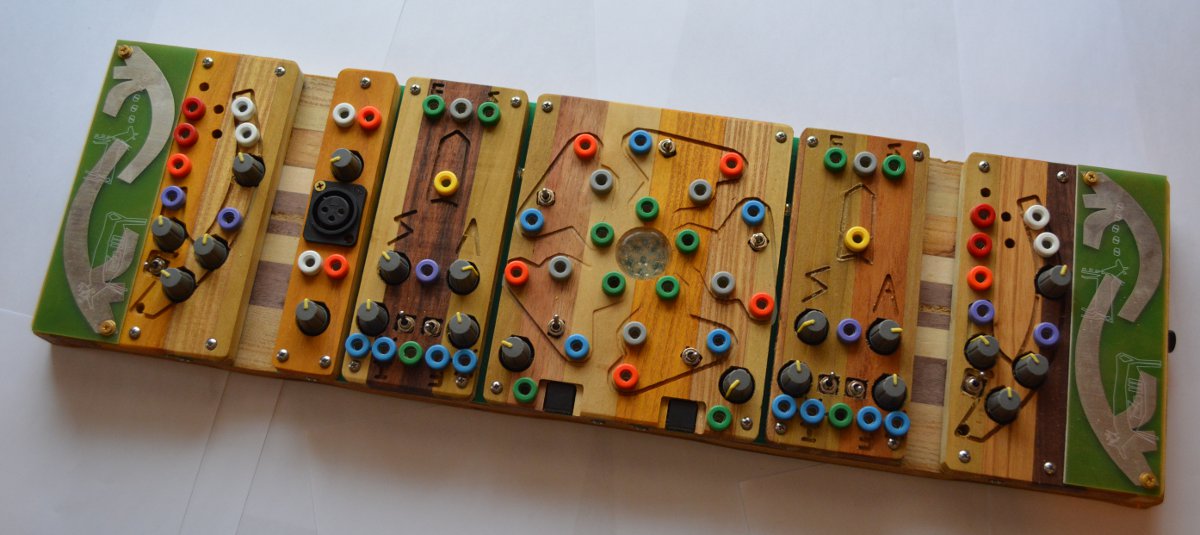
I was curious to take a look at the hardware Quantussy (What is the Quantussy?) that provided the inspiration for Richard’s version, and that led me to some of the most unusual modules I’ve yet come across. As described on the website:

Ciat-Lonbarde specializes in intuitive analog organs for your atonal/chaos squishing needs. The following instruments are assembled in Baltimore out of local wood, and machine assembled circuit-boards that are hazmat free.

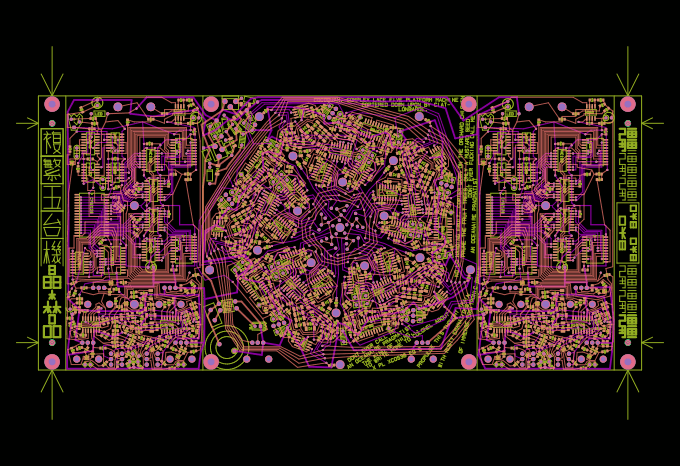
The circuit boards are works of art in themselves. Here’s a Reddit Inquiry into the artsy-hipster side of Synthesis, and an ilovefuzz.com thread with a number of videos of these instruments in action.

Modular Diary – 054

After yesterday’s look at the striking Ciat-Lonbarde instruments, I got to thinking of Rob Hordijk’s Benjolin and Blippoo boxes, and specifically a comment of his about their potential status as objets d’art:

…a little device called the Blippoo box, and that type of instrument I always call a ‘patch in a box’ because it is sort of like a concoction of certain electronics that have a certain specific character of its own, …it should be playable of course, it can also be seen as maybe an objet d’art, what the French call an objet d’art, an ‘object of art’, instead of an instrument, but that is basically free for the people that have one to interpret whether you want to use it as an actual musical instrument on stage, or if you just want to have it in your room as something special next to your paintings and your other stuff…
—Rob Hordijk at Basic Electricity #15, Berlin

Modular Diary – 055

The Din Datin Dudero – ‘the original, esoteric analog synth for babies’ – something that caught my eye amongst all the unusual on the Ciat Lonbarde site. There’s also the Nobsrine:

It is for babies of DJs and noise musicians, who want to introduce their children to strange sounds, chaos magic, the idea of infinite degrees of relationship between tones, without the more complicated techniques involved in uper crust CIAT INSTRUMENTS.

I was wondering about the relationship between all these instruments and Rob Hordijk’s ‘patches in a box’, and sure enough, looking though the images for the Din Datin Dudero I stumble across:

Stuber shall have two knobs, a philter mechanism for audio and also for gesture, with Q control. The binary matrix reinterprets resonances, as a “Rungler.”

Here’s a video of their creator Peter B. explaining his Plumbutter.

Modular Diary – 056

A little side-note on the Turing/Quantussy/Rungler Audulus implementations: Something that I did notice while playing around with STS’s Copier and Turing Machine was that patches would open in exactly the same state as last, something that Richard Brewster also draws attention to in the post on his Audulus Quantussy.

One very interesting feature of an Audulus patch is that it will start off playing in the exact state in which it was saved. So, very much unlike the analog Quantussy, I think that the sequence of events created by the software Quantussy may be able to repeat exactly.

Following on that, Rob Hordijk’s thoughts on the differences between digital and analogue implementations of these kinds of cicuits:

Imho a rungler circuit works best in an analog electronics implementation. It is definitively more alive and surprising due to the slight instabilities in the analog circuitry. I did digital implementations, but they can’t beat the ‘organic behaviour’ of the analog versions. But this is just personal taste…