Modular Diary

A background project that I’ve been busy with during the course of the last few months has been making recordings of the demo patches that I’d put together for my series of Audulus Hordijk Modules. After adding those to the respective posts on my site it occurred to me that it might be fun to record the texts and combine them with the examples, creating audio versions of the posts that could then be made available via a podcast feed.

As is often the case, it took a little longer than anticipated to get everything in place, but it’s finally done – hopefully useful as a little review of the project.

Here’s the link should you be interested in listening to them in a podcast player: https://huffduffer.com/rudigermeyer/tags/modular-diary/rss, or check it out on HuffDuffer where there are also links to open the feed directly in various podcast apps (should you be on a mobile device of some kind): https://huffduffer.com/rudigermeyer/tags/modular-diary.

It’s also possible to follow through all the entries on my site, which also includes the individual audio examples, starting here: https://rudigermeyer.com/notes/2018-03-24-17-12-30
Modular Diary

A little over a year ago I set about recreating Rob Hordijk’s modular system in @Audulus. You can follow that journey in podcast form here: huffduffer.com/rudigermeyer/tags/modular-diary, or here: rudigermeyer.com/notes/2019-03-01-12-00-49

Modular Diary

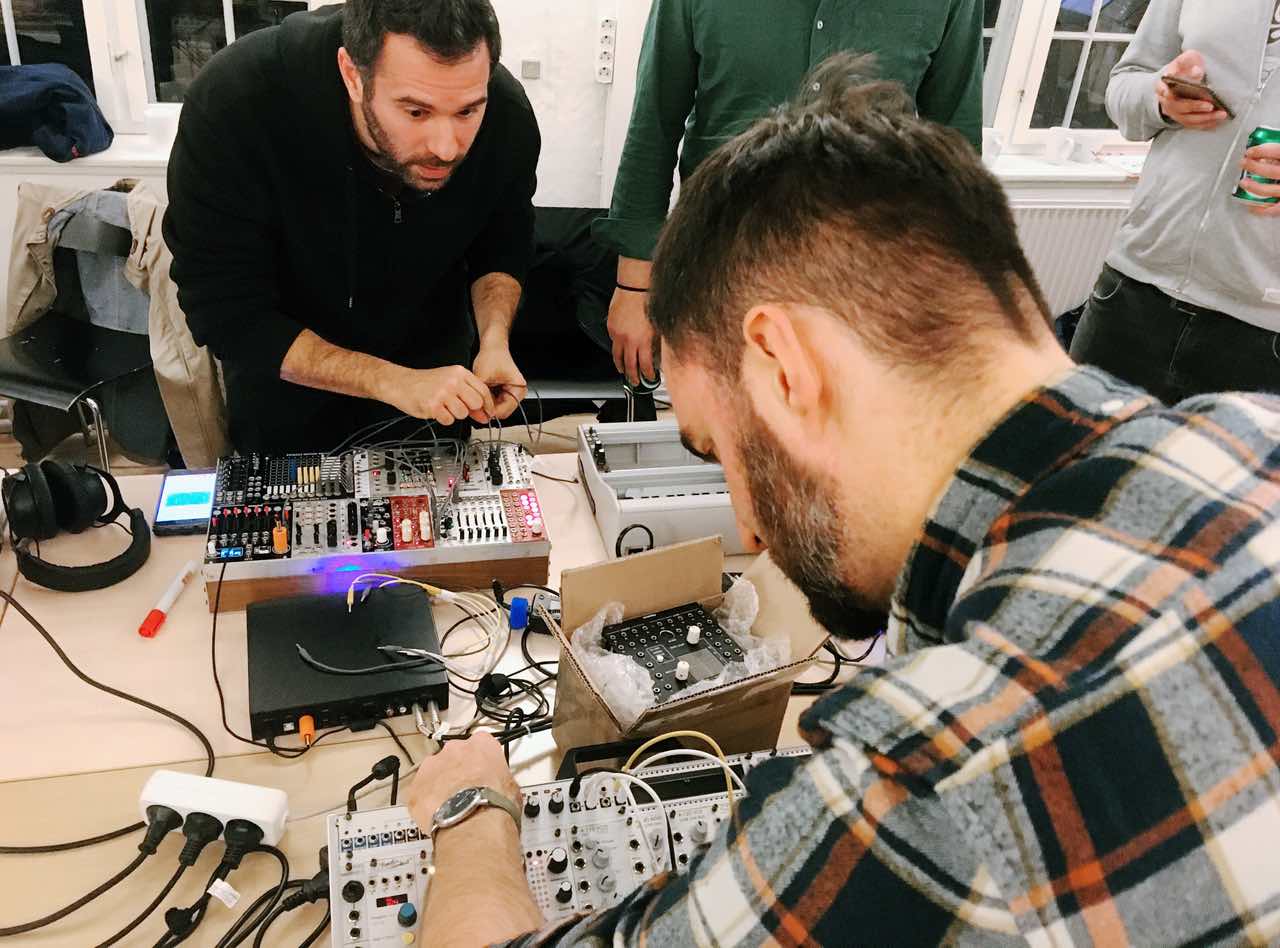
At the Danskmodular meet-up in Copenhagen last week Konstantine got into explaining how one might approach creating a chaos patch on an analogue modular system without using a random/chaos module.

He demonstrated how the logistic equation k*x*(1-x) might be reformulated as k*(x-x^2) so as to make it easier to patch. (Some source reading on the equation can be found here.)

I had a go at putting it together in Audulus, both using the expression node as well as simply using the multiplication and addition nodes.

It turns out to be a simple way of achieving something similar to the kind of chaos spectrum Rob Hordijk achieves with his Rungler. The logistic equation outputs a constant value when k is smaller than 3, followed by a period of doubling with a second bifurcation at 3.5, chaos shortly after 3.577, and 3-step period around 3.83.

It also reminded me of @biminiroad’s look at the difference between chaos and randomness in one of his Audulus live streams almost exactly two years ago.

I’ve put the patch up on the Audulus forum.

Modular Diary

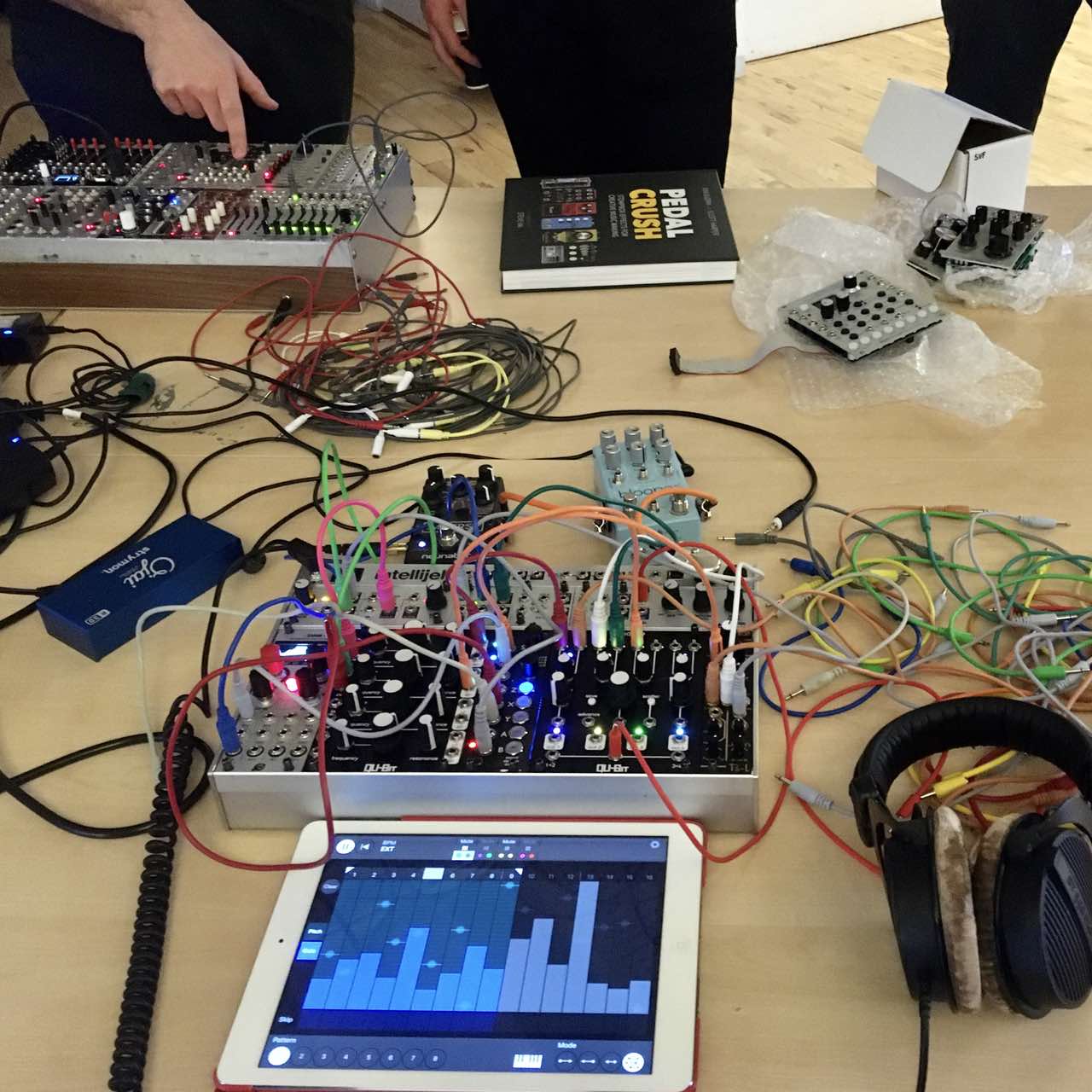
Kim Bjørn brought an interesting small setup along to the Danskmodular meet-up last Saturday. It included the Mi.1e, a bluetooth MIDI to CV adapter that connects wirelessly to an iPad, enabling it to operate, via its own iOS app, as a sequencer, LFO, MIDI to CV interface and more.

There’s a little more on it in this review, which also mentions the similar Instruō Aithēr.