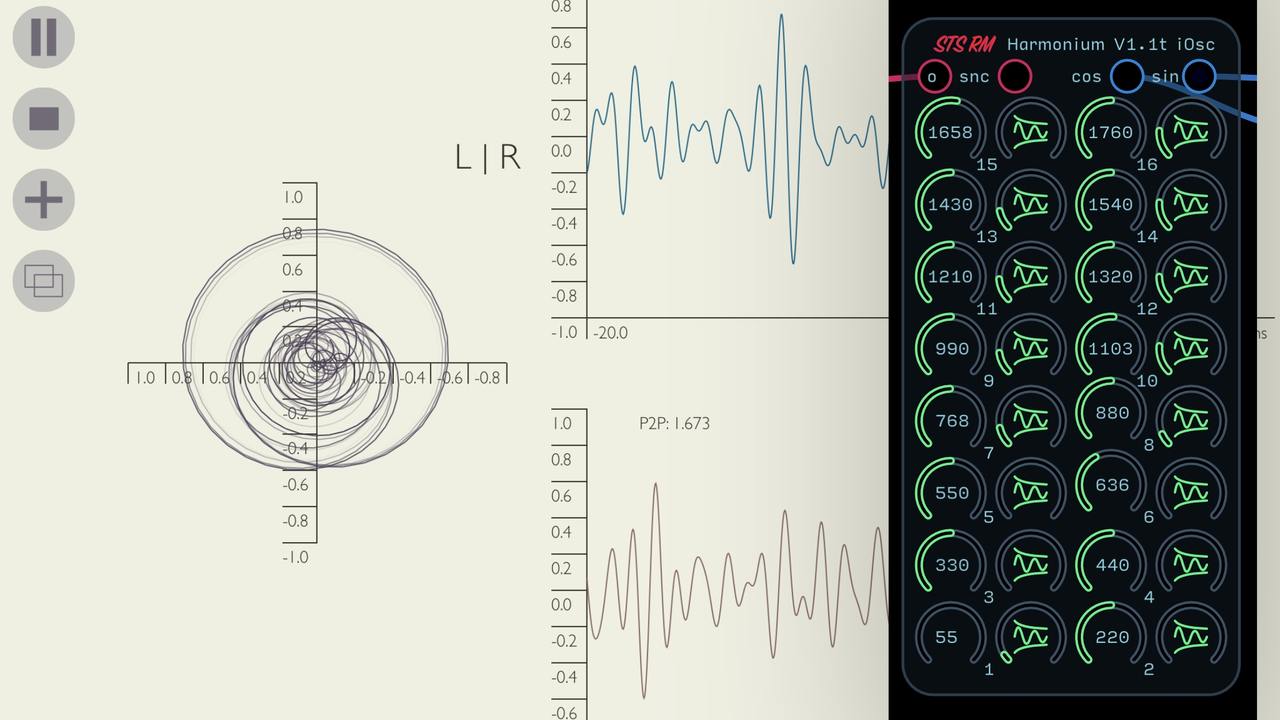
Last year I made a little modification to STS’ harmonic oscillator, adding a cosine output so as to enable the XY oscilloscope shapes covered by Jerobeam Fenderson in one of his oscilloscope music videos. I finally got round to making another modification, this time making it possible for the frequency of each harmonic to be individually tuned instead of adjusting the phase. The perfectly tuned harmonics can be very beautiful but sometimes slight deviations can add a little movement and character to the sound – also visually – see Jerobeam’s video from around 5m30s.
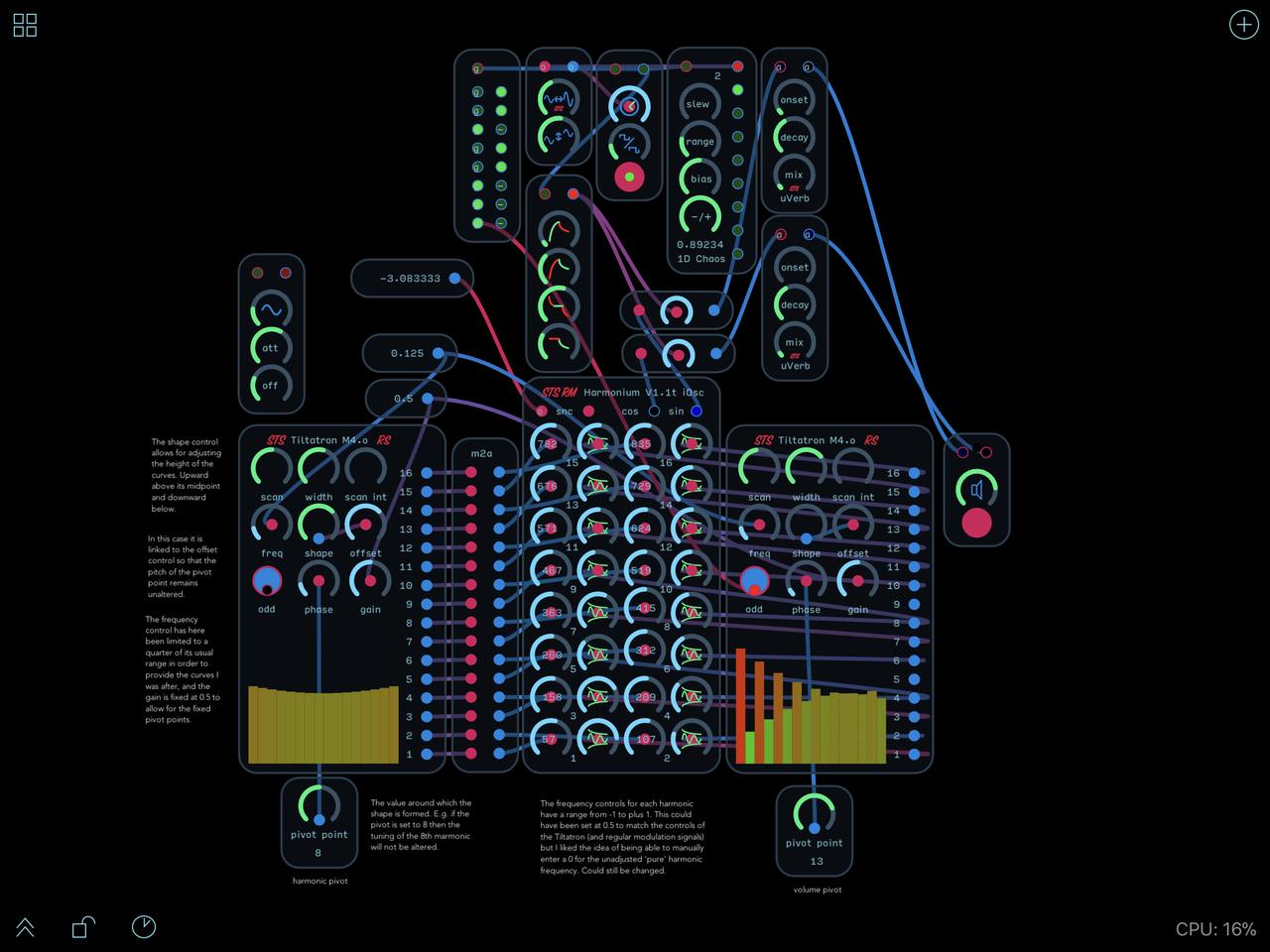
Since making some modfications to STS’ Harmonium last week, I’ve been experimenting with ways in which to slightly stretch the pure ratios of the harmonic frequencies, and listening to the timbral changes that result. Fortunately STS and Robert Syrett had already put together a Tiltatron that provided a good starting point for making adustments to the 16 values with a minimum of controls.
By reducing the range of some of the Tiltatron controls, fixing others, and adding a further offset control I manged to set up a controller that could give me the various ‘spread’ shapes I was after with just two parameters – the ‘shape’ control adjusts the intensity and direction of the curves, and the pivot point makes it possible to select a fixed harmonic around which the shape can fold. For example, a fixed root with gradualy increasing deviations as the harmonics increase, or vice versa. Or a central harmonic as a fixed point with deviations (up or down) towards the higher and lower frequencies.
I’ve posted a tryout patch on the Audulus forum. Rather than automating the spread and pivot I’ve left them standing for manual interaction. The option to invert the values for the even/odd harmonics can lead to some nice bell like tones, and the ‘scan’ row of controls on the Tiltatron provides a nice way of highlighting specific harmonics.
A next step could be to strip it all down and put together a compact module with only four controls. A shape and pivot for adjusting the frequencies of the harmonics, and a shape and pivot for adjusting their intensity.
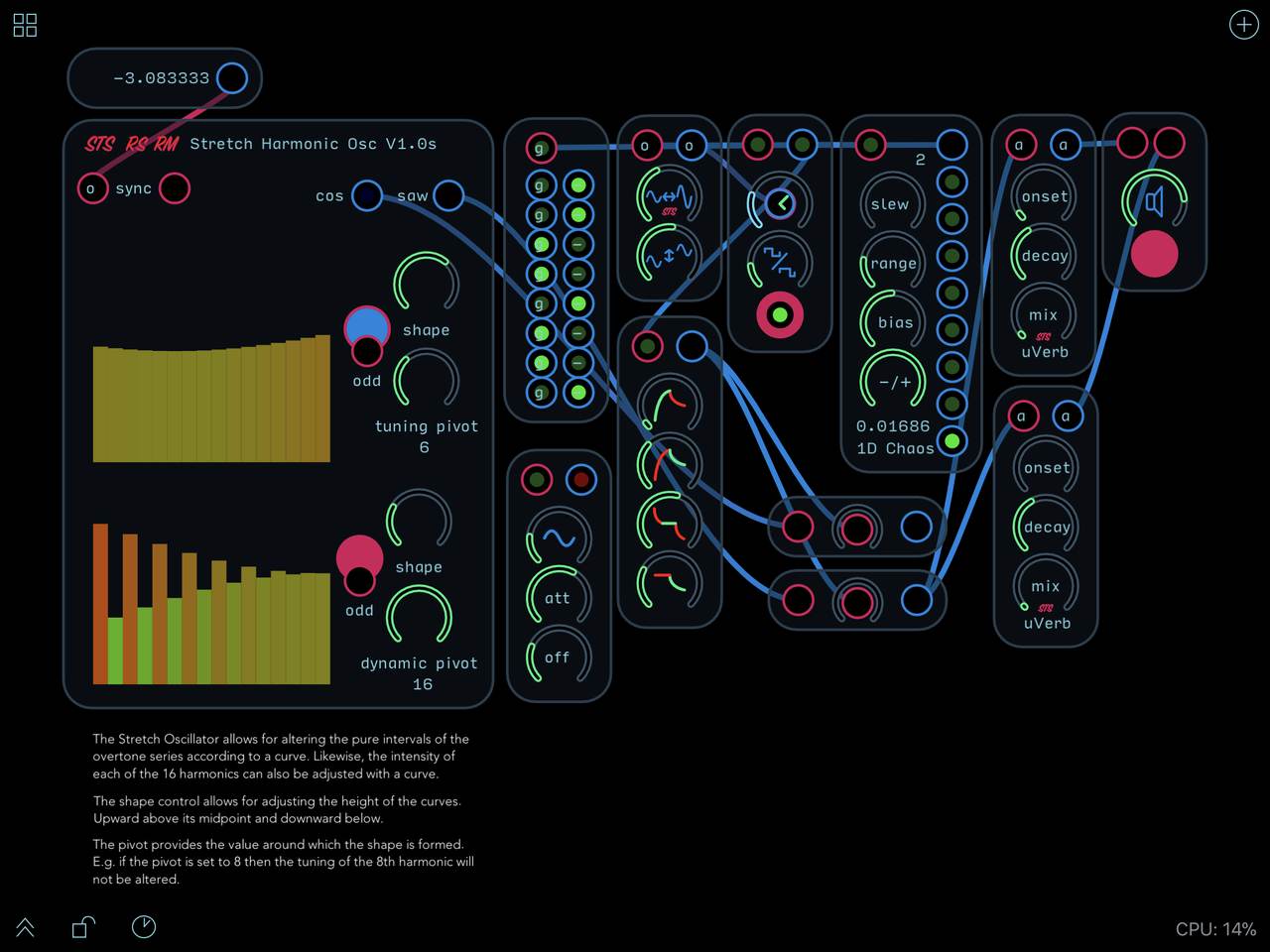
@stschoen suggested a sawtooth version so I replaced the sine output with a saw. With just a little bit of a tuning curve I find it quite effective at generating a rich ‘analogue’ sound with a minimum of fuss.
I also put together a micro version. Since having a visual representation of the curves is quite useful, especially when getting to know the module, I’ve kept the meters on the inside of the module. Open it up for a quick reference peek.
Looking through, organizing, and reviewing the many Audulus patches that I’ve accumulated and worked on over the last year, I was reminded of the Hordijk TwinPeak filter. A simplifed version of it was included in the Blippoo Box that I’d put together, and I remembered that I’d meant to make a standalone version of it at the time – only to realize that that had already been tackled on the forum.
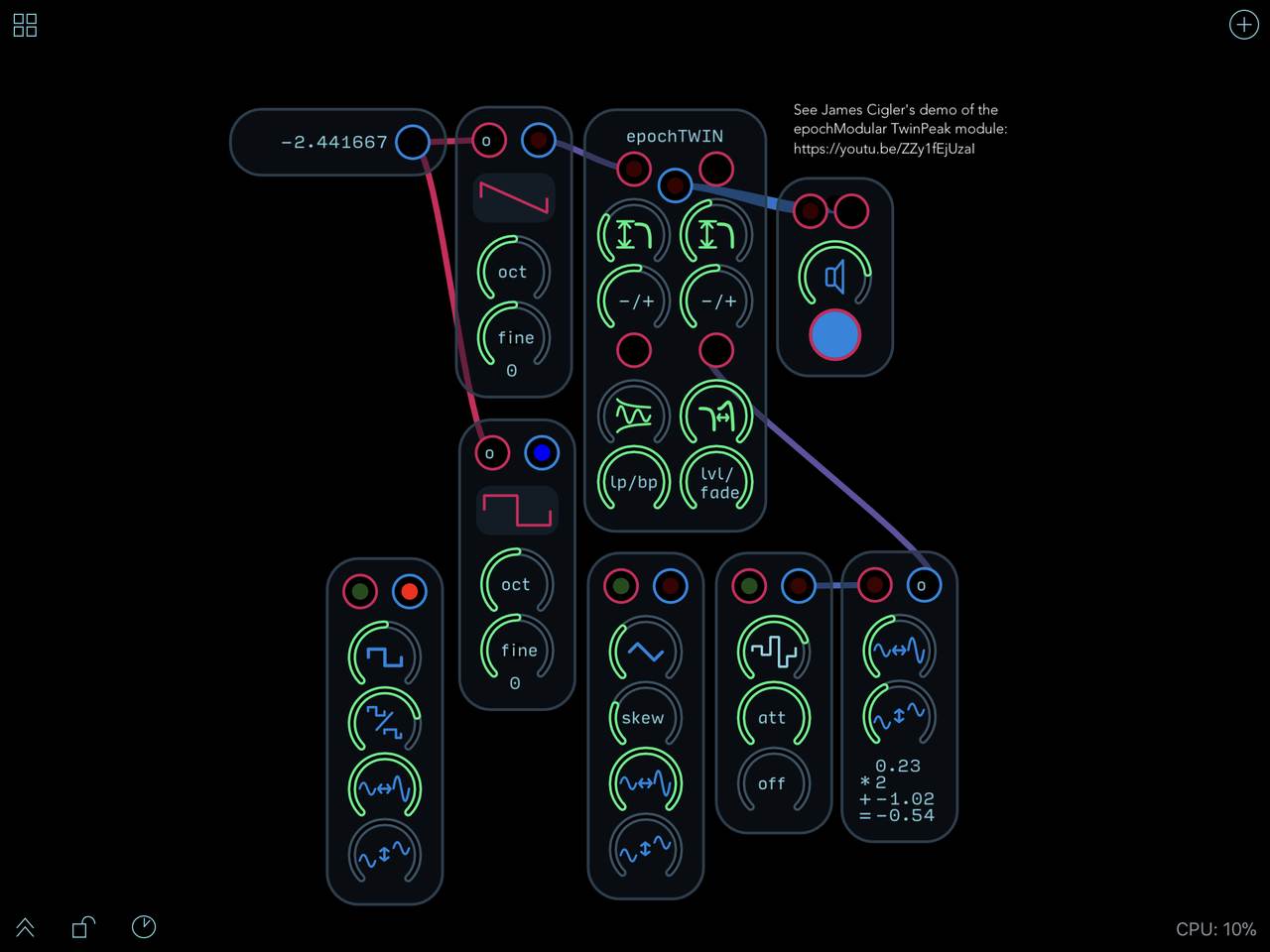
Here’s my fresh take on the Epoch Modular version demonstrated in the James Cigler video at the top of the forum thread, building on the updated modules and approaches that have been introduced over the course of the last year.
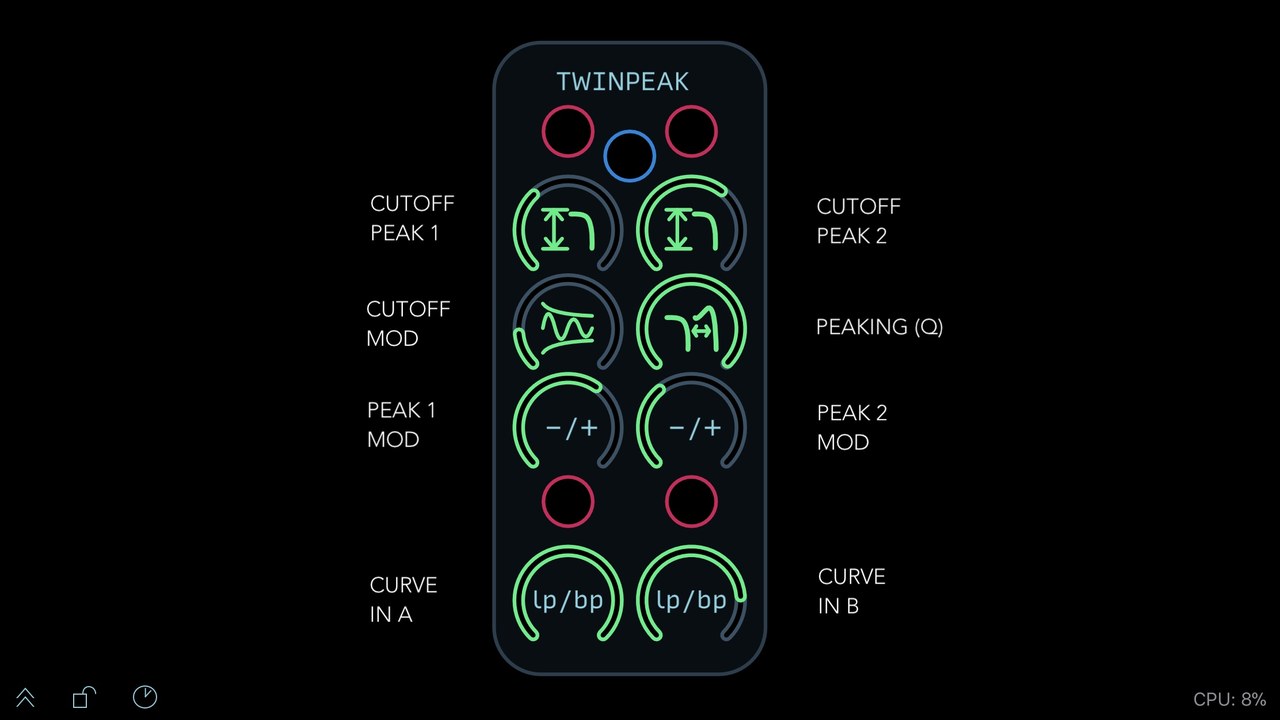
I’ve also put together a version of the TwinPeak filter following the layout and design Rob Hordijk created for his own modular system. It doesn’t have the cross-fader that is a handy feature of the Epoch Modular version, but that’s not necessarily needed in the context of Hordijk’s system since it includes a Dual Fader module. There’s a directness and clarity in the pure symmetry of his design that I find very satisfying.
The hordijk-synths.info site appears to no longer be online, but can fortunately still be accessed via the Internet Archive’s Wayback Machine. I also discovered the recently established Hordijk Modular Blog, which has an enthusiastic entry on the TwinPeak filter that includes an informative video in which Hordijk himself explains how the design enables not only a bandpass filter, but one with two peaks.
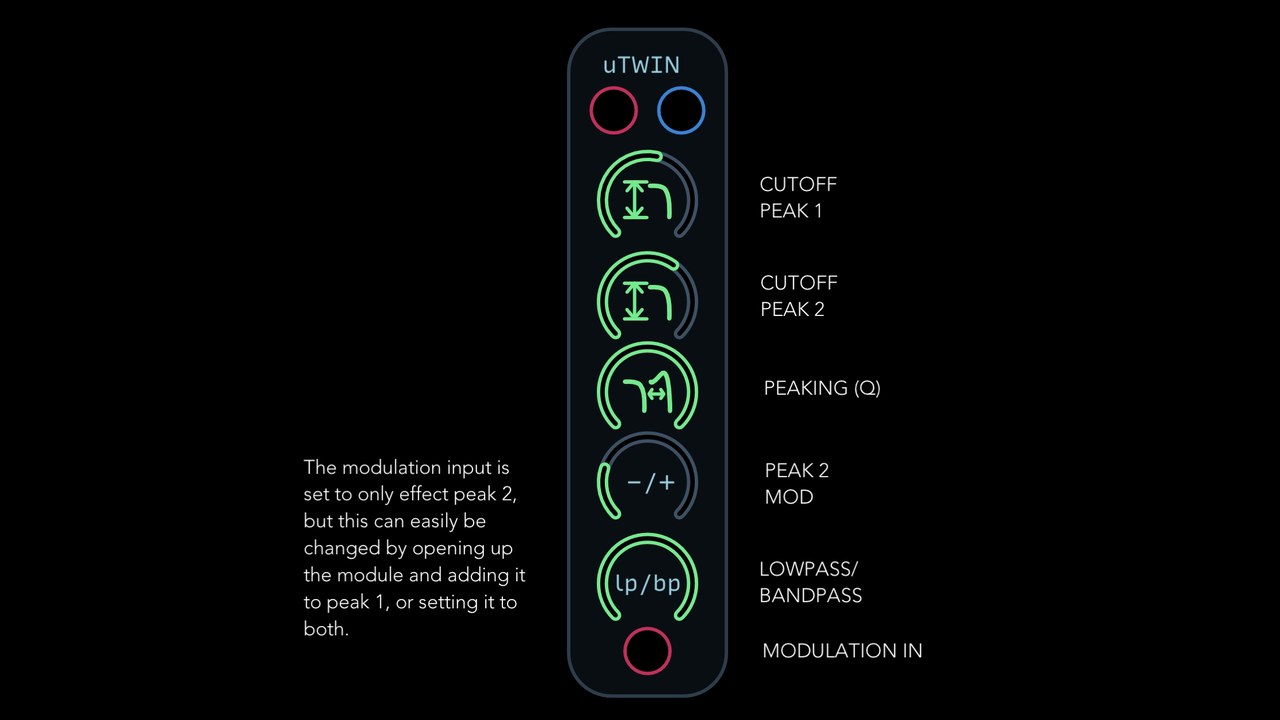
I’ve also put together a simplified, single input, micro version of the TwinPeak filter. The modulation input is set to only alter peak 2 by default, but this can easily be changed by opening up the hood and changing it to peak 1 or adding it to both.
The Hordijk Modular Blog suggests using multiple TwinPeak filters in order to achieve a complex filter with multiple resonant peaks, so I’ve tried something of that out in a little demo with the filters being triggered at sub-audio rates.
While taking a look at the difference between the Epoch Modular TwinPeak filter and the one that Rob Hordijk uses in his own system, I got curious about his Dual Fader module. At first I thought that it might not be all that relevant in the Audulus context, but the closer I looked, the more compelling I began to find it.
The NOVARS Research Centre has fortunately posted an extensive series of Hordijk tutorials (presented by the man himself) and I found it very useful to take a look at the two videos (#12 and #12a) in which he presents the Dual Fader.
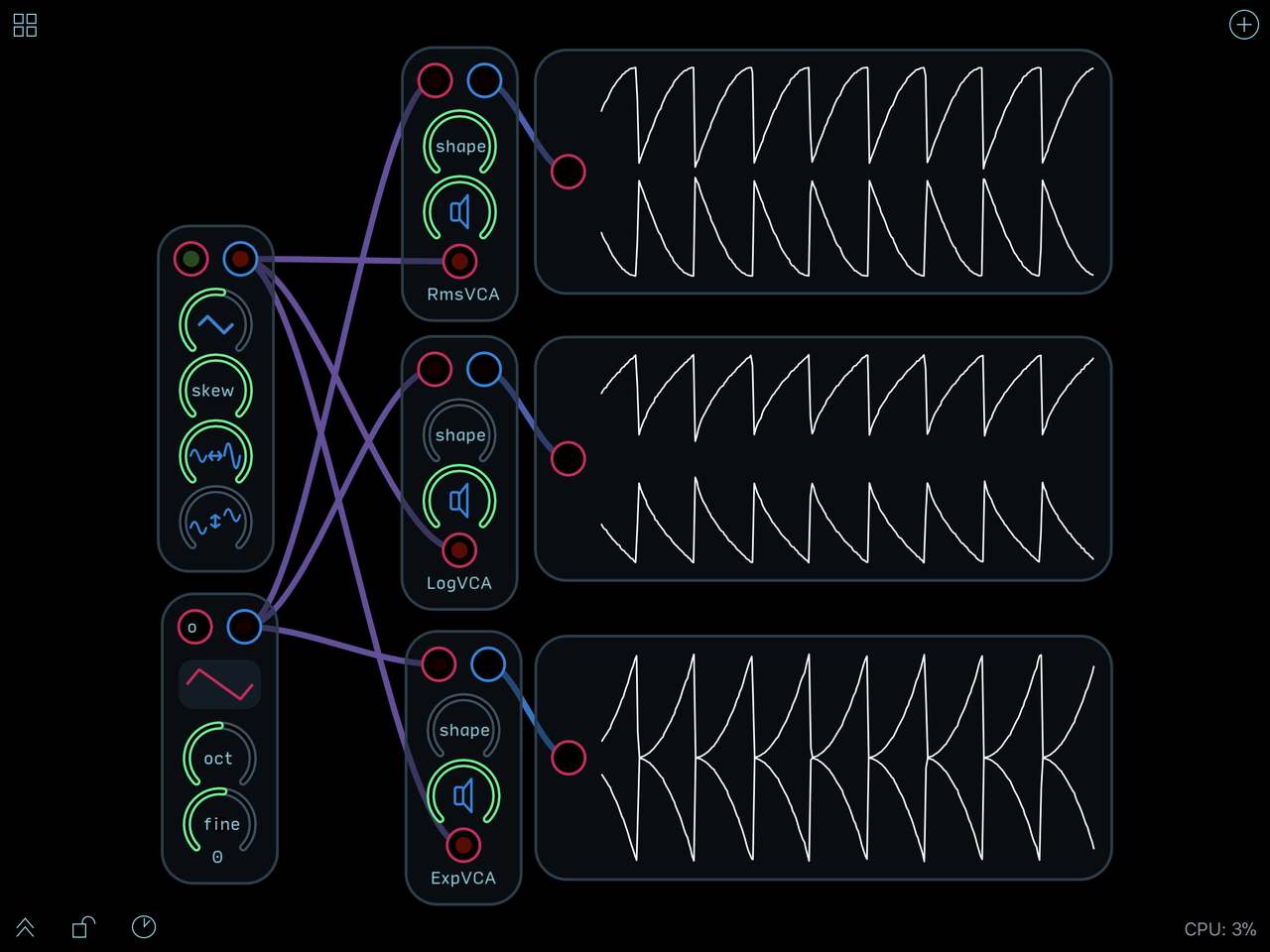
My first take-away was the simple idea of using one half of a cross-fader as a VCA with an RMS curve, and so I put together a little Audulus VCA and a comparison patch with exponential and logarithmic curves.