Modular Diary – 099

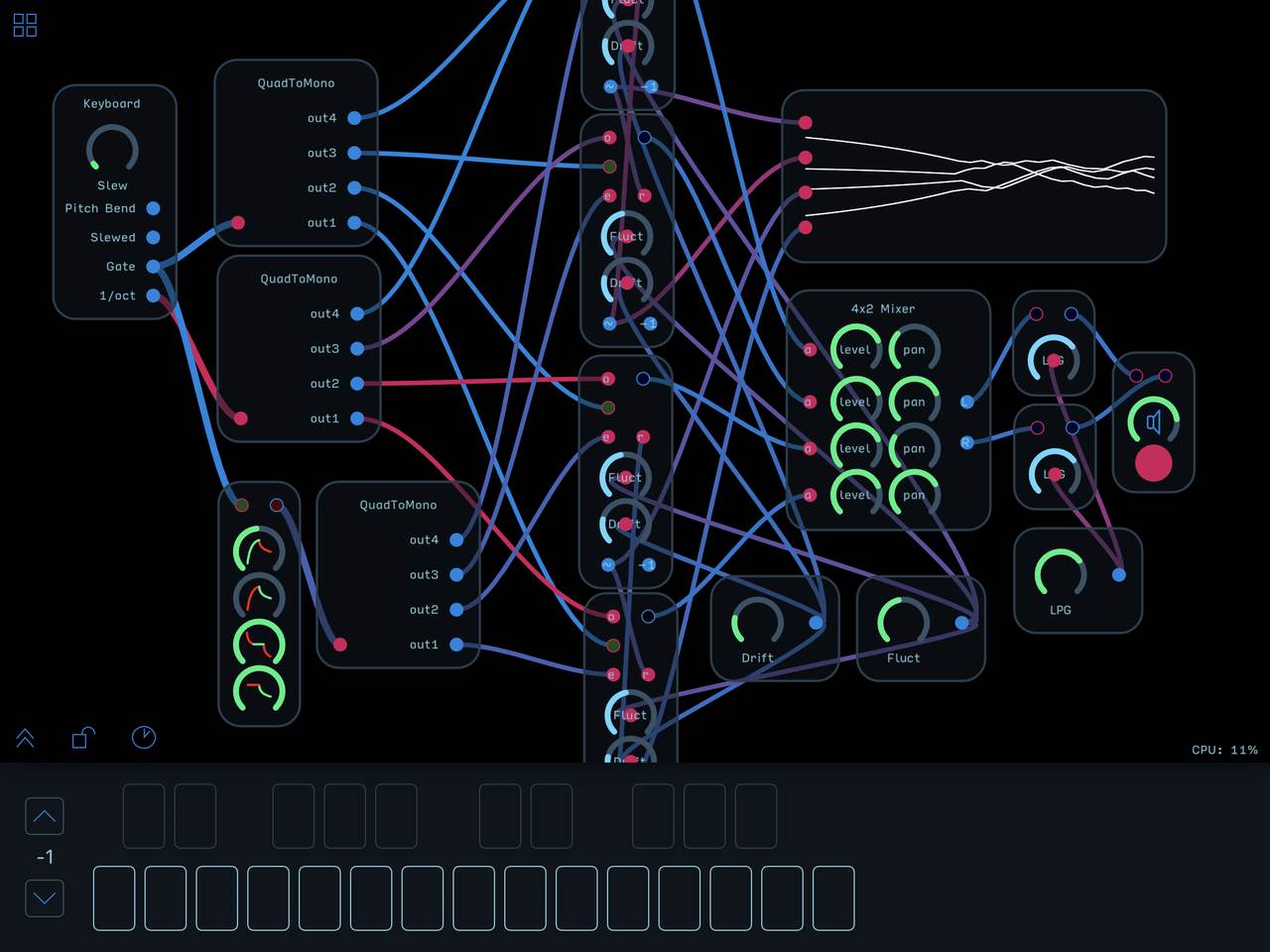
A few days ago I started experimenting with using Mark Boyd’s 1D Chaos Module to generate small pitch fluctuations. However, since Audulus very conveniently takes care of polyphony behind the scenes, I realized that fluctuations applied to a held chord, for example, would effect all the notes in parallel. I started experimenting a little with splitting the incoming notes into individual voices, each with their own pitch and amplitude fluctuations. There are still some things to figured out with the envelopes, but it’s a start – fun for creating sustained drone-like textures along the lines of the Hyve.
Modular Diary – 100

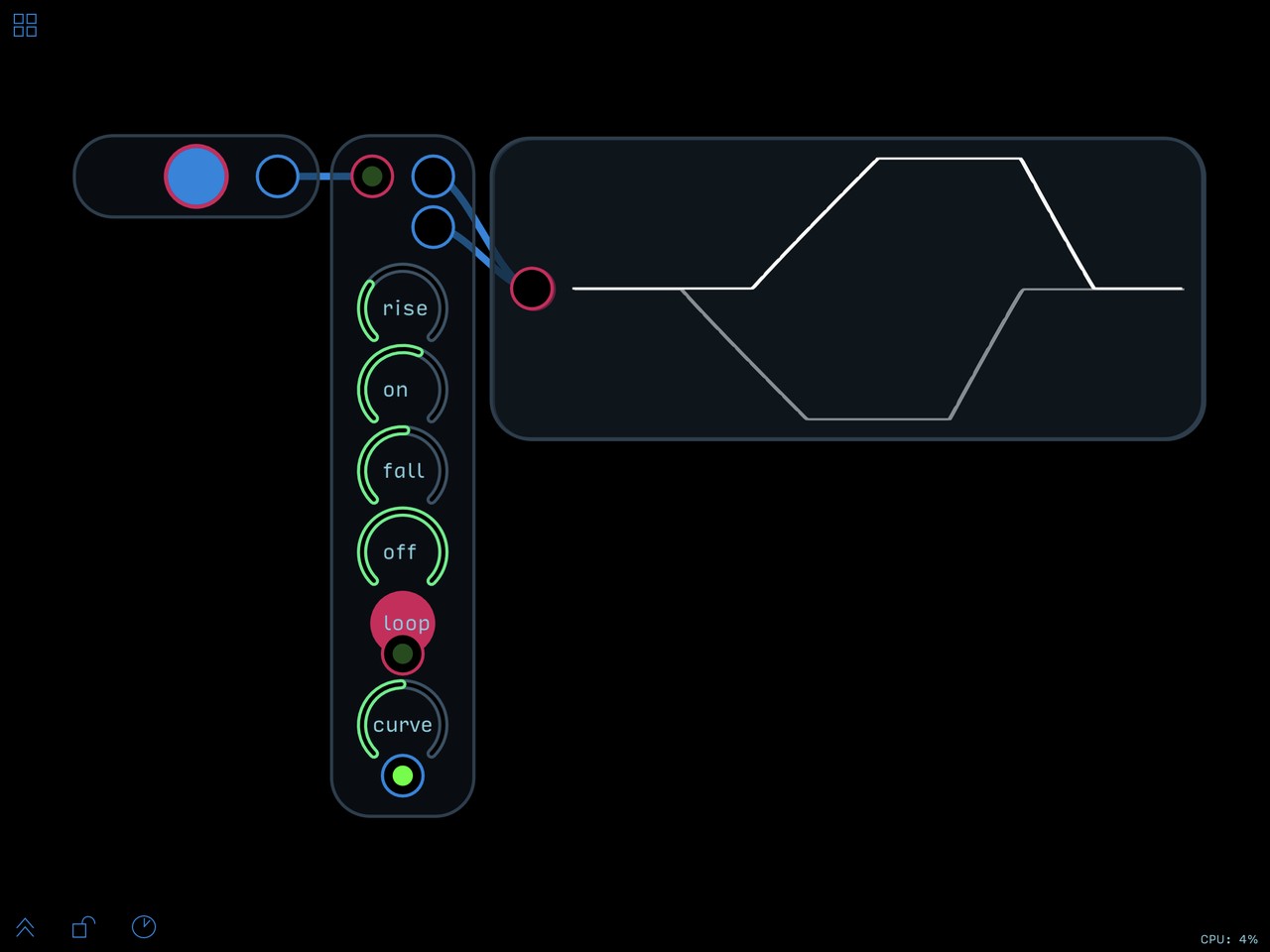
A few days ago I mentioned coming across a short video demonstrating the unusual Dual Envelope Generator of the EMS Synthi 100. RobertSyrett has since posted his Audulus version of the Synthi Trapezoid Envelope (with curve controls for the rise and fall), and that provided the basis for putting together a version of the Synthi 100 Dual Envelope. As described in the manual, one of the main features is the staggered outputs:

In addition, there is a second output which lags behind the first one by one quarter of a complete trapezoid cycle. Thus the time set for, say ‘on’ in respect of output 1, becomes the attack from output 2, and so on.

I’ve included an external output for the ‘on’ of envelope 1, which I imagine could be used to trigger a second dual envelope module, and so on…

Modular Diary – 101

And so I’ve come to the end of the Modular Diary as a 100 Day Project. It’s the third 100 Day Project that I’ve completed, and the one I’ve enjoyed the most. It seems somewhat strange to stop while still feeling very much in the middle of it, and I’m considering continuing posts under the Modular Diary heading, but following time and inclination rather than as a daily discipline.

I’ve collected it all in chronological order should one want to read through the process from the beginning. Looking back at some of the first posts I’m struck by the distance travelled, and it might be worthwhile summing up some overarching thoughts in a blog post sometime soon. Audulus and all those contributing to the forum have certainly played a big part in all that I’ve learnt and I feel very fortunate to have had that available as a place to share and learn.

Modular Diary

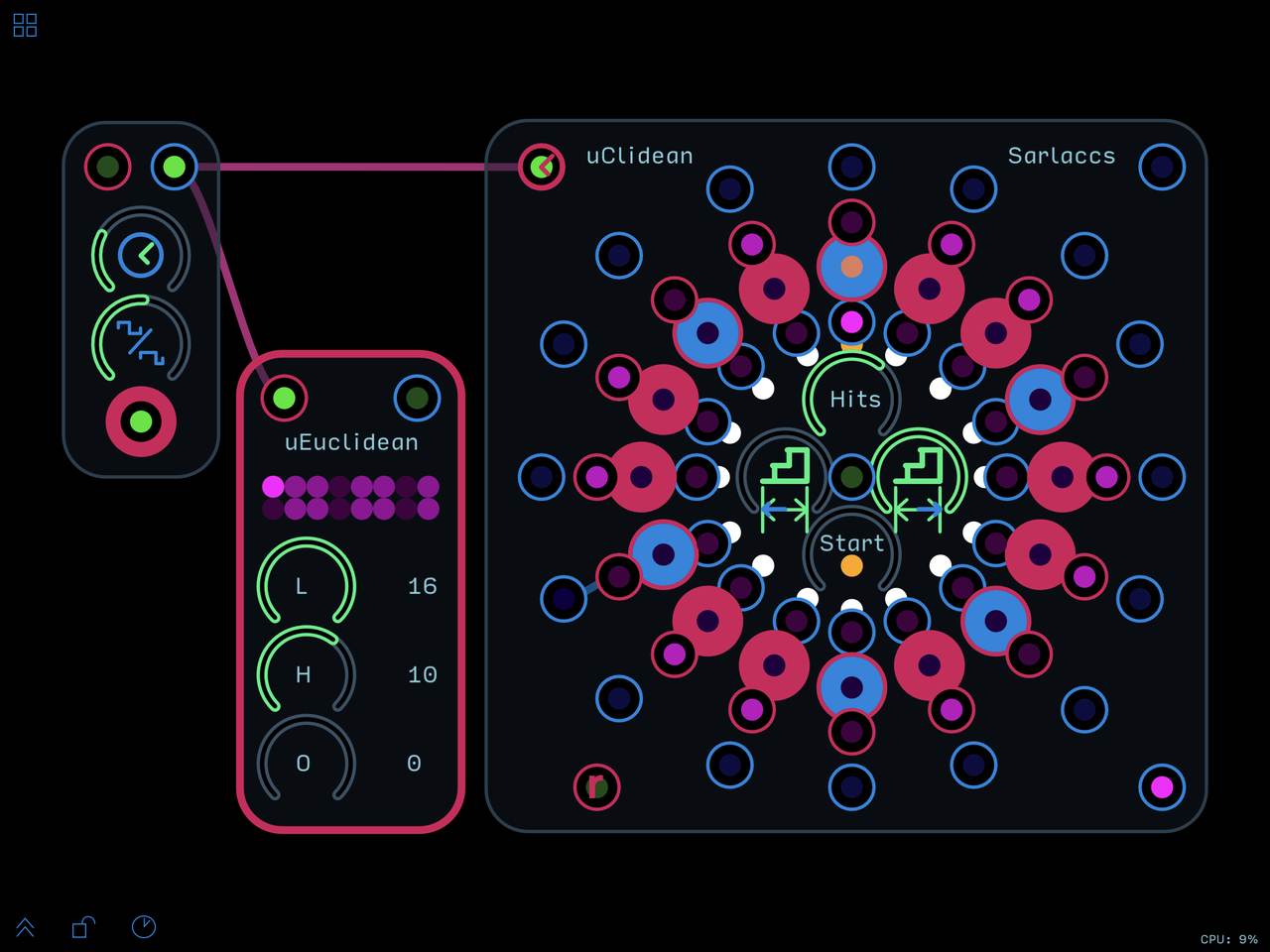
A few weeks ago RileyGuy posted his Audulus version of the Euclidean Circles Eurorack module, and ever since then I’ve been thinking that it would be nice to include a visualisation of the Euclidean distribution of beats within a cycle.

I started with an adaptation of the Euclidean sequencer in the Audulus library to include a visual display, and after experimenting with different (circular) layouts settled on two horizontal rows of 8 in a µModule version. The horizontal rows seem to read most easily, especially when selecting shorter cycle lengths.

RileyGuy has since expanded his uClidean Sarlaccs module into a deluxe version that includes on and off-beat (gateable) outputs. I simply added a set of Euclidean distribution indicator lights to the circle of gate inputs and included an extra ‘hits’ knob in the center. The length is calculated from the start and end steps, and the offset determined by the start position. A (green) output in the very center provides the Euclidean output, with the idea that the other gate outputs can be selected manually using the lights as a guide.

Modular Diary

I came across Analogue Research’s Artificial Neural Network Eurorack module last year, and have been wanting to re-create some of the submodules in Audulus ever since. The Audulus Library already includes modules for the standard logic gates, but there was something in the addition of thresholds to the Boolean on or off that intrigued me: ARC provides a nice explanation, in both their video and manual, of the biological model on which the Threshold Logic Neuron is based.

As DivKid covers in the final section of his video on the Joranalogue Compare 2 dual window comparator, there’s a lot of fun to be had in the combination of knobs and logic. Mylar Melodies too has some thoughts on Why Logic Modules are Ace!

Robert Syrett orginally posted the DivKid video on the Audulus forum in connection with the uWindow module he based on the Compare 2, and, since it’s a little different to the comparator, I thought it also would be worthwhile to go through the steps of putting together a Schmitt Trigger.

I’ve posted my versions of the ANN submodules on the Audulus forum along with some demos.

Modular Diary

…what a Schmitt trigger does is it takes a kind of wavy analog signal and turns it into a sharp digital signal
—@TomWhitwell On The History Of Synthesizers

Since piecing together a Schmitt Trigger in Audulus yesterday it’s been interesting to read a little about the various ways in which the basic idea can be implemented. Upper and lower threshold triggers combined with a sample and hold seemed to be the simplest way to go with Audulus, but the Wikipedia article also covers the many ways in which it might be implemented with analogue components.

As with the ARC Threshold Logic Neuron it’s interesting to look at the history of its development and origins in the study of biological processes. Tom Whitwell, in his talk On The History Of Synthesizers, assigns this humble device a central role in the development of not just electronic music, but electronics in general.

Modular Diary

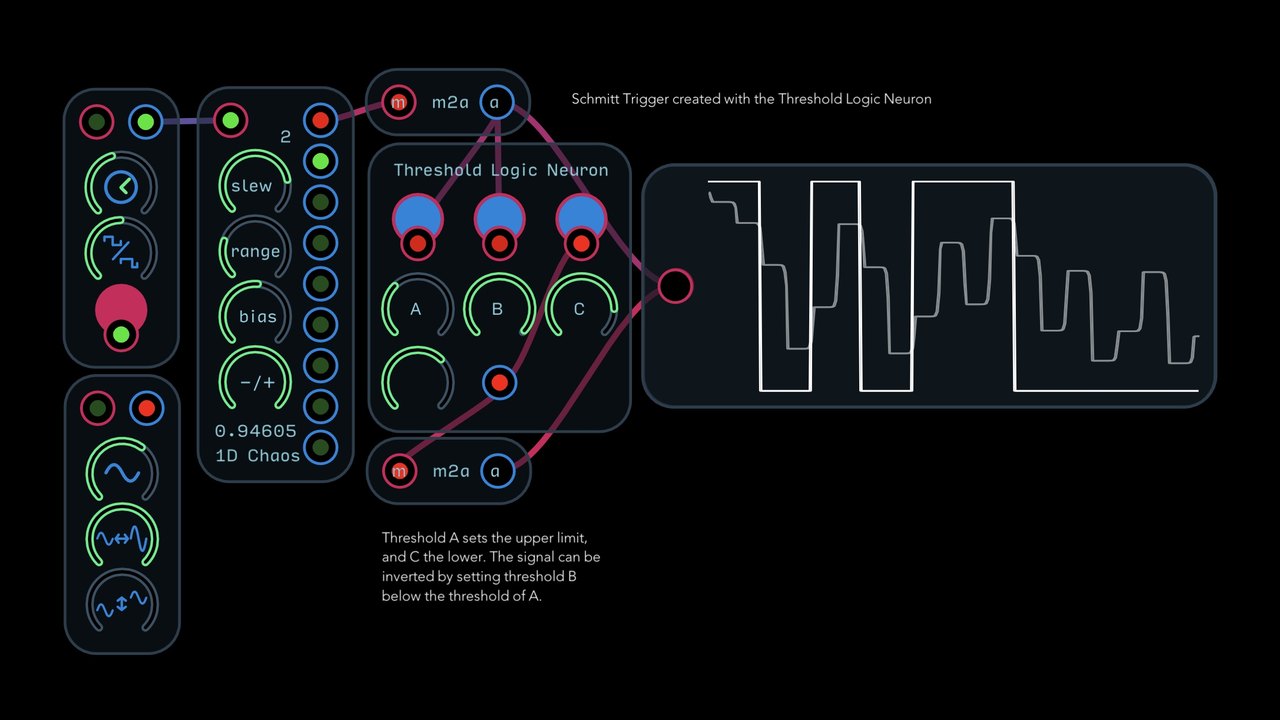
A further detail on Schmitt triggers: Reading in the Wikipedia article that “a Schmitt trigger can be converted into a latch and a latch can be converted into a Schmitt trigger” made me realize that the ARC Threshold Logic Neuron could be used as a Schmitt trigger. The ‘single-bit’ configuration allows for the threshold and memory properties to be incorporated in one element, as in some of the analogue circuits, rather than separating them into distinct elements as with a flip-flop or sample and hold.

I put together a little example in Audulus.