Modular Diary – 015

It seems to me that a large part of the increase in activity on the Audulus forum during the last half year has been due to recreations of hardware modules/instruments. The hardware models seem to provide a useful grounding – something to kick against in the open space of the software platform. In the absence of owning any hardware syths at the moment I’ve also found the fixity of app recreations – the Moog, Ripplemaker and VCS3 apps that I’ve looked at, a useful counterpart to the openess of instruments/devices created in Audulus. I do keep coming back to Audulus though – it still ends up being the place to get on with some real building after diving into the behaviour of the other apps.

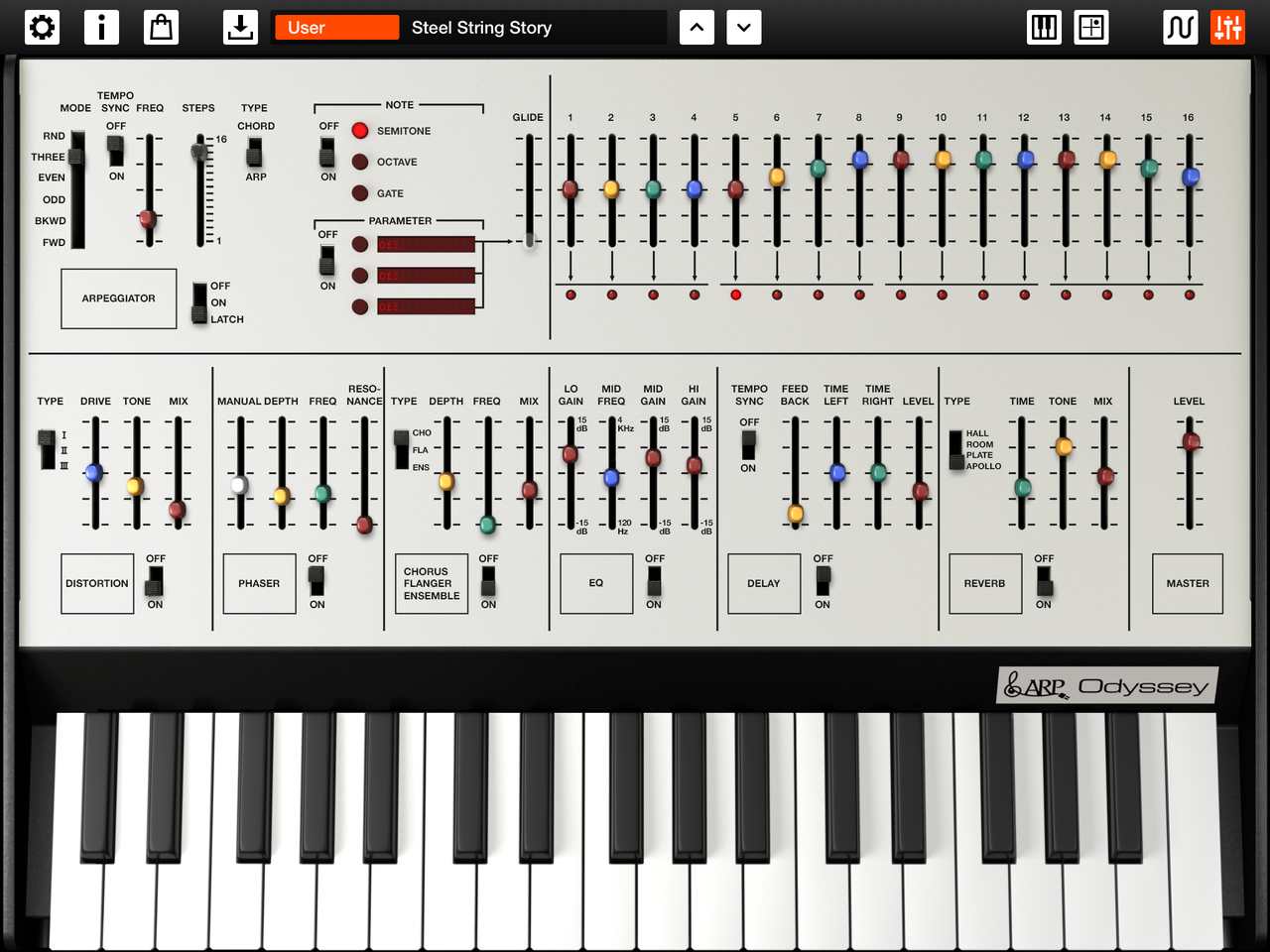
A few weeks ago I had the Korg 2015 version of the ARP Odyssey under my fingers on a visit to a music shop, and now the Korg ODYSSEi also has it’s place on my iPad. While not exactly a modular synthesizer it has a wealth of routing options that make it extremely flexible, while at the same time practical to use as an instrument. GForce have created their own software version of it – the Oddity – and also provide a wonderful introduction to the original as part of their synth archive. As they mention in the video this can be a bit of an in-your-face punk instrument. The opposite of the distant spaciness of the (i)VCS3.

The iPad ODDYSEi sounds great, and especially with the white Rev. 1 face is a visual pleasure as well. The fader interface design1 (there are no knobs on this synth) seems well suited to an iPad touch-screen. I was delighted to find that the analogue tuning has been modelled as well. One can shift between pure equal temperament and the analogue version if it and clearly hear the differences. Richard D. James talks about layering similar differences between equal temperament and the analogue tuning of the Roland SH101 in his interview with Tatsuya Takahashi.


  1. With handy tooltips too. ↩

Modular Diary – 016

The ARP Odyssey marks is an interesting point in the development of sythesizers with some of the flexibility of the modular systems it grew out of and the fixity of a portable performance instrument that became the norm. I’ve been thinking about the development of synthesizers over the years – the gradual change from modular systems that lent themselves to ever-evolving textures to banks of presets and large libraries of relatively short sounds. The Art + Music + Technology episode with E-Mu’s Dave Rossum provides a good example of this arc – and the spiral back to the beginning that we’ve now reached.

Benge’s 20 Systems presents 20 pieces of music created with 20 different synthesizers, one from each year between 1968 and 1988. Starting with the Moog Modular 1968, moving through ARP, Serge, Roland, Oberheim, and Yamaha in the 70s, and ending with the Fairlight and Synclavier, amongst others, in the 80s. I was thrilled to receive the CD as a gift when it first came out nearly a decade ago, feeling that it nicely mirrored the first 20 years of my own life. It too provides a good trace – a journey in sound of the arc from evolving textures to precise presets.1


  1. See also Junkie XL’s historical overviews of his classic synth collection. ↩

Modular Diary – 017

The interesting thing with modular systems is that things can be fed back into themselves. The O-Coast Krell that got me started with all of this is a good example. The generative aspect puts one in a very different position from the prog rock ‘keyboard wizard’ of the 70s. The person ‘playing’ the modular is potentially both listener and performer.1

Oscillators and filters can be feedback loops within themselves – which can then be connected together to form larger systems in which everything feeds back into everything else. Cicuits such as Rob Hordijk’s Rungler, Benjolin and Blippoo Box embrace the chaotic behaviour that can arise, with the player more in the role of steering the direction of the sound than using it as a form of ‘expression’.

Nicky Case recently presented a wonderful talk at The Long Now Foundation: Seeing Whole Systems. He visualises differences between linear cause and effect thinking, and complex systems in which everything influences everything else, covering examples from nature and social constellations to health and economics. He suggests some tools (and has also written games and apps) that might help us learn how to steer and play the chaos.

And that’s exactly what a lot of modular people are doing.


  1. See Walker Farrell’s thoughts on his own back and forth bewteen generative systems and improvisational input in the Cycling 74 interview with Zeos Greene. ↩

Modular Diary – 018

In the liner notes to 20 Sytems Benge explains his initial aim of ‘letting the instruments speak for themselves’:

The original idea for 20 systems was to set these machines running and hear what they could do with no personal input at all. But none of these machines are capable of working on their own: a certain amount of input has been necessary to create something musical with them.

The balance between setting up generative situations and interacting with them.

Each track on 20 Systems was intended as a presentation of the ‘pure sound of the individual instrument’. Benge has since embarked on a series of albums each focussed
on a single synthesizer system. I’ve been listening to two of them lately, at first enjoying the clean abstraction of Abstraxa, created using the Buchla Electronic Music Box, and now slowly coming to consider the two long Serge tracks of Forms 6 – Works on Paper to be something of a masterpiece.

Modular Diary – 019

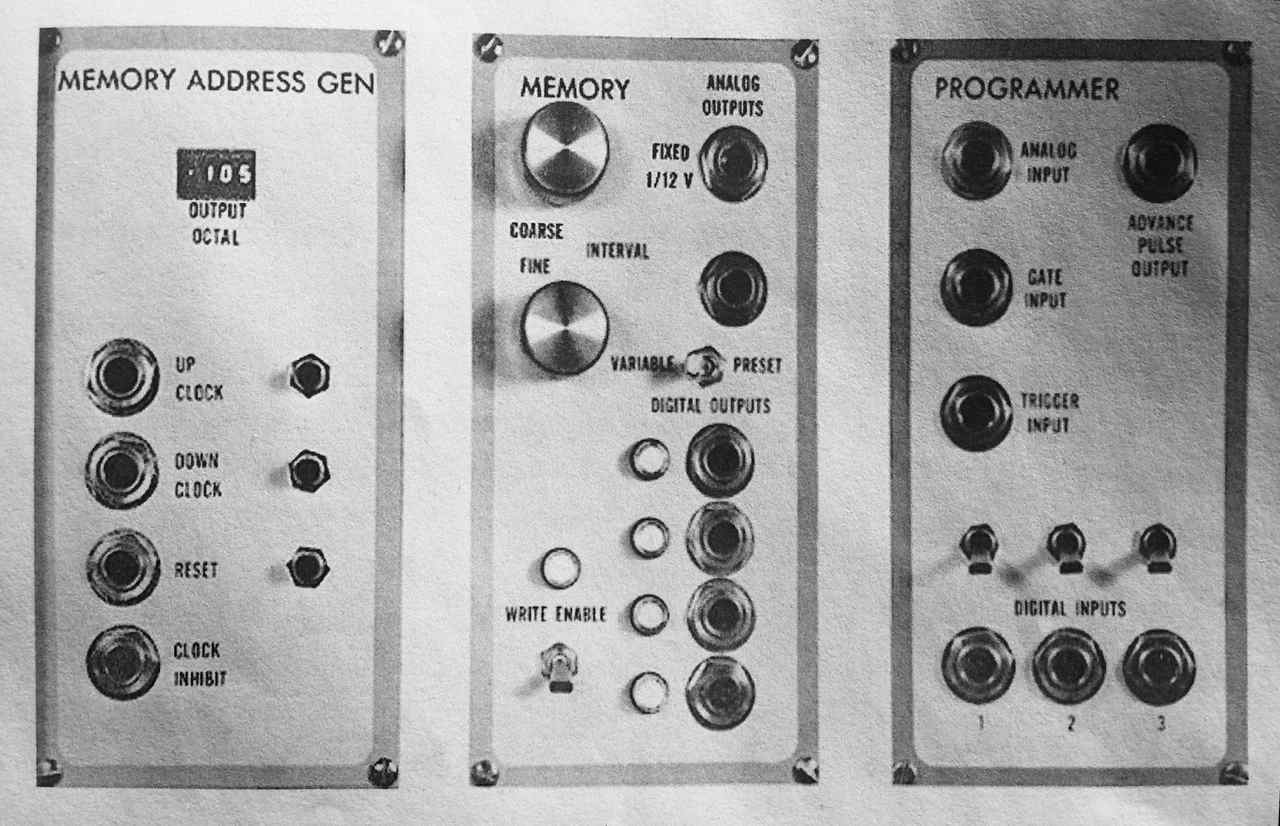
As I mentioned a few days ago I was intrigued to find out about the the EM-u modular sequencer on Darwin Grosse’s Art + Music + Technology podcast, but had a hard time finding more information on it. Digging through Benge’s blog I discovered that he too had difficulties gathering information on the workings of this device. I also came across the picture above, some more videos, and an entry with a detailed explanation of setting up a 32 step sequence on it.

Modular Diary – 020

I was watching a video of Lars Lundehave Hansen’s Lunar Eclipse and got to thinking of mechanical sequencers (to take a step even further back than the analogue ones). I seem to remember seeing a post about someone constructing an electro-mechanical sequencer with control voltages so that it could be used in a modular set-up. I unfortunately haven’t been able to find my way back to that post, but remember it as being based on a circular switch similar to the one found on the 1959 Wurlitzer Side Man. It also go me thinking of the Polyphons that inspired the sound-sculpture that Ida Raselli presented in a recent Frankenstein’s Lab. Finnish sound artist Martin Bircher used a similiar Symphonion as the basis for a hand-cranked MIDI sequencer.

In a way it’s surprising that circular forms aren’t more common in sequencer design. There’s the Buchla 250e (that Benge used in his tour of sequencing modular systems) or iOS apps like Patterning or dot Melody. I can’t think of much else.

Modular Diary – 021

I‘ve been taking a look at putting together a quantizer for custom tunings in Audulus – there’s been a little activity on that front in the forum. I have in mind something that builds on the small ratio modules that I was using to tune a sequencer in a previous post. Something very flexible that can be changed on the fly with the possibility of additional ‘hand-tuned’ deviations from the basic ratios. A kind of hybrid between systematic and empirical tuning.

Since it’s taking me a little time to figure it all out here’s a little experiment with changing the tuning on the ARP ODYSSEi from Equal to Analog while running a simple sequence. The deviations are subtle but nevertheless quite noticeable (often a little flat in relation to equal temperament) – at some point it could be interesting to measure them precisely and put together a little list that could be used in other contexts.1

Here’s the unadorned sequence – two cycles in equal temperament followed by two with the analogue tuning:

ARP Equal Analogue

And a longer jam trying out the analogue tuning at different transpositions as well as playing with the length of the sequence.

ARP ODYSSEi Analogue Sequence

  1. See, again the Richard D. James interview with Tatsuja Takahashi. ↩