Modular Diary – 085

Robert Syrett suggested making some Halloween patches on the Audulus forum and I’d hoped to make a little patch with some typical ghostly sweeps based on Rob Hordijk’s fluctuation modulation. I unfortunately didn’t find the time, but did manage a quick µFluct module.

STS on the other hand has built a full-blown Halloween soundscape around his newly created Harmonium and µTuring modules.

Modular Diary – 086

Following on STS’ Harmonium, jjthrash, creator of an Audulus Game of Life, has posted a Hymnotron. It’s based on the Dewanatron Hymnotron, which is basically an ingenious instrument for playing justly intoned chords. Taking a look at some of the other instruments the Dewans have built is a little like coming across the Ciat-Lonbard instruments for the first time. They certainly present a very specific (beautifully handcrafted) world of their own. They received some attention a few years back with articles in The New Yorker and New York Times (and a nice portrait on Rhizome) after Trent Reznor of Nine Inch Nails used their Swarmatron on the soundtrack for The Social Network.

The technique of stacking sine tones (and in the case of the Hymnotron adding harmonics through a process of wavefolding) reminded me of the Telharmonium, which I’d come across while taking a look at the Make Noise tELHARMONIC, and the still somewhat unusual appearance of triadic harmony in the modular world.

Modular Diary – 087

Richard D. James on tuning and drift in his interview with Tatsuya Takahashi:

RDJ: …I guess some people like their Osc’s drifty and others not so. It changes with the context I guess. Also, if you’re doing FM you might want to keep them dead on, and for analogue lead sounds, really drifty. Anyway I think I mentioned it before, but the drift on the monologue sounds REALLY nice. It seems to move, but then never go out… Sounds to me like it gets reset/synced at some point…

TT: That’s bang on! So same thing in the minilogue and the volcas too: the oscillators are re-tuned when they’re not being used.

Mark Boyd (biminiroad) has posted a few patches on the Audulus forum exploring different approaches to simulating oscillator drift and detuning. His Drifting Gateable Quantizer doesn’t drift so much as introduce small pitch deviations that can be dialed in post-quantizer to get a pseudo micro-detuning effect. Simple (and light on CPU) but effective.

His Drift VCO takes a more complex approach: When the oscillator frequency is below 1000Hz, an adjustable amount of FM feedback (also scaled by the pitch) is sent to the oscillator’s input, and since the lower frequencies have more feedback, they are also more out of tune. Above 1000Hz (roughly two octaves above middle C) a slow sine LFO modulates the pitch in order to avoid FM noise. I’ve been taking a look at the patch and wondering how best to introduce something similar – a reset when there’s a pause in activity.

It’s interesting that now that we have the possibility of perfectly tuned oscillators we yearn for the beauty of slight imperfections. Certain of Jerobeam Fenderson’s visualizations in his oscilloscope tutorial come to mind – the spinning (around 5 mins into the video) introduced by an overtone having a slightly imperfect ratio, for example.
Modular Diary – 088

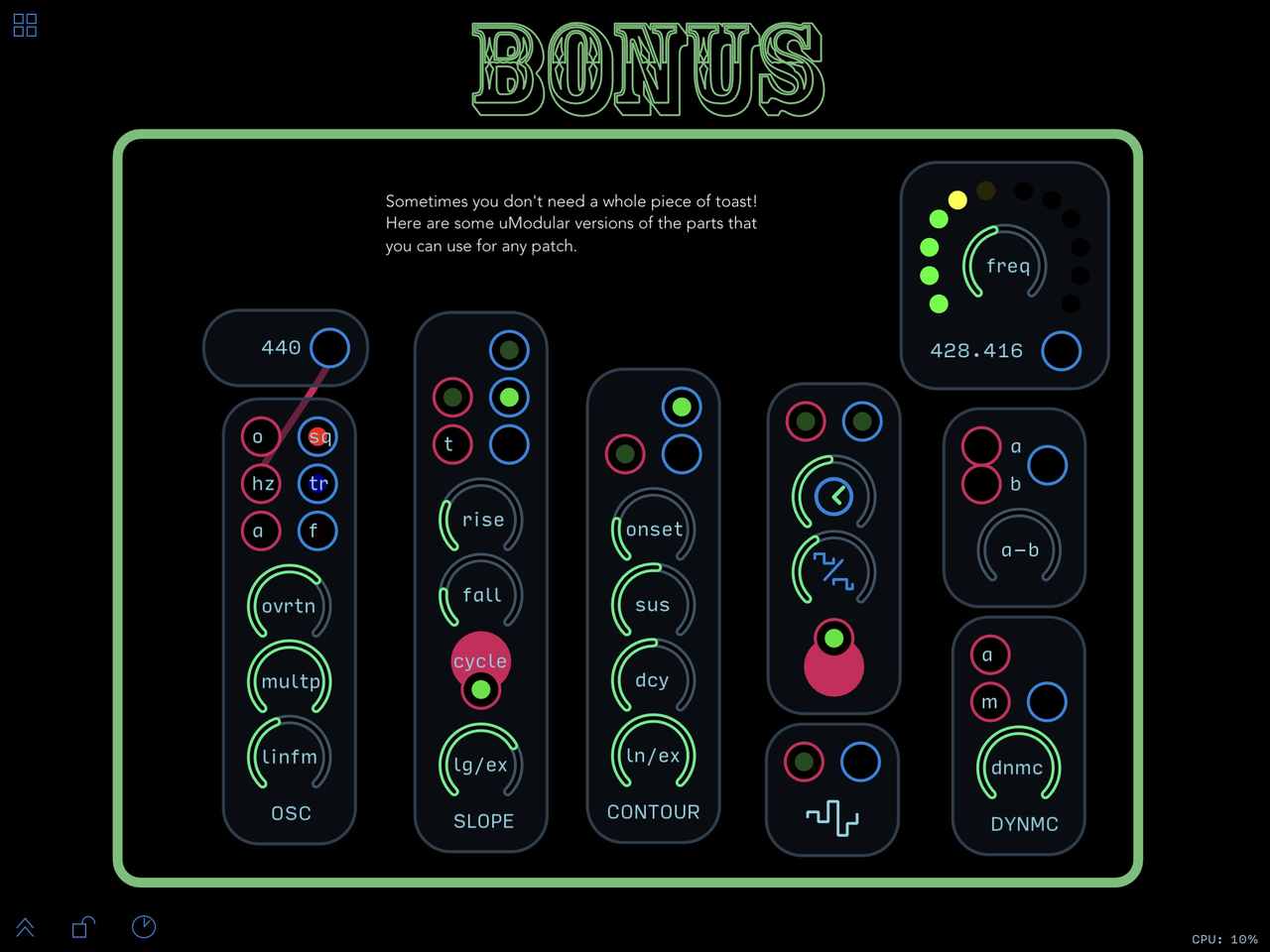
Robert Syrett has posted an updated version of the O-Toast, his Audulus clone of the Make Noise O-Coast. An attempt to make a version both more CPU efficient and closer in sound to O-Coast, as well as reflect his growth in understanding how to design things like looping function generators.

Along with the new 1-Toast, he’s also included µModular versions of the basic O-Coast building blocks, something that I think makes a lot of sense in the Audulus context. As he points out, there are also certain bits (such as the attenuverter) that are better out of the box – elements that benefit from being copied and used in multiple places.

Treating the component parts as separate modules is also a direction that Make Noise have taken with expansions on O-Coast core elements in their Contour and Dynamix modules.

Modular Diary – 089

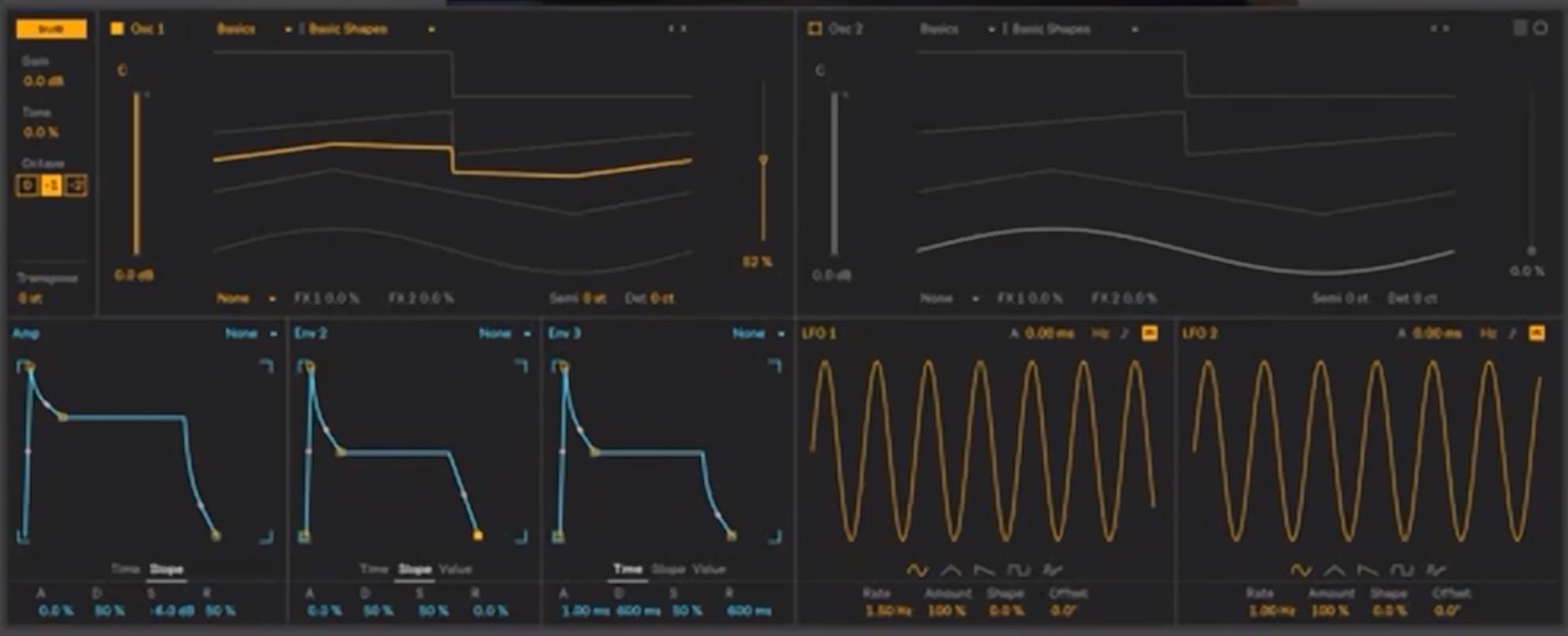
In its current state there’s no easy way to implement wavetables in Audulus, but taking a look at Brian Funk’s tutorial/walkthrough/exploration of the Wavetable synth that will be included in Ableton Live 10, I was struck by how much has been achieved in Audulus recently on the waveshaping front – a lot of it thanks to the interest and efforts of Robert Syrett. Making wavetable waveforms without using wavetables, as he puts it.

A detail that intrigued me with the Ableton Wavetable setup was the order of the basic oscillator waves as sine–triangle–sawtooth–square, with the phase of the sawtooth shifted 90 degrees to match the edge of the square instead of the peak of the triangle, as one might expect. In the Audulus morphing oscillator included in the µCollection the sawtooth comes last and shares the same phase as the other waves.1

Something to take a closer look at and experiment with.


  1. In the Curvature micro the square is placed last. ↩

Modular Diary – 090

As I mentioned yesterday I was intrigued by the placement of the sawtooth between the triangle and square waves in the new Ableton Wavetable synth, and I spent a little time today exploring the results of changing the order of the oscillator shapes in one of the Audulus µVCOs. In the case of crossfading between oscillators, that placement, along with shifting the phase of the sawtooth to match the edge of the square, results in the octave harmonic of the sawtooth appearing before the fundamental when shifting between the sawtooth and the square. With the Wavetable synth the interpolations don’t appear to be the same as would occur when fading between set waveforms and I guess this is what opened up the possibility of arranging them in that order. When simply crossfading between waveforms a (co)sine–triangle–square–sawtooth ordering with all the waves sharing the same phase provides the smoothest transitions.

While a change from sine to triangle is fairly subtle, the square and sawtooth waves are more tricky when attempting to morph smoothly between waveforms. It’s an issue that Jerobeam Fenderson touches on in the third of his Oscilloscope Music tutorials. He explains the discrepancy between perceived loudness and the actual amplitude of the waveform in terms of our not hearing positions, but rather changes in positions – referring to the explanation of DC-offset in his second tutorial. The discrepancy might also be explained in terms of the higher overtone content of the sawtooth and square waves and the increased sensitivity of our hearing in the ranges in which the overtones of mid to lower tones appear.

Modular Diary – 091

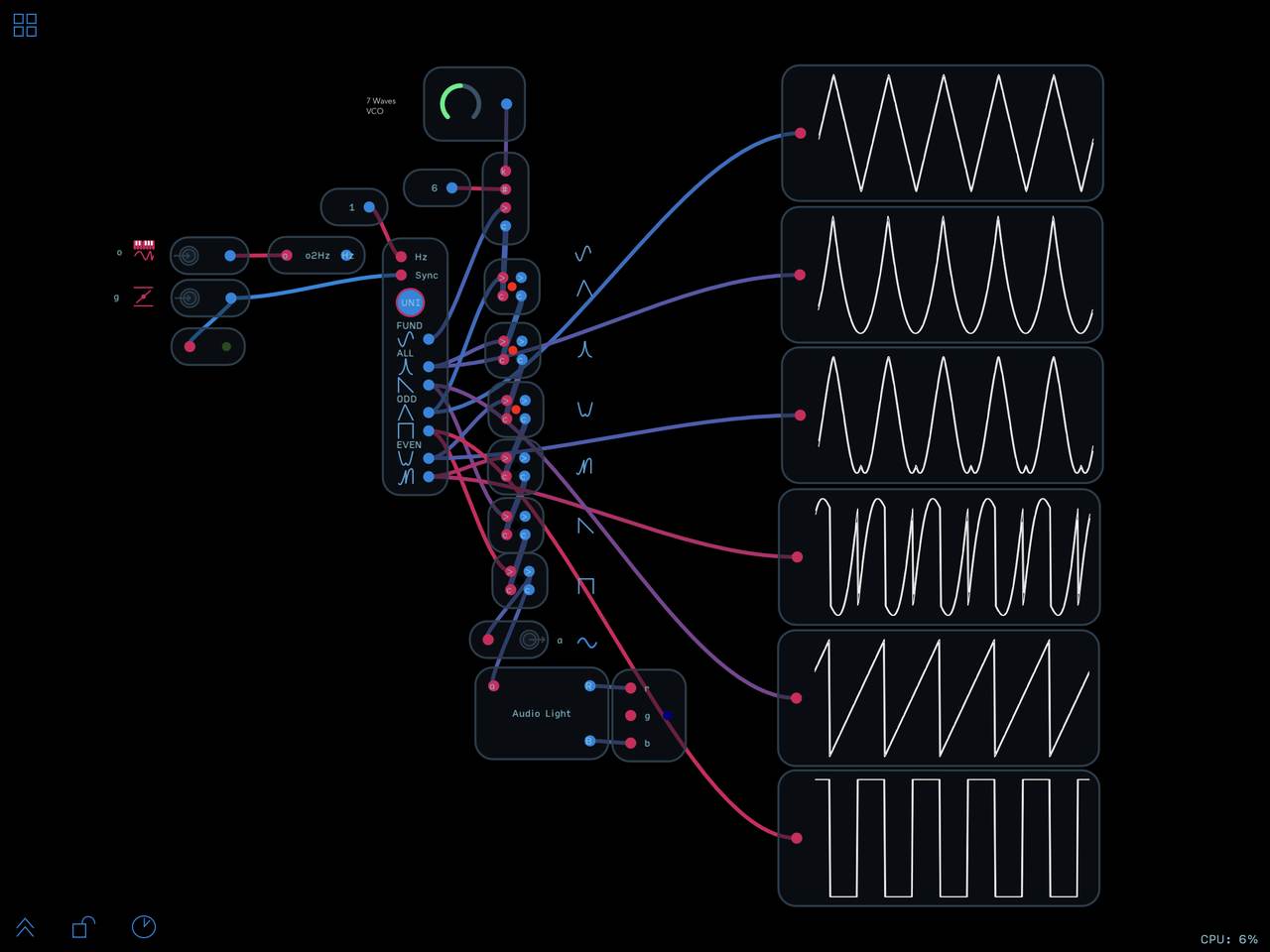
A little further down the waveform rabbit hole: I revisited Biminiroad’s morphing version of Robert Syrett’s 7 Waves VCO, and experimented a little with the order in which the waveforms are placed. Robert’s original setup had them organized in terms of all, odd, and even harmonics – with the inclusion of some new neighbouring waveforms invented by Don Tillman. I’ve rearranged them so as to provide the smoothest transitions – at least to my ears – when morphing between the waveforms. I‘ve placed the square wave last, not only because it provides better transitions for the sawtooth, but also because it does indeed (subjectively) seem to be louder, even though the sawtooth has greater overtone content. It seems that Jerobeam Fenderson was right in his explanation that it is the amount of (abrupt) change that catches our attention – the square has two vertical edges while the sawtooth only has one.