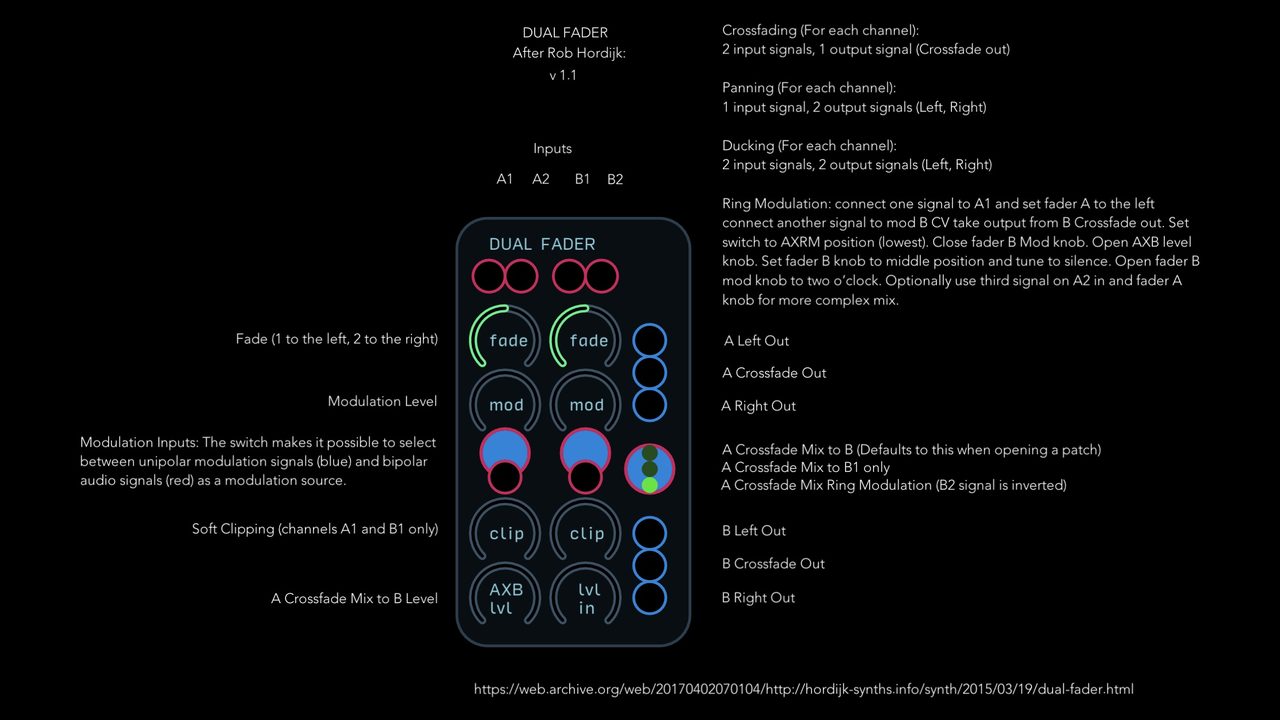
A few details on Rob Hordijk’s Dual Fader and my Audulusrecreation of it: Hordijk makes clever use of normalized inputs and outputs to achieve a wide range of possibilities with only a few inputs and outputs:
Crossfading: 2 input signals, 1 output signal
Panning: 1 input signal, 2 output signals
Ducking: 2 input signals, 2 output signals
Since normalized1 inputs and outputs aren’t (yet) a viable possibility in Audulus I’ve simply included an extra output for the crossfaded signals. Another feature of Hordijk’s module is a 20db Gain control on two of the inputs to enable using external signals within the modular system. That isn’t something that needs to be thought of within the Audulus context, but those controls can also be used to introduce clipping distortion, so I’ve kept that as a feature. 2
Hordijk also includes a switch that changes between the crossfade output of channel A being routed to:
Both inputs of channel B
Only input 1 of channel B
Both inputs of channel B, but with input 2 inverted. That means that when fader B is set precisely to its center, the two signals cancel each other out resulting in silence. However if that fader is modulated at audio rates a type of Ring Modulation is heard, with a particular quality that is the result of the RMS curves.
I’m impressed by Hordijk’s take on a simple mixing module, both the way in which distinctions between levels and placement are eased, and just how much can be gotten out of what is essentially two crossfaders – especially when modulation is introduced.
DualFader DemoDualFader Fadeaudio version of this post
Normalized connections are ‘behind the panel’ connections that don’t require patch cables. However should a cable be connected the hardwired connection is broken and the patch cable connection takes over. ↩
Soft clipping in my case, but that could be adjusted. ↩
My next stop while working my way though the treasure trove that is the NOVARS collection of Hordijk tutorials, has been his Harmonic Oscillator – a module I’ve been keen to take a closer look at for quite some time.
In the first of two videos he provides a general introduction to the basic idea of the oscillator – one in which the three classic parameters of sound synthesis: pitch, timbre, and amplitude, are all present, and all available for voltage control.
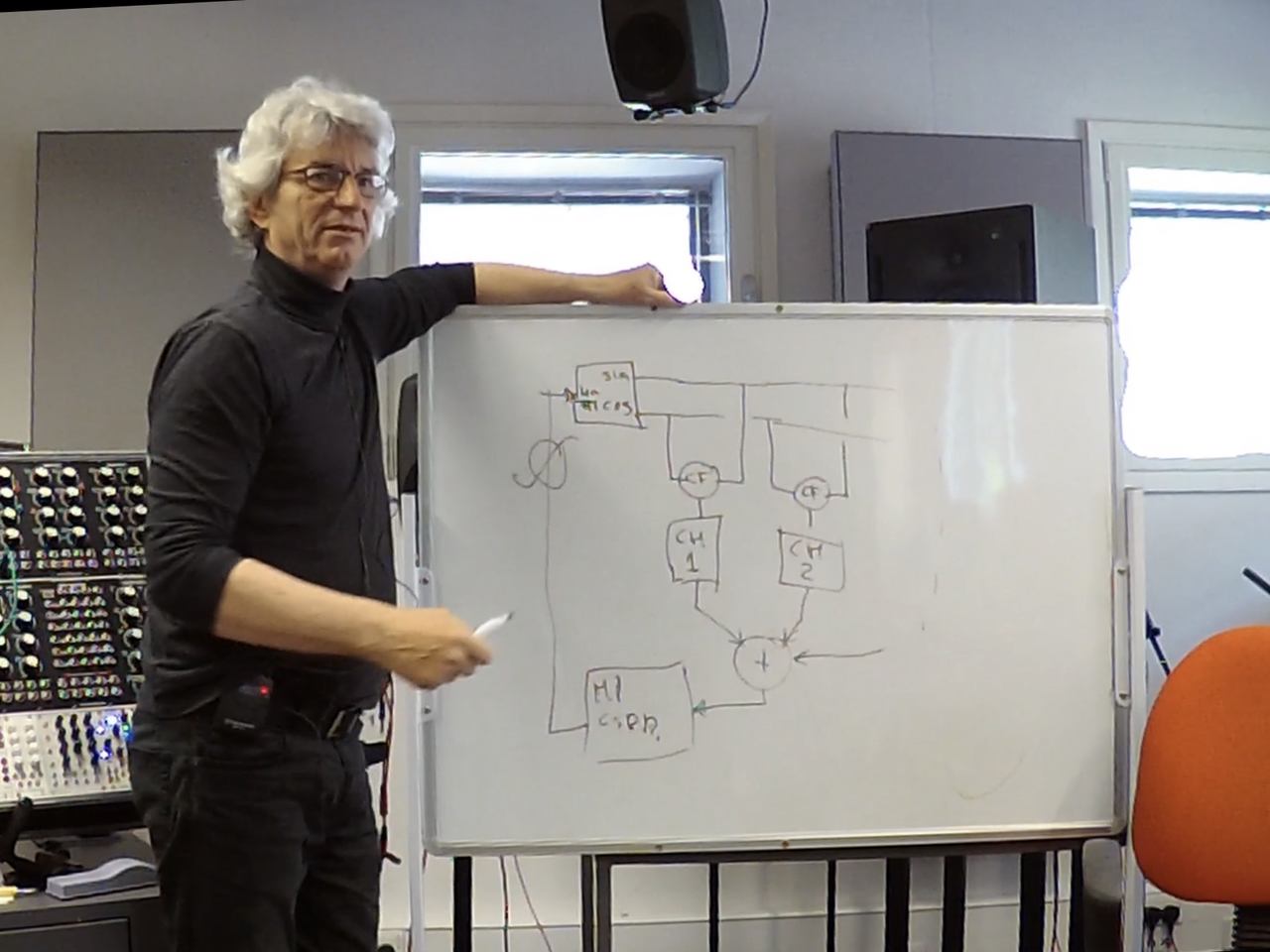
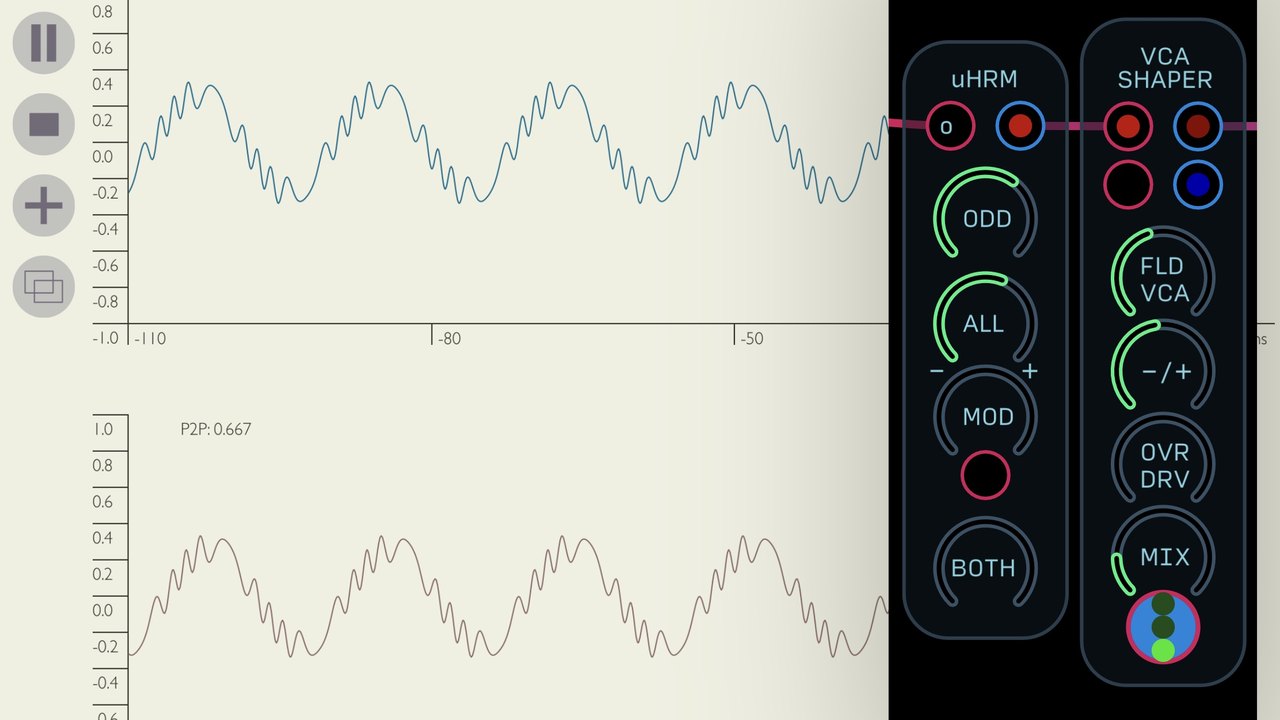
In the second video he takes a closer look at the algorithm that defines the oscillator: a sine/cosine oscillator that feeds back on itself via linear FM, creating a spectrum that contains all harmonics. A second spectrum containing only odd harmonics is created with a Chebyshev polynomial feeding back the pitch an octave higher. The combination of the two spectra creates pulse-width timbres.
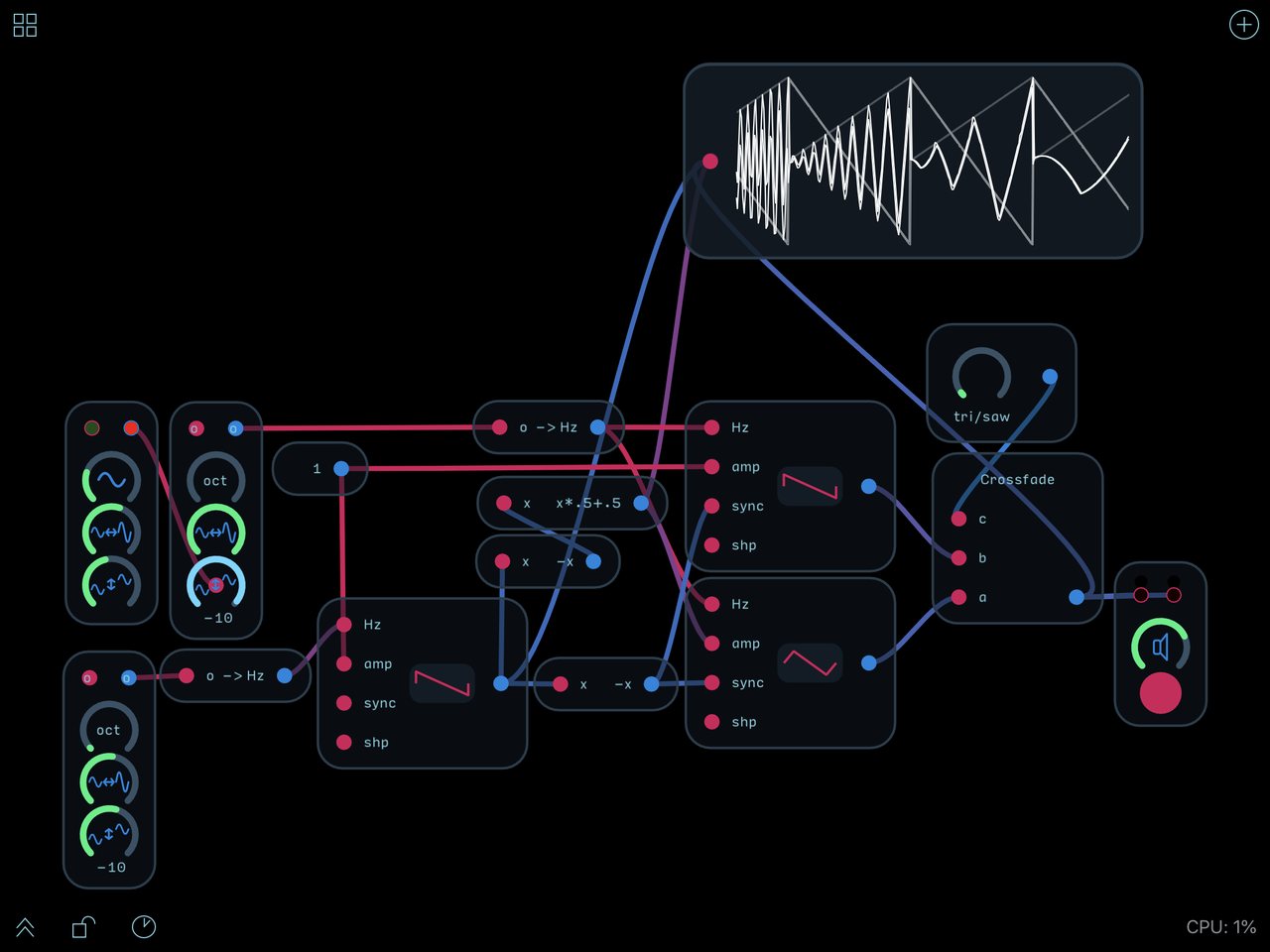
Despite Hordijk’s warnings on the difficulties of implementing his Harmonic Oscillator algorithm digitally, I was keen to try out some of the ideas in Audulus. One of the aspects of the feedback loop involves using a cosine waveform to avoid the DC offset that would occur when feeding the sine back on itself. In the Hordijk’s diagrams he indicates a crossfade between the sine and cosine signals as part of the feedback loop, but I kept on running into the pitch drop problem that he explains is a result of the DC offset.1 I eventually gave up on the linear FM route and decided to try implementing it with phase modulation instead – with some success.
The morph from sine to saw has a different character than making a crossfade between the two waveforms since the saw edge gradually tilts rather than appearing as an abrupt vertical,2 and the sawtooth and square waves also have a rounder edge than the characteristic forms of these waves. I haven’t been able to achieve quite the same sharpness in the shapes that Hordijk does with his analogue implementation (compare the waveforms at the beginning of the second video) since the phase modulation begins to distort, but the somewhat more mellow quality that results also has a charm of its own. 3
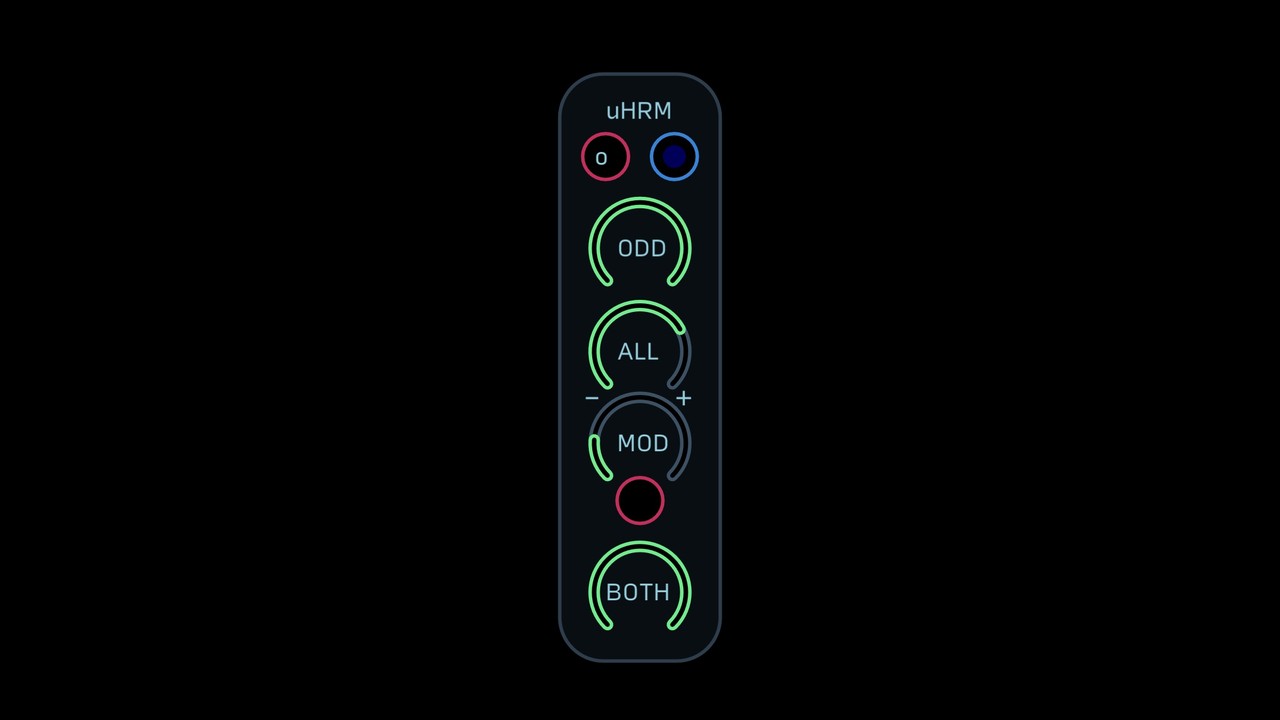
I’ve put it together as a simplified µModule, with the addition of a control that adjusts the level of both the odd and all spectra simultaneously in relation to the sine.
uRM Drone Demoaudio version of this post
There’s more from Hordijk on FM synthesis on the old Clavia Nord Modular website, fortunately still available via the Wayback Machine. ↩
I’m also curious as to why the inverted form of the waveform appears to be slightly lower in pitch. (In the case of this oscillator shifting the “All” knob in the positive direction results in what is commonly know as a reverse (or inverse) sawtooth. This is the default result of the pitch being fed back on itself.) ↩
It is possible to increase the definition of the square wave a little more than I have, but that results in distortion when combining the square and sawtooth spectra. ↩
The Physics of Sound video takes a look at phase shifting and All Pass Filters, and as a tryout I used the 1 Pole LPF in the Audulus library as a starting point for an APF with nice resonant qualities, and then used that as a point of departure for putting together a phaser along the lines of Hordijk’s Dual Phaser. He adds some nice touches such as a switch that flips the direction of half of the modulation input, or keeps half of it static while the other half moves, as well as a fader between the LP and Phaser modes.
I find the nicest thing is being able to push up resonance and then trigger the phaser with sub-audio pulses for some nice percussive sounds.
Robert Syrett briefly touched on the subject of Wavefolding in his recent Know your Nodes Audulus tutorial on Phase Modulation. He notes that even in the case of the carrier oscillator having a frequency (ratio) of zero, one can still obtain a result – the carrier can be used as a waveshaper.
Rob Hordijk takes a closer look at this fascinating topic in tutorial #18 of his series given at the NOVARS research centre. Using Robert Syrett’s Audulus Wavefolder as a starting point I set about recreating what I could glean from Hordijk’s tutorial video.
As usual, Hordijk takes care to think things through and combine elements in a way that takes it all to the next level. He cleverly adds a crossfader to the waveshaper so that one can easily adjust between the original signal and the folded one – something that can be especially effective when subjected to voltage control. The one side of the crossfader can furthermore be set to point to either the original signal, no signal at all, or the output of the VCA.
The VCA is, as far as I can gather, a bipolar VCA along the lines of the one in his Dual Fader. With an inverted signal equally present alongside the original the two signals cancel each other out – until one introduces some modulation. With modulation at audio rates the resulting ring modulation provides a nice counterpart to the harmonic content generated by the wavefolding.
The waveshaper also works nicely alongside the Harmonic Oscillator since the oscillator lacks the verticals of conventional sawtooth or square waves that don’t lend themselves well to wavefolding.1 Conversely the shaper can add a little more definition to the more rounded shapes of the Harmonic Oscillator, at least in my Audulus version of it.
I’ve been fascinated by the Rob Hordijk’s description (in the Sines and Squares masterclass video) of how one might think about sound in three dimensions (rather than the two we are used to on our screens) and how sine and cosine waves can be used to describe the phase and amplitude of a resulting wave, defining its waveshape over time.
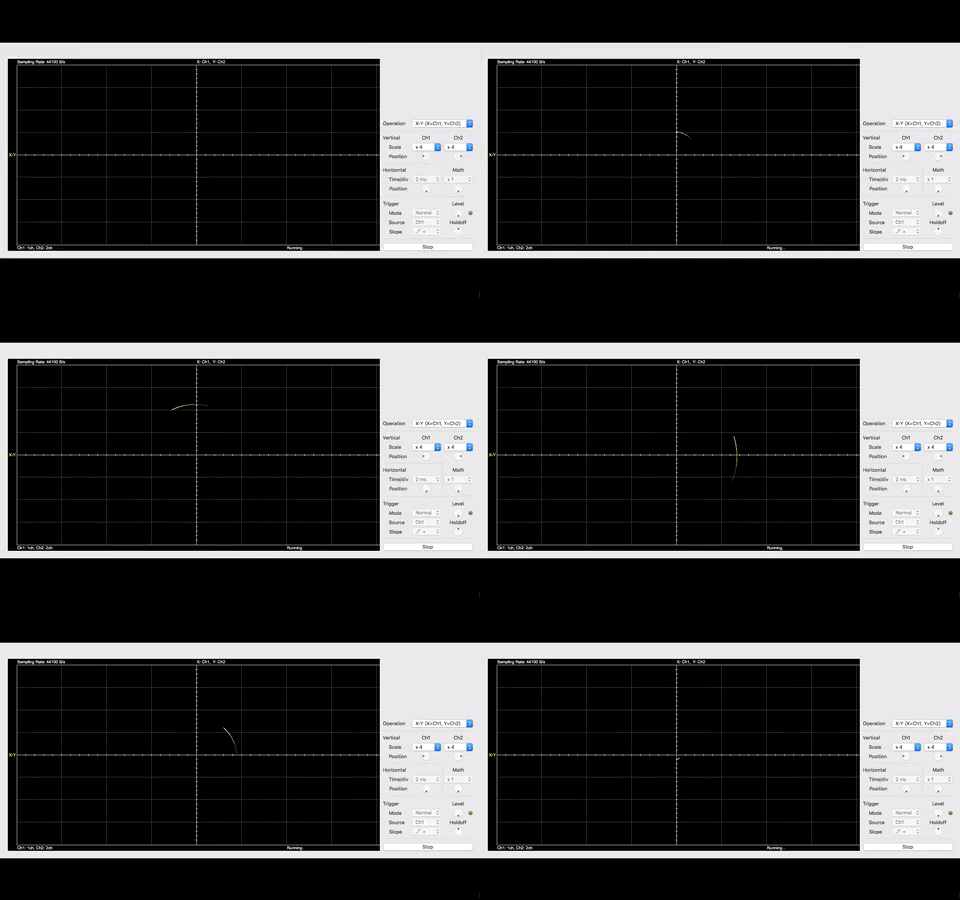
He describes it as a corkscrew waveform, also occurring in nature, with the phase describing its rotation, and the amplitude, distance. When viewed on an XY oscilloscope with a slow sine modulating the amplitude of the sine and cosine, it looks like a circle approaching from the distance and receding again. With very low frequencies one can view it as rotating points and get an even better idea of the ‘corkscrew’ effect.
This helps fill out some background on Hordijk’s thinking of sound in terms of depth – for example with his fluctuation waveform, in which amplitude and frequency modulation are combined to provide a special kind of vibrato. Based on a rounded triangle ‘parabol’ waveform, the larger the wave is, the lower the frequency – i.e the lower part of the frequency fluctuation corresponds to the higher part of the amplitude modulation. In his 2015 masterclass on Waveshaping & Fluctuation Hordijk describes this waveform (when modulated) as advancing and receding – giving a perspective effect.
I’ve uploaded a little demo patch (used to create the gif above) to the Audulus forum.
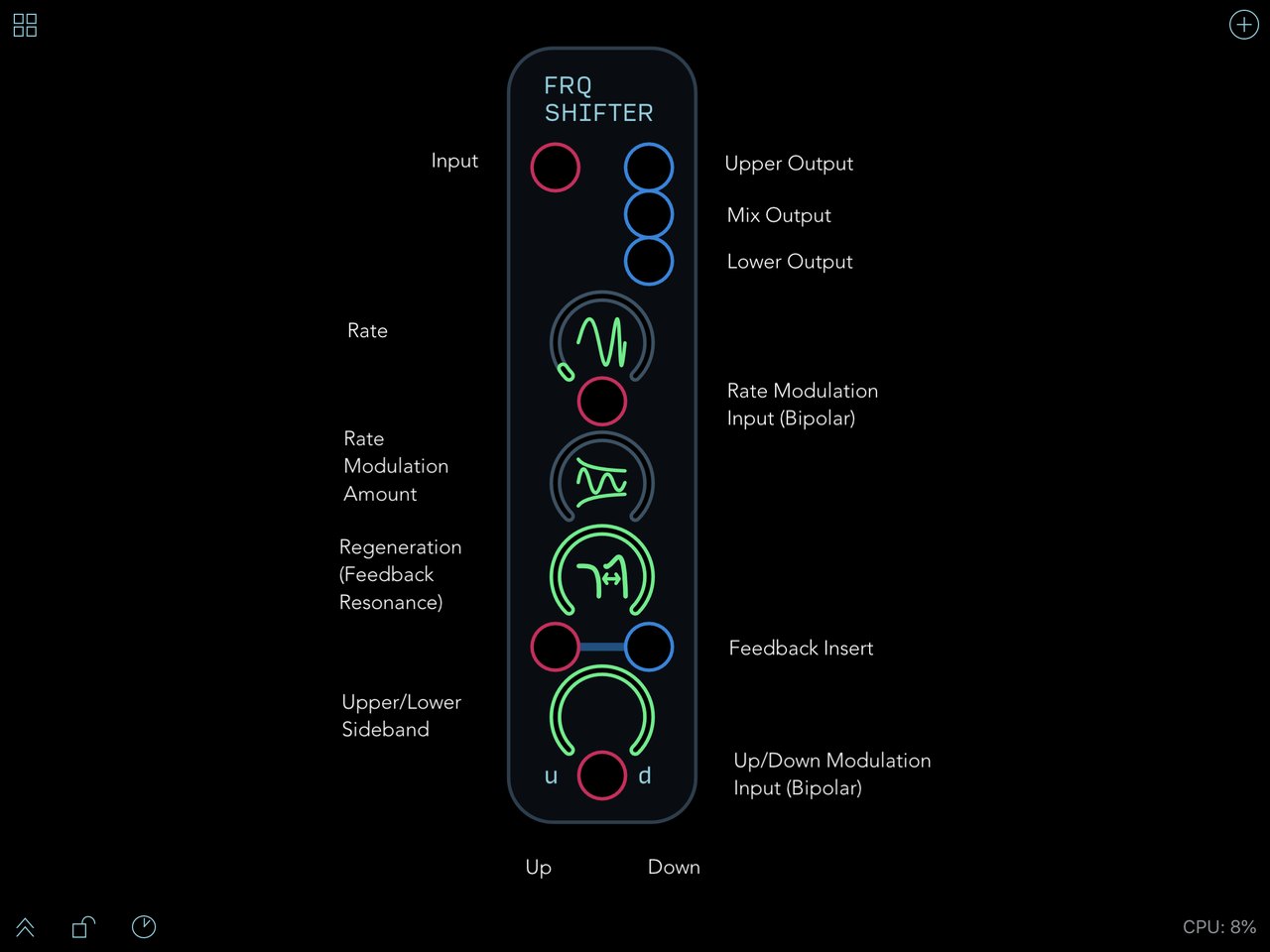
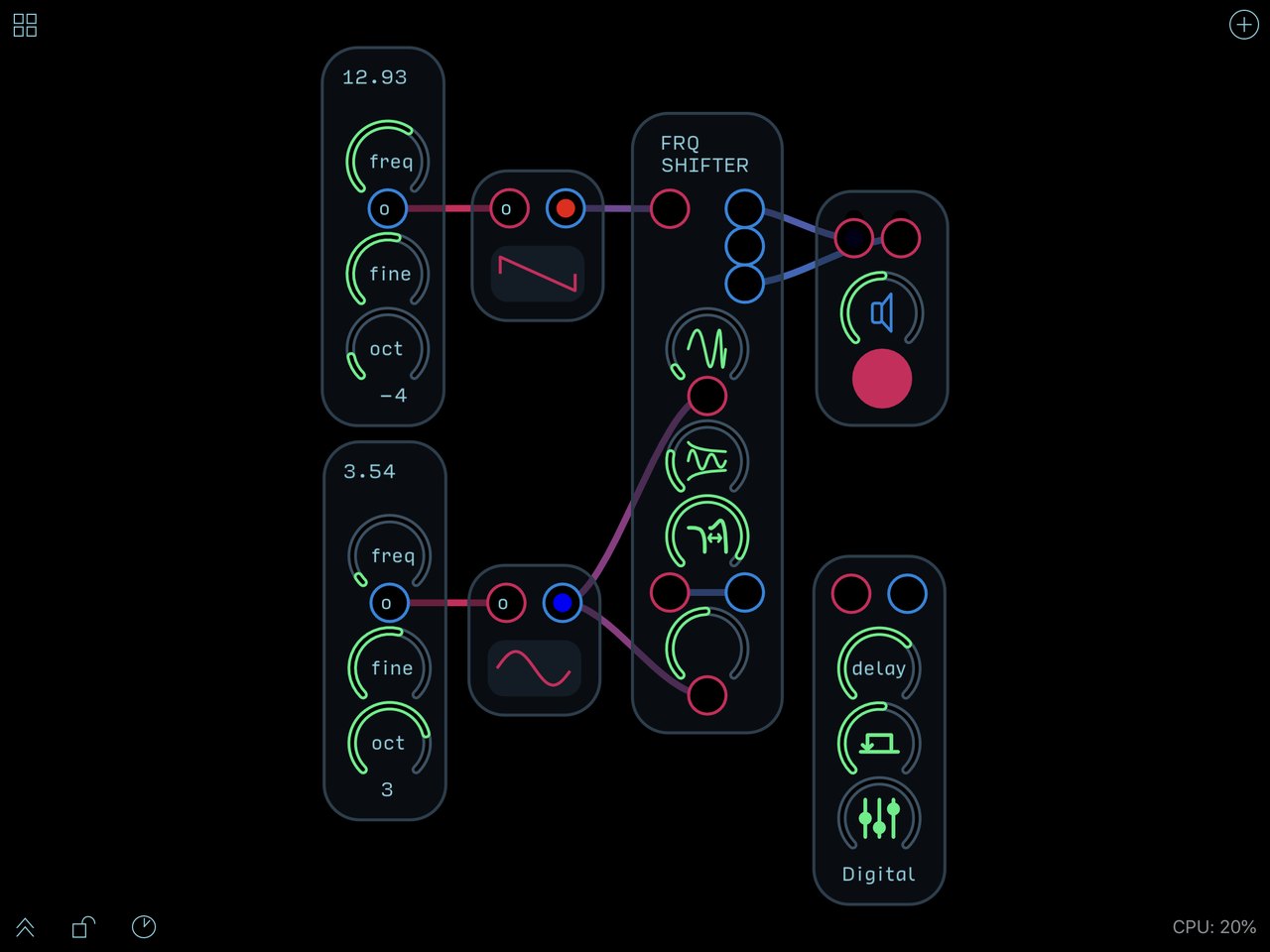
Here’s my first take at putting together a Frequency Shifter in Audulus. Once again, one of Rob Hordijk’s NOVARS tutorials has provided the inspiration and point of departure.
Hordijk describes the frequency shifter as kind of luxury ring modulator – with the added feature that it’s possible to split the upper and lower sidebands and achieve some special transformations through that. In essence it’s a ring modulator and an all-pass filter network, with the filters making it possible to remove one of the sidebands through phase cancellations.
The all-pass filter is something that Hordijk covers succinctly in his video on the Physics of Sound, and I’d already made one on the basis of his description while putting together an Audulus version of his Dual Phaser. While Hordijk provides a good explanation of the principles behind the frequency shifter and a thorough demonstration of his own module, I needed to do a little detective work before I could figure out what was going on with the filter network.
Further details on the frequency shifter all-pass filter network:
If one was only dealing with two (sine) frequencies it would be possible to use a single all-pass filter and adjust the cutoff point accordingly. However given that ring modulation typically produces multiple frequencies (especially when applied to a complex input signal) a network of filters is needed to cover the entire audible frequency range.
Via Don Tillman’s collection of Moog Patents I could download a PDF of the Bode Frequency Shifter that Moog produced in the early 70s. That helped fill in the final pieces of the puzzle, showing how the sine/cosine oscillator (which I’d already encountered in Hordijk’s Harmonic Oscillator) connects up with the Hilbert filter network (or ‘Dome Filter’ in Moog parlance) to enable the ring modulation and phase cancellations.
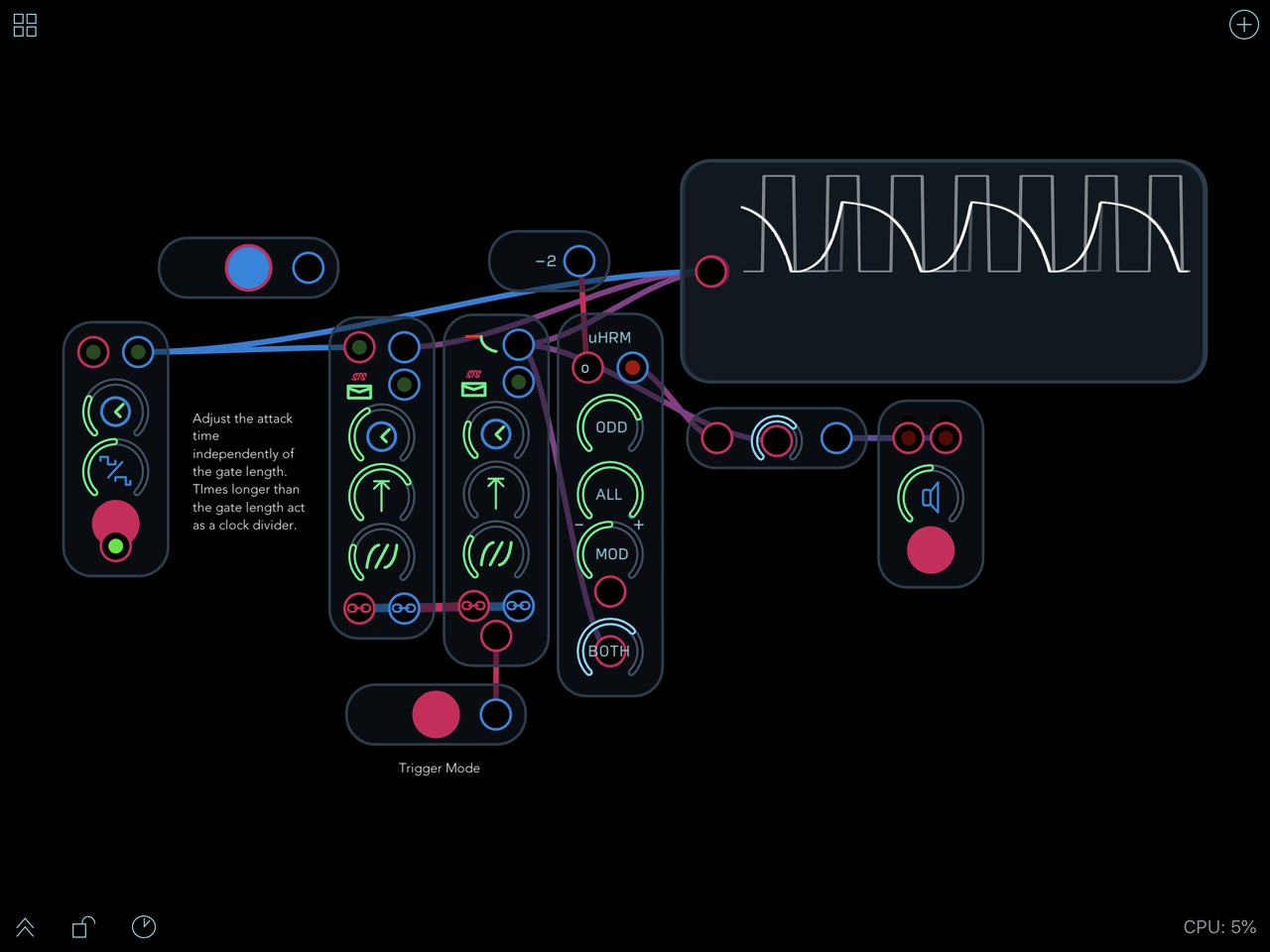
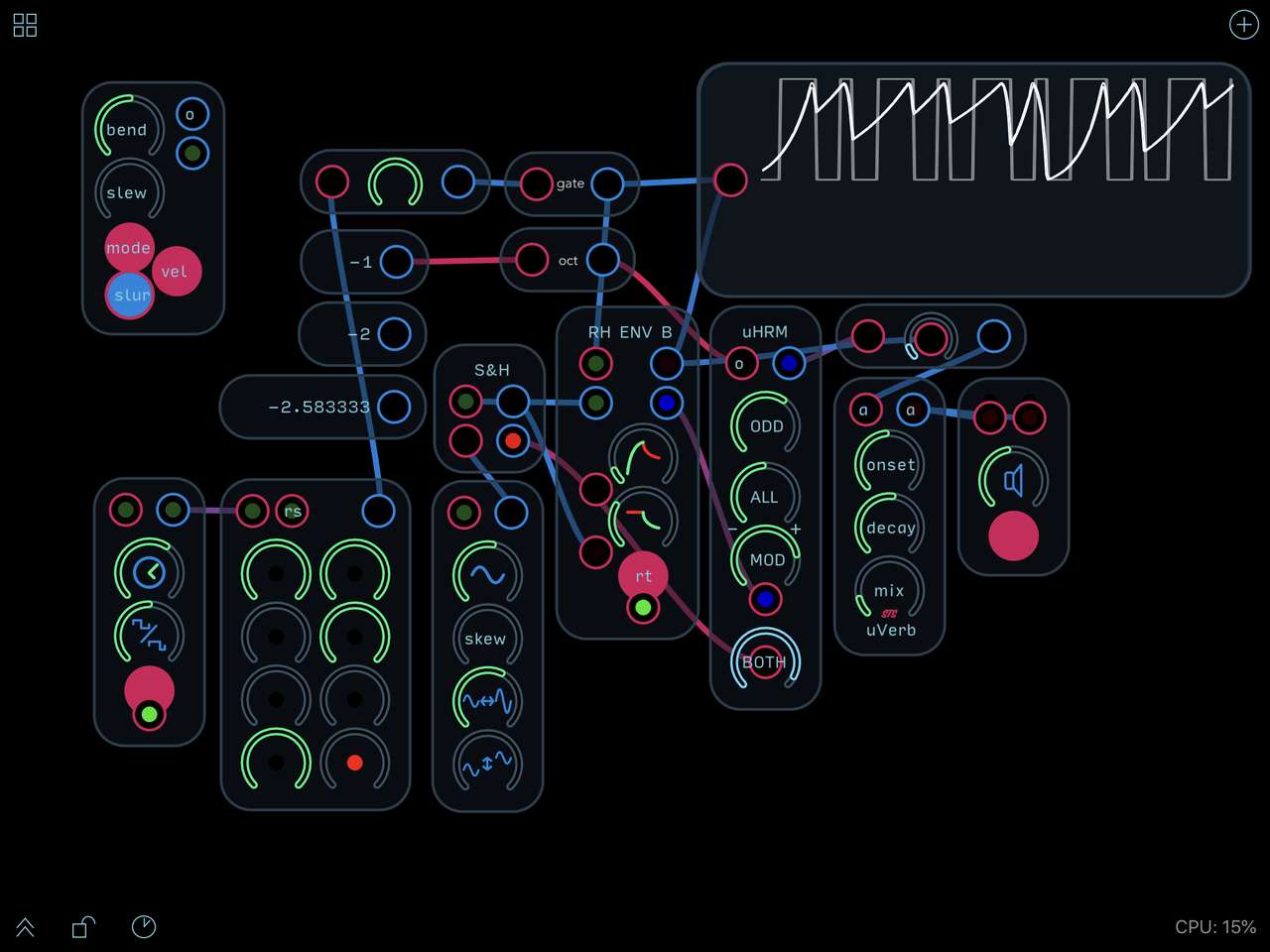
I’ve made a small start on putting together an Audulus version of the Hordijk Dual Envelope generator.
Hordijk mentions in one of his videos that designing an envelope generator is perhaps the most difficult of all the modules in that there are so many possibilities to consider, and that certainly rings true as I’ve begun to explore it.
In this first small patch I’ve adapted some of Stephen Schoen’s uLope modules to include a trigger mode – i.e. the attack time of the envelope is independent of the gate time. This means that a short trigger can result in a long attack swell, or a short attack can be triggered with a broad gate. It’s a simple feature that opens up a number of possibilities. With the attack time set to longer than the clock rate the envelope generator can suddenly starts to function as a kind of clock divider, as Hordijk points out in his NOVARS tutorial video. With in-between settings, e.g. with the gate setting in before the release stage has completed, interesting rhythmic effects can arise.
I’ve made a further modification to Stephen Schoen’s uLope so that sustain modules can also be added to the envelope chain with the trigger mode activated.
Before I pack it into a module that more closely resembles Hordijk’s design, it’s fun to have all the controls available to experiment with. For example, by setting the first sustain module in the chain to a lower level than the one that follows, it’s possible to achieve a secondary attack-like phase with a resulting ‘reverse’ effect. It’s also interesting to play with the degree to which the curves are logarithmic or exponential, finding the sweet spots for what sounds ‘natural’ – at least in relation to what we know from acoustic instruments.
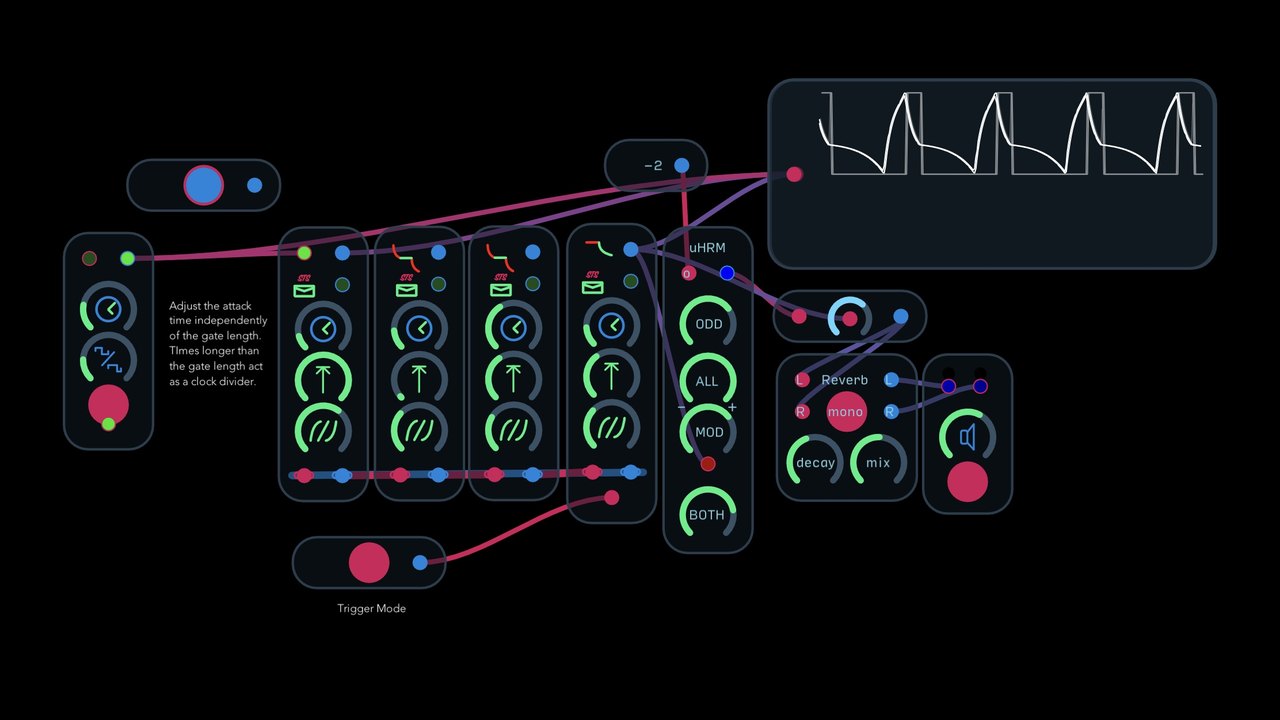
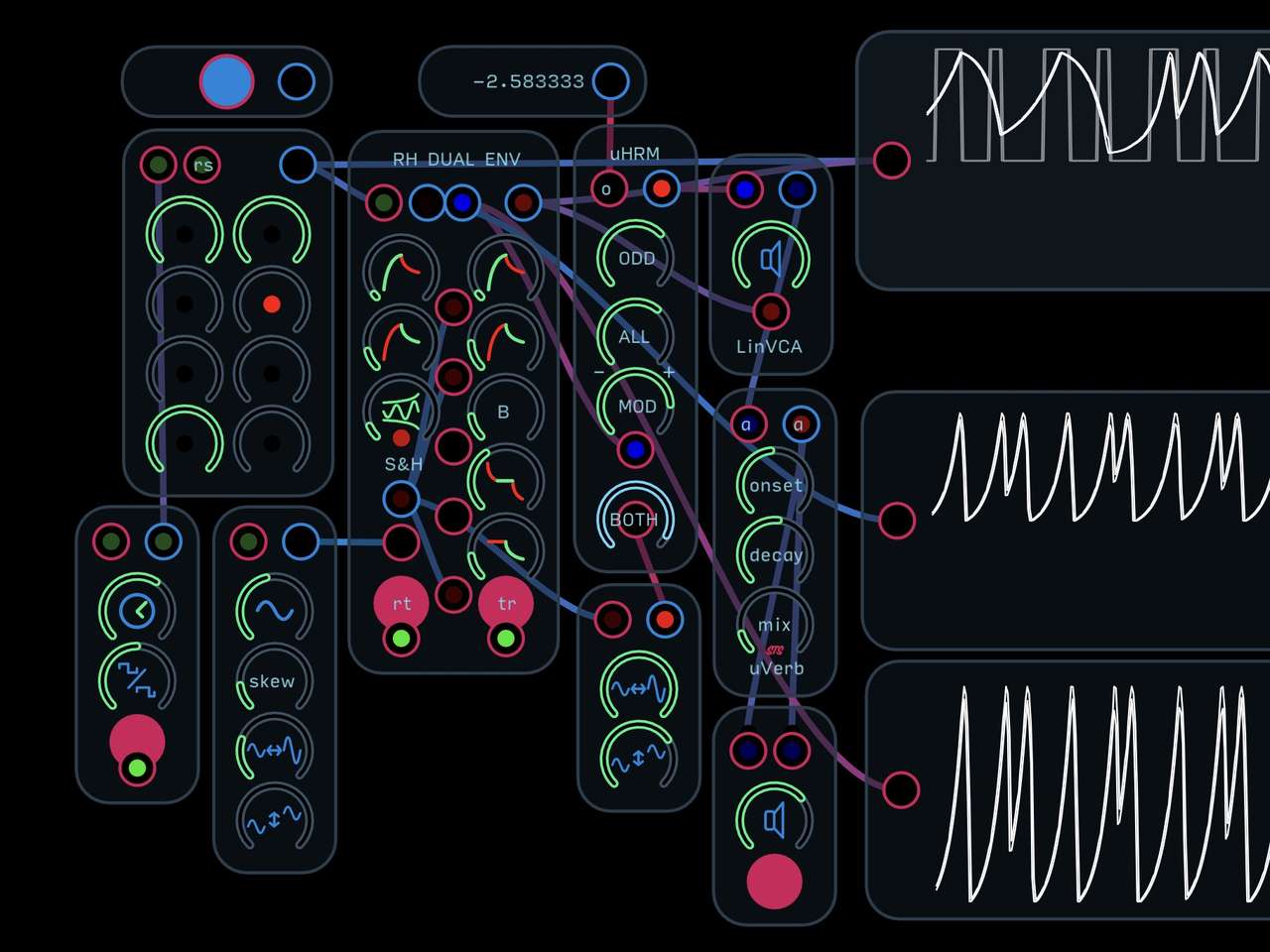
I’ve packed the modified uLope sub-stages into a module that more closely resembles the ADBDR envelope in Hordijk’s Dual Envelope generator.
One of the innovations in his design lies in replacing the sustain section with second decay stage that can slowly taper off, thus allowing for more ‘natural’ sounding contours. With the decay knob turned all the way up, a conventional flat sustain can be achieved. The second decay is also preceded by a break setting that adjusts how far the first decay falls. The resulting shapes are perhaps most easily understood by taking a look at the diagrams in Hordijk’s schematic.
Each stage also has a modulation input that adds to the values set by the knobs. Since modulation is most effective when the pitch of the modulating waveform is lower than the one being modulated, a sample & hold has been included. Hordijk provides a nice explanation of this technique in one of his NOVARS tutorial videos.
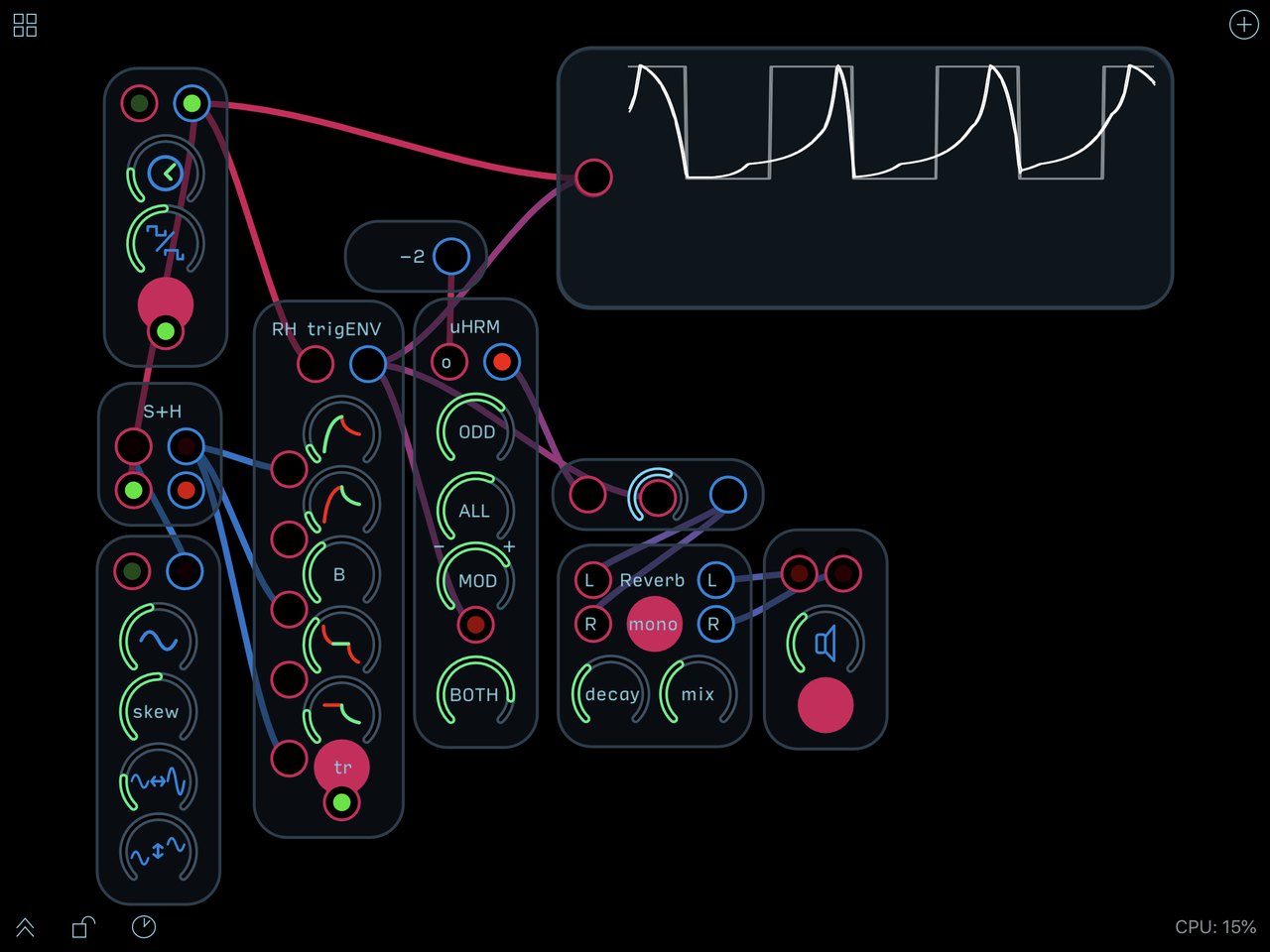
It’s taken some time, but I’ve managed to get a little closer to the curves I was aiming for with my version of the Hordijk ADBDR envelope generator.
My approach has been to sample the value of the release or decay curve at the moment a new gate pulse arrives, and use that as the starting point for the next attack. (In trigger mode gate pulses arriving before the attack phase has completed are ignored.) In @stschoen’s original uLope modules this was efficiently achieved by using the addition node to add the attack to the release curve, with the disadvantage though of sudden jumps should a new attack arrive during one of the decay phases.
Sampling the value and crossfading between the first and last part of the envelope introduces some tricky timing issues (which I’ve solved by adding an extra timer for the sampled end/start values and introducing a very small delay before the attack phase timer kicks in). One the other hand, having a sampled start value for the attack not only makes it possible to have it pick up on the value of a potential preceding decay phase, but also scale the amount of time allocated to the attack according to the height available, i.e. the higher the attack point starts (depending on the level of the previous decay or release) the shorter the attack time. This also keeps attacks in quick succession that ‘build’ the overall volume from overshooting the top value of 1.
The result is an ADBDR envelope that can be re-triggered at any moment in gate mode, or any moment after the attack in trigger mode. In gate mode the release kicks in as the gate ends, while in trigger mode it’s independent.
Small glitches can still occur from time to time when pushing the envelopes to extremes and I’ve added a low pass filter in an attempt to smooth them out. Generally it seems to be usable though. The next step is to add build it into the Dual Envelope module.
Here’s envelope B from the Hordijk Dual Envelope generator, updated as with envelope A, as a little standalone module.
The repeat mode makes for some interesting rhythmic possibilities: On its own, without an incoming gate but with modulation on the attack or release, irregularly fluctuating rhythms can easily be set up. Alternatively, when used in conjunction with incoming gate pulses, slight anticipations or ‘off’ beats that don’t exactly fit the clock grid can be created.
I’ve uploaded a demo patch to the Audulus forum.
Toggle the master clock in the patch to get an idea of how it works.
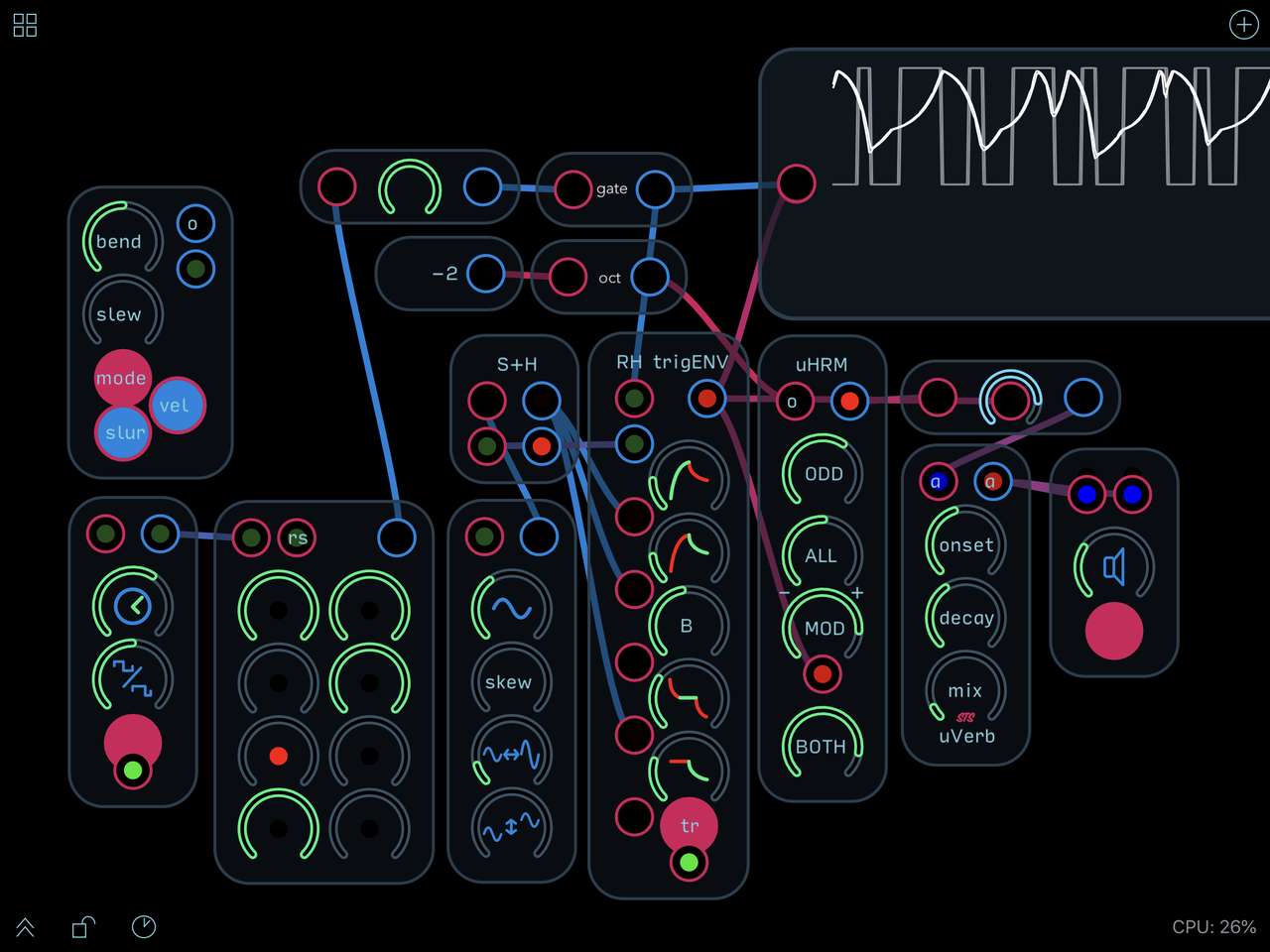
I’ve put together a new version of the Hordijk Dual Envelope with updated internals – this time with envelope A placed on the right. Since the ADBDR modulation inputs will probably mostly be run via the S&H, it seemed more practical to avoid having the internal patching cross over the knobs too much. I found myself sometimes inadvertently attaching the S&H output to the knobs themselves as I attempted to detach it from the modulation inputs with the previous UI.
I’ve put together a first tryout patch exploring Rob Hordijk’s sync oscillator, in particular the masking feature he describes in his NOVARS video tutorial on the module.
The first step in syncing the two oscillators was to invert the syncing sawtooth so that the synced waveform shares its transient with the sawtooth. If the two Audulus oscillator nodes are synced directly, the transient of the synced oscillator will appear in the middle of the syncing oscillator’s sawtooth. Since the synced oscillator is reset whenever the input crosses zero from below, the rising slope of the sawtooth resets the synced waveform when it (the sawtooth) reaches its zero midpoint. With the inverted sawtooth the slope crosses zero from above and doesn’t reset the oscillator until is crosses from below at the point of the transient.
I was particularly intrigued by the masking feature Hordijk describes in the video. In this case the inverted sawtooth is converted to a unipolar, positive only, waveform and used as an envelope applied to the synced oscillator. This means that the transient points of the synced waveform correspond to the zero point of the envelope and, importantly, are always the same size – effectively reducing that unwanted side-effect of the introduced transients.
Some more information on the masking technique can be found in one of Hordijk’s tutorials for the Nord Modular, as well as on his own site. As the Nord tutorial points out, the masking, while smoothing out the transients, also introduces a distortion of it’s own, and suggests crossfading between two versions of the synced waveform slightly out of phase with each other in order to minimize this side-effect.
In the case of this tryout I’ve kept things simple. I find the masking particularly effective in the case of the triangle wave – it’s interesting to compare it with a version in which the inverted envelope is replaced by setting the amplitude to full on the oscillator. With the sawtooth the mask side-effects are more noticeable, and since there are so many transients in the wave already I find it somewhat smoother to simply set a fixed amplitude for the synced sawtooth. Using a mask for the amplitude does however make for a smoother crossfade between the triangle and sawtooth waves and also allows for some interesting effects at low frequencies where the envelope is more apparent as an envelope.
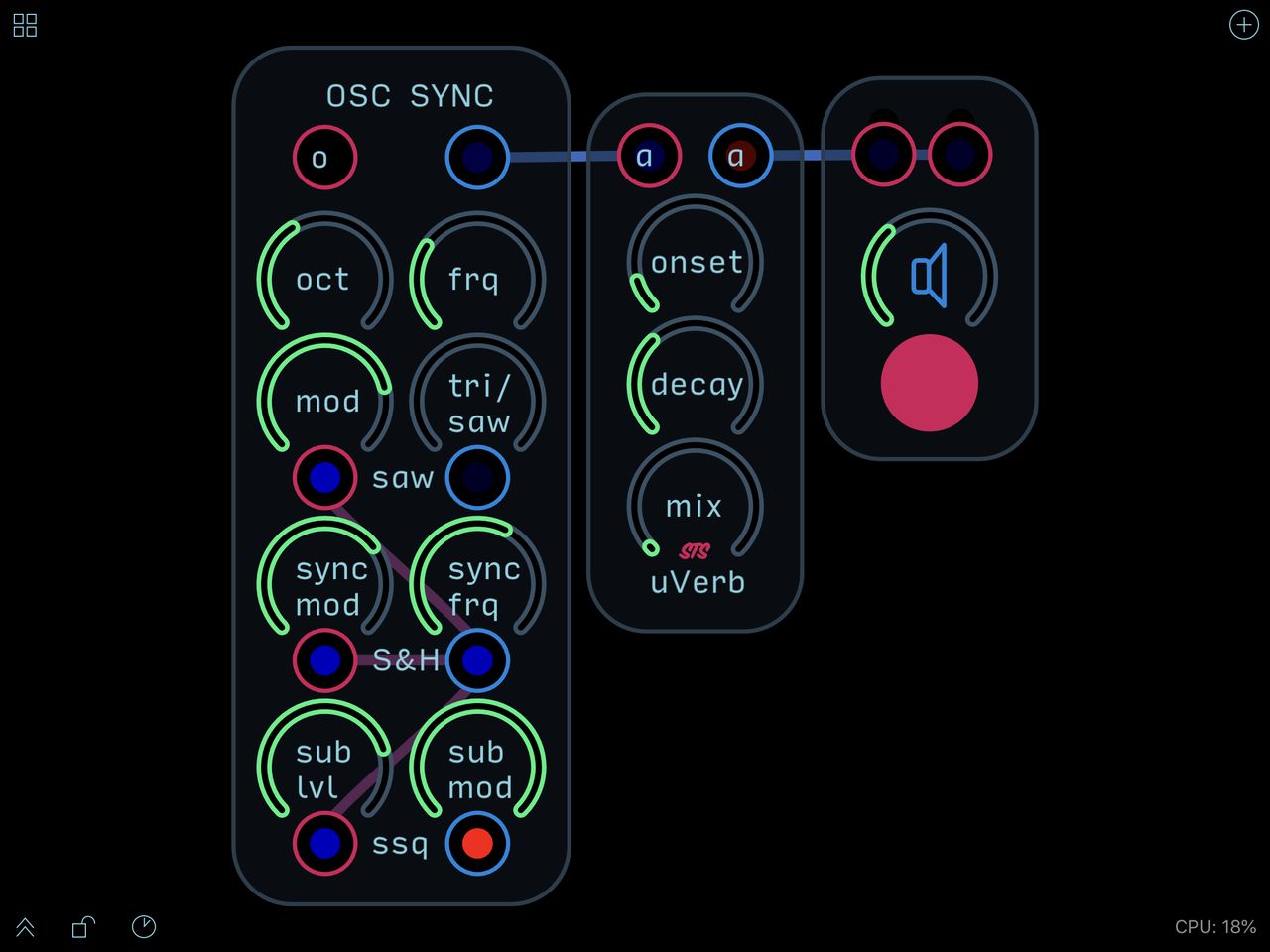
I’ve put together a full version of the Hordijk Sync Oscillator. As usual Hordijk has taken things a step further and turned the irregular transients that were smoothed out with the masking technique, to good use. The transient heights are captured with a sample and hold circuit, and can then be fed back to either the synced oscillator (which generates the well known random S&H pitch effect) or the syncing oscillator (which will change the rate at which the pitches are generated). The combination of the recursive pitch and tempo modulations means that Krell or Rungler-like textures (venturing into noise territory) can easily be generated.
Rob Hordijk provides a nice explanation of how the (true) randomness is generated in his NOVARS tutorial on the oscillator.
An additional aspect is the inclusion of a subsquare divider which can be used to modulate the synced oscillator on every alternate sync cycle. This can be used for the creation of vowel like effects, as well as adding a little bottom end to the synced sounds.
The sample and hold signal can also be applied to the subsquare modulation, and the sync sawtooth, subsquare, and S&H signals also have their own outputs.
I’ve uploaded two demo patches to the Audulus forum.
OscSync – Vowel DemoOscSync – Fast Krellaudio version of this post
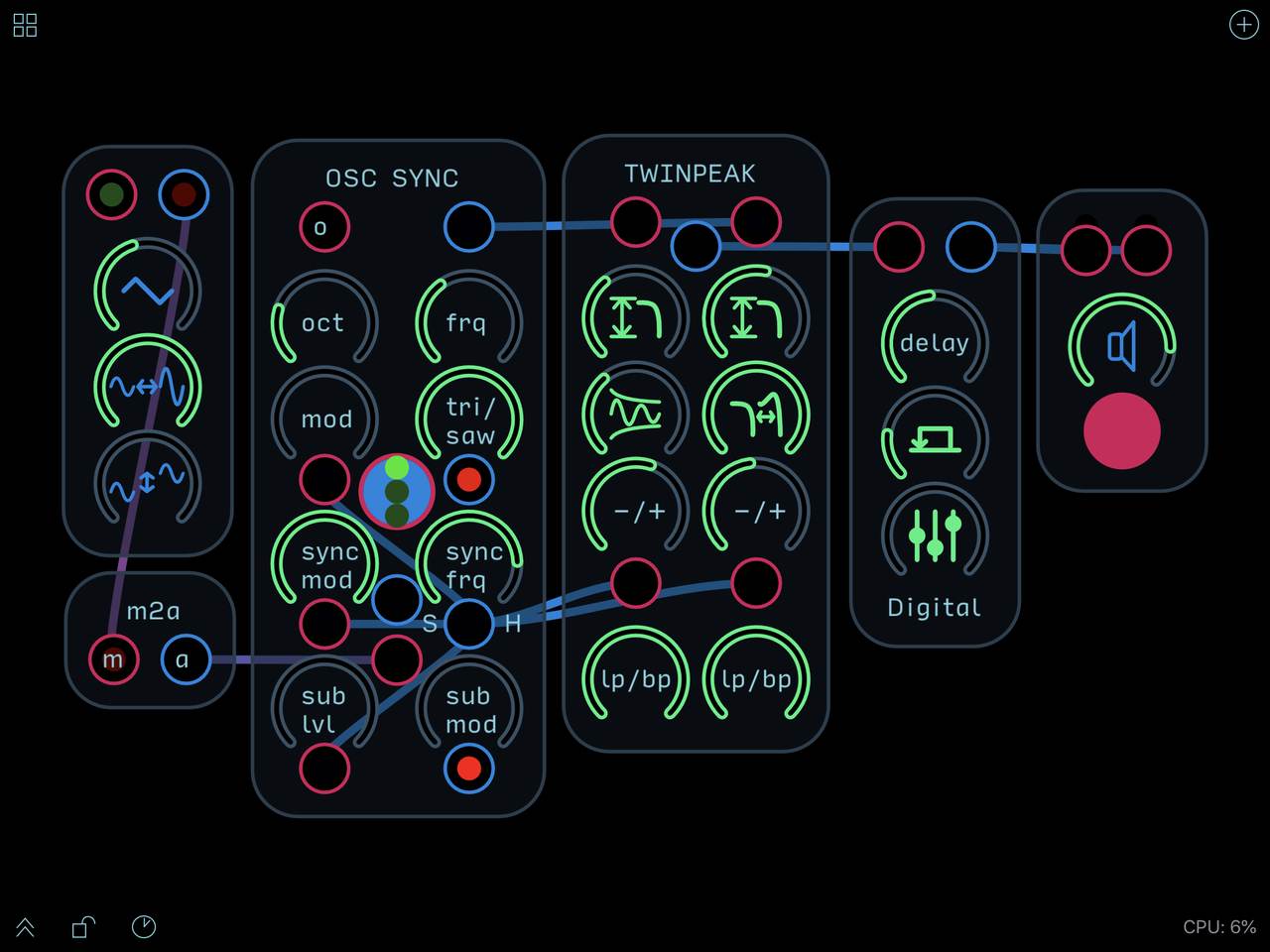
I’ve taken a few extra steps with my Audulus version of the Hordijk OSC SYNC. As much as I’d enjoyed the wide range that came with not having any tracking between the syncing and synced oscillators, I realized of course that as soon as sequencing is introduced, tracking becomes desirable/necessary. Along with a tracking switch allowing selection between full, 2/3, or 1/3 (around ‘c.v.’ = zero as a reference point), I also added an external input for the sample and hold. 1
OscSync – Sequenced
Using external modulation with the S&H allows for some interesting effects. I’ve uploaded two demo patches to the Audulus forum: In the first the TwinPeak filter is pinged with low pulses creating a resonant percussive sounds. It’s fun to explore the different timbral results that can be obtained by simply changing the tracking setting. The second patch creates an arpeggiator like effect – with this one it can be fun to turn up the modulation dial and/or add some subsquare modulation.
Here’s my take on an Audulus version of Rob Hordijk’s Triple LF-VCO.
The first of the three VCOs is pretty much the same as oscillator A in the Rungler, and so I used @stschoen’s Audulus recreation of it as a starting point. Oscillator A, taking the 3rd oscillator of the EMS Synthi as a point of inspiration, has a range from around a minute extending all the way up to 5 kHz, well into the audio range. Its special feature is a rounded triangle ‘parabol’ waveform (very close to a sine) and the fluctuation modulation1 that can be applied to it with LFO C as the modulation source. Fluctuation, a combination of frequency and amplitude modulation, makes for a gentler, more natural sounding vibrato than is possible with regular frequency modulation, and since the amplitude varies, opens up for interesting modulations when combined with a waveshaper.
LFO C is closer to a more standard LFO with a range from around 60 seconds to 100 Hz. Both oscillators A and C have bipolar audio outputs and this, in combination with the wide range of oscillator A, makes them useful in combination with the modulation inputs on Hordijk’s other modules, many of which can be used with bipolar signals well into the audio range.
In the version of the Triple LF-VCO demonstrated in both the NOVARS tutorial and Mallorca demo, LFO C has a selfmodulation feature in which the downward part of the triangle wave can be modulated with the pulse wave that runs parallel with it. This means that the upward slope maintains the set frequency while the downward slope can be slowed down allowing for the creation of an something approaching an inverted sawtooth wave. The pulse width of the accompanying pulse wave is coupled to the upward slope of the triangle, and maintains its width, while the time between the pulses (the downward slope) can be stretched to as much as half an hour! 2
Hordijk has apparently replaced this selfmodulation feature with a sample and hold circuit in his most recent version of the Triple LF-VCO. The S&H is triggered at both the upper and lower peaks of the triangle wave making it possible to create slopes that rise and fall at different rates, again with potentially large differences between them, as was possible with the selfmodulation version. In this case the modulation input for LFO C, i.e. the input for the S&H, is normalized to the output of LFO A, which can in turn be modulated by LFO C, allowing for complex cross-modulations.
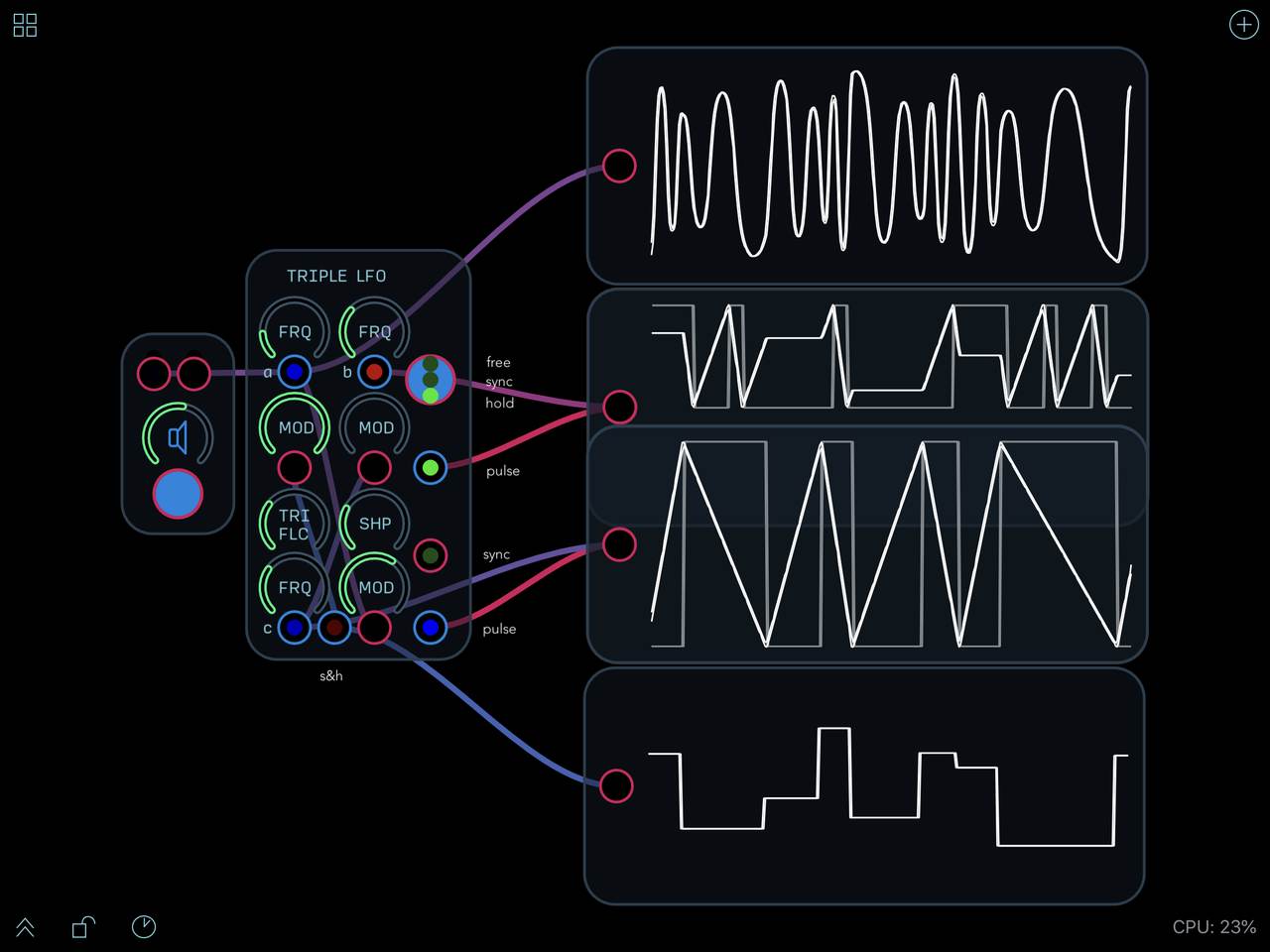
LFO B differs in that it generates a unipolar signal, making it suitable for generating envelope-like modulations. Inspired by the modulation generator on the KORG MS-20 it has a range from around 10 seconds to 100 Hz, and its triangle wave can be skewed to gradually approach an inverted or regular sawtooth shape. As with LFO C the accompanying pulse wave follows the rising slope of the triangle wave, meaning that skewing the triangle also adjusts the width of the pulse wave. I used the skewed triangle LFO in the Audulus library as my starting point, but ended up having to rethink the equation for the triangle wave so that it syncs from the bottom point of the triangle rather than in the middle of the wave (as it does in the Audulus library/docs examples) – in this way both the transient of the inverted saw (when the triangle is skewed that way) and the pulse wave correspond to the beginning of a new (sync) cycle.
The syncing is an important aspect since LFO B can be synced via a switch with LFO C (which can in turn be synced externally). This makes it possible to easily generate irregular or shuffle-like rhythms. The switch can also be set to a ‘hold’ position so that on each downward slope of LFO C the pitch of LFO B is frozen until the point at which LFO C changes to an upward slope, at which point LFO B continues from the point at which it left off, making it possible to create interesting step-like modulations. Hordijk provides at good demonstration of the possibilities in his Mallorca demo as well as at the close of the NOVARS tutorial video.3
I’ve uploaded both the S&H and selfmodulation versions to the Audulus forum.
See also more on fluctuation on the Audulus old forum. ↩
In the hardware version the LFO C pulse wave is normalized to the modulation input of LFO C – in my Audulus version this ‘internal’ connection needs to be re-connected manually if broken when connecting an external modulation source.) ↩
The switch in my Audulus version doesn’t maintain its state when closing the patch, and so I’ve chose to have the free, ‘mode’ position at the top, followed by the sync and hold settings.) ↩
Here’s a take on Rob Hordijk’s 24dB Filter – the last in my series of Audulus versions of his modules.
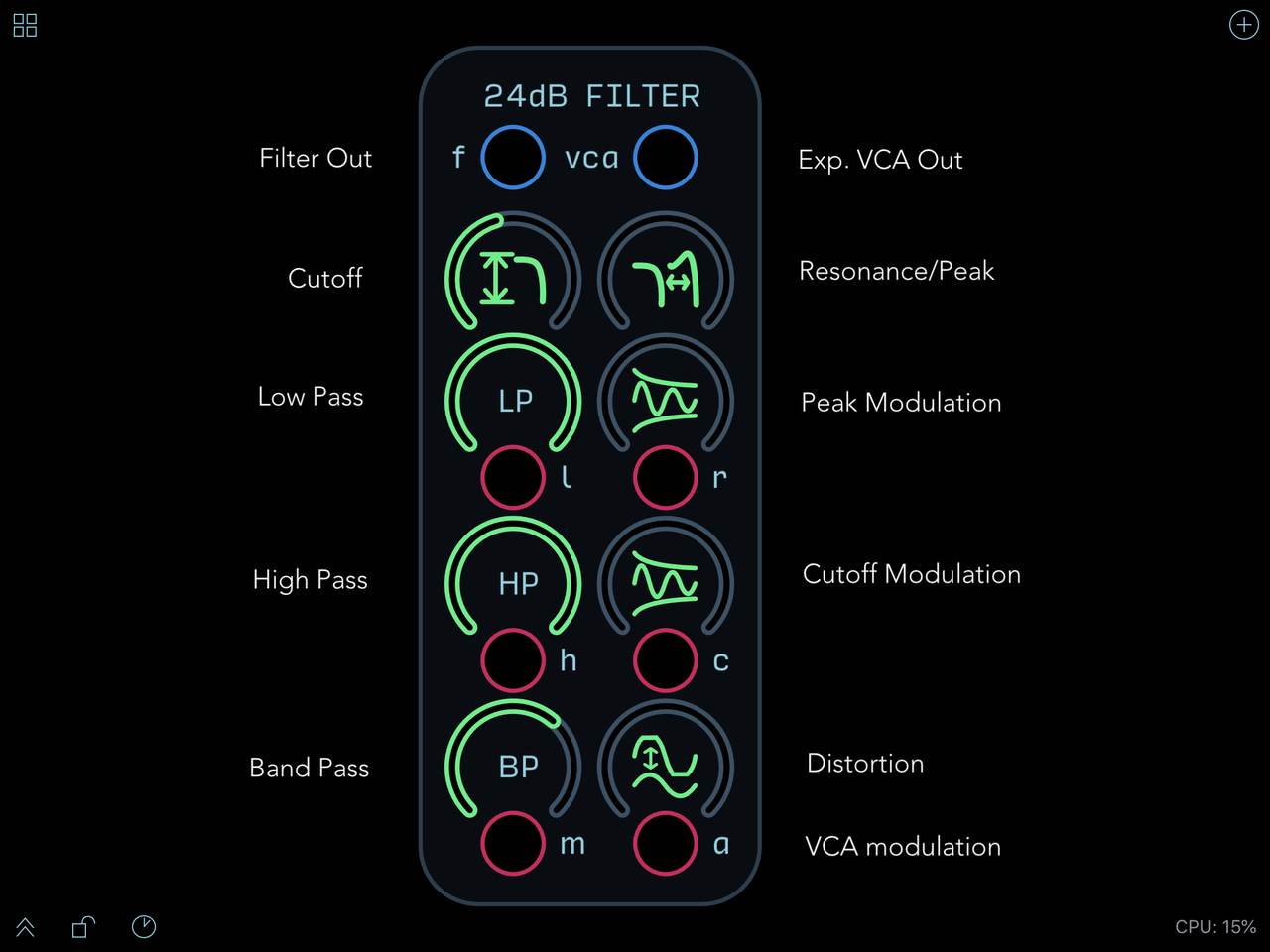
As usual Hordijk gives his own take on the classic Moog 4-pole ladder filter, creating a multimode filter through the addition of high-pass and band-pass inputs all mixed to a single output (rather than a single input with multiple outputs). This arrangement makes it possible to use the filter as a kind of mixer and spectrally cross-fade between the (independent) input signals.
One can also connect the same signal to all of the inputs1 and use the input controls to shape the curve of the filter. Ideally if the low- and high-pass inputs are set to the same amount they should complement each other and the cutoff frequency (and feedback resonance) should have no effect on the sound.2 Unfortunately, despite some head-scratching and various attempts, I haven’t managed to get this aspect to work, and one can hear a peak when sweeping though the frequency range. The high-pass with the cutoff frequency all the way to the left does however match the low-pass with the cutoff frequency all the way to the right, and spectrally crossfading between two different signals works well. With the same signal applied to all inputs the cutoff frequency (and potentially resonance) is clearly apparent on the band-pass input which can be used as a kind of equalizer.
Hordijk provides a good explanation of the principles on which the ladder filter is based in his NOVARS tutorial, and with that clear starting point I took the opportunity to dive into the The Art of VA Filter Design by Vadim Zavalishin – the ‘Bible’ of digital filter design as @stscheon puts it – as well as @stscheon’s Introduction to Digital Filters. I found the Introduction useful as an accessible complement to Zavalishin’s in-depth explanations with some good examples of Zavalishin’s diagrams patched in Audulus.
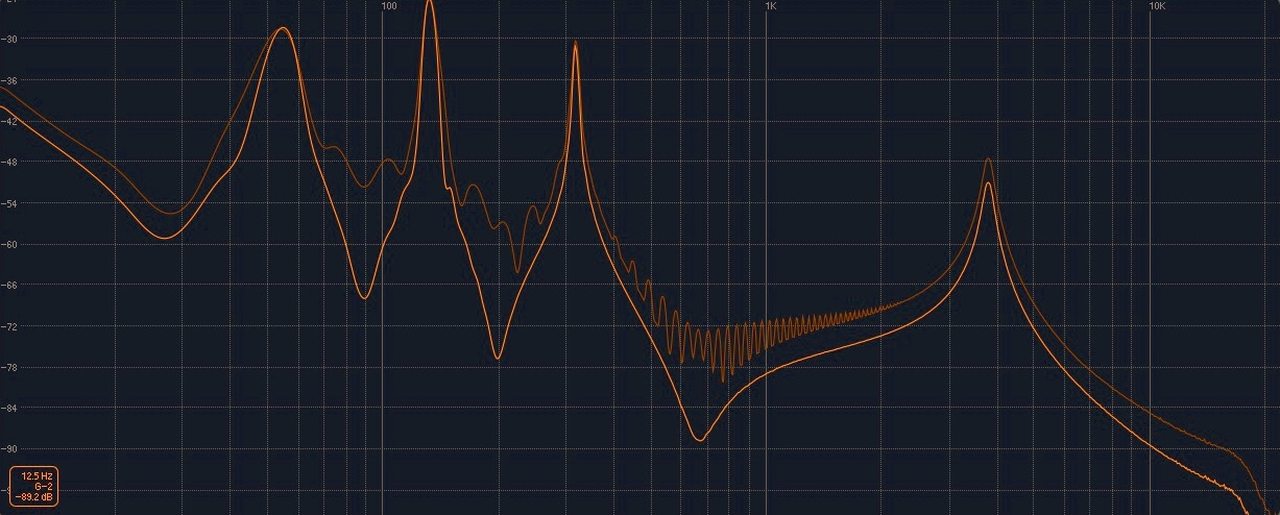
On the basis of @stscheon’s explanations I replaced the LPFs in the 24dB ladder filter with LPFs based on the Audulus LowPass node – and they indeed turn out to be more efficient. Comparing the node-based 1-pole low-pass filter with the patched version from the Audulus Module Library shows that they are almost identical: the node version does however have a slightly stronger attenuation – c. 2–3dB above 10 kHz, or thereabouts. This difference meant that in the 24dB filter the high-pass with the cutoff all the way to the left was slightly brighter than the low-pass with the frequency all the way to the right, and I ended up reimplementing the patched 1-pole LPFs in order to achieve the same brightness. (See above.) 3
Zavalishin interestingly describes (in Chapter 4.4) some of the multimode functionality that Hordijk builds on, warning however that:
The multimode functionality of the ladder filter is a rather exotic feature. If you’re looking for the bread-and-butter bandpass, highpass, notch etc. filters, you should first take a look at the multimode 2-pole state-variable filter discussed later in the book.
Exotic or not, Hordijk’s inclusion of independent inputs that simultaneously combine to a single output provides some unique functionality with the ability to spectrally crossfade between them. Although there is a diagram available on The Hordijk Modular Blog I’ve nevertheless been unsure of the details on how to combine the various filter modes. I’m not sure if I’ve solved this in the best way – but, with the exception of the HP and LP inputs perfectly complementing each other, it seems to cover the functionality that Hordijk demonstrates in the NOVARS video. Regarding the LP/HP asymmetry, my guess is that the four 1-pole LPFs each need to be converted to a HPF to achieve a ‘true’ HP ladder filter as Zavalishin explains in chapter 4.5 of The Art of VA Filter Design. The problem though is then how to maintain the LP signal simultaneously – unless one has a parallel ladder of filters… (which would seem to defeat the point of the design)?
An additional feature of Hordijk’s module is the addition of some subtle tube-like distortion that can help boost the resonant feedback peaks. He favours an all-harmonic distortion rather than one that only boosts the odd harmonics – as is the case with soft clipping and some tube-distortion models, as well as the tanh saturation that Zavalishin suggests in his diagrams. Hordijk generates his distortion through a process of FM feedback and I experimented with achieving something similar building on the techniques that I’d tried out in the Audulus version of his VCA-Shaper and Harmonic Oscillator. In the end I settled on using the JFET VCA in the Audulus library for the subtle all-harmonic distortion4 that it can provide (the Audulus Tube VCA provides odd harmonic distortion).5
The JFET distortion does however introduce a strong fundamental when applied to the high-pass input even though it is effective in boosting the peaks. The introduction of lower frequencies when resonance is applied to the high-pass is however a general problem with the ladder filter design and I haven’t found a satisfactory countermeasure (such as introducing a HPF in the feedback loop, as Zavalishin suggests) given the multimode nature of the module. Nevertheless, despite the rough edges in my version, I find it an effective and fun way of blending and shifting between different signals or different spectral areas of the same signal.
I’ve uploaded the module and various demos to the Audulus forum.
24dB Filter Demoaudio version of this post
Hordijk has the low-pass input normalized to the high- and band-pass inputs. In my Audulus version those connections have to be made manually. ↩
See Hordijk’s demonstration in the NOVARS tutorial at around 8 minutes. ↩
The description in the Audulus docs of the LowPass node having a 12dB rolloff per octave had me confused at first since it matches the 6dB rolloff of the patched 1-pole filter. The 12dB rolloff does however apply to the Filter node. ↩
I’ve stuck to the standard (clipping) distortion SVG icon, even though I realise that it’s a little misleading in this case. ↩
I’m keen to do a little more experimentation with different saturation possiblities that Zavalishin diagrams for the standard ladder filter, some of which @SansNom has already explored – see the thread on the old forum. ↩