rss

Modular Diary – 048

Today a look at STS’s Neo-Riemannian Chord Transform – another Audulus clone based on a section of the ornament & crime Eurorack module.1

As before I found it useful to take a look at the Voltage Control Lab video demonstrating these functions. I also found it interesting to take a look at the o_C user manual, something I hadn’t previously gotten round to, which STS has used as the point of departure for his Audulus modules.

Triadic harmony is not something I normally associate with modular patches – it’s unusual to find polyphonic set-ups simply given the number of modules required to create multiple voices. Two examples that come to mind though are Mylar Melodies achieving polyphony with the help of the Expert Sleepers ES8 module and Silent Way software, and Richard Devine’s beautiful Harmonic Symmetry patch, using the Make Noise tELHARMONIC.

“…a new approach to handling music theory in the modular context,” as Make Noise explain on their site.


  1. See also the accompanying Chord Inverter and Arpeggiator. ↩
Modular Diary – 049

I got around to taking a look at STS’s Audulus clone of the Turing Machine today. Whereas the ornament & crime module was split into stand-alone Audulus modules, in this case the Turing Machine Pulses and Volts expanders have be integrated into a single module.

Since I wasn’t familiar with the Turing Machine in any detail I decided to work through the Music Thing Modular demo, and recreate the different parts of it in Audulus as I went along. That was a fun exercise and left me impressed with the quality of STS’s clone. I‘ve uploaded the patch with the modules I collected for following along with the demo to the Audulus forum.

The only part where I ran into difficulties was the final patch of the demo in which the Turing Machine is clocked at audio rates to generate chiptune sounds – I’m not sure if Audulus is hitting some limits of what is possible, or if there’s something that could be set up differently. In any case it’s possible to get an idea of how the chiptune patch works, even if the quality isn’t quite the same as in the demo.

Modular Diary – 050

A few weeks ago I tried measuring the pitch deviations of the Analog tuning in the Korg ODYSSEi app using a little patch built in Audulus using the ZeroCross node. It turned out that those measurements were increasingly inaccurate as I progressed up the frequency range, and in the end I turned to another app to map the deviations. Puzzled at the time, I should have taken a closer look at the Audulus docs first, since they provide a thorough explanation of why accuracy decreases as the frequency increases.

The reason for this margin of error has to do with sample rate. At a sample rate of 44.1kHz (the default for Audulus in standalone mode), the ZeroCross node has 44,100 samples per second to evaluate the zero-crossings of a 1Hz wave, whereas it only has 4.41 samples per second to evalute the zero-crossings of a 10,000Hz wave.

Those sample rate considerations also have important implications when creating waveforms digitally. The docs provide, with copious examples, a thorough explanation of what is going on with the Osc and Phasor nodes. A fine, and it seems ever-evolving, resource.

Modular Diary – 051

STS has been quick to update his Audulus clone of the Turing Machine – now also a Mk.II. He pinpointed the cause of the audio rate clocking problems that I’d run into and took the opportunity to redesign the shift register (which now uses 30–40% less CPU cycles than before) as well as implement some other improvements.

I’ve played around a bit with the audio rate clocking – specifically trying out waveshaping with the volts expander and changing the pulse width on the pulse out, as in the last section of the MTM video. It seems to be working very nicely.

I’ve posted the patch on the Audulus forum.

Modular Diary – 052

Looking through a (physical) folder dating back to my student days many, many years ago, I came across a 40 page printout of tuning systems.1 Some of the scales are expressed as ratios, others in cents. It seems quite comprehensive: Ancient Greek scales, Indian modes, Werckmeister, Rameau, lute and bagpipe tunings - even Xenakis’s Byzantine Liturgical modes. Wendy Carlos is in there too.

Here’s a scan of the printout. I ran a quick OCR on it so it should be searchable to some degree.


  1. Unfortunately I can’t credit the person who put the list together – all I know is that I probably picked it up while taking some classes at the Akademie für Alte Musik while studying in Bremen in the late 90s. ↩

Modular Diary – 053

While playing around creating drone-like textures with STS’s Turing Machine, I got to thinking of Pugix’s Audulus Quantussy drones that I came across in the forum a few weeks ago. He has a nice post on his website explaining it all along with some sound examples.

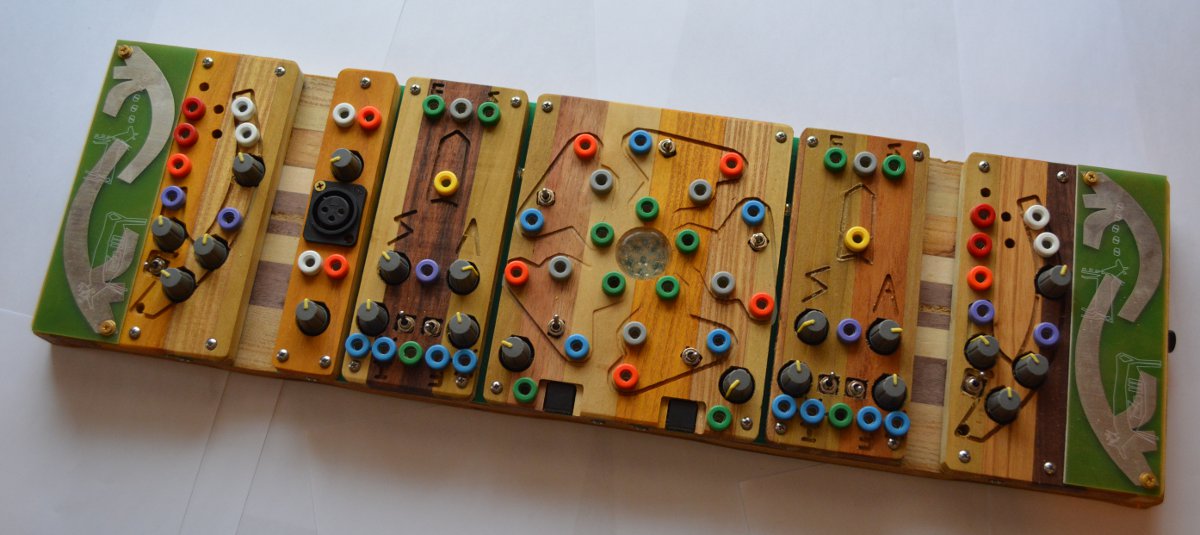
I was curious to take a look at the hardware Quantussy (What is the Quantussy?) that provided the inspiration for Richard’s version, and that led me to some of the most unusual modules I’ve yet come across. As described on the website:

Ciat-Lonbarde specializes in intuitive analog organs for your atonal/chaos squishing needs. The following instruments are assembled in Baltimore out of local wood, and machine assembled circuit-boards that are hazmat free.

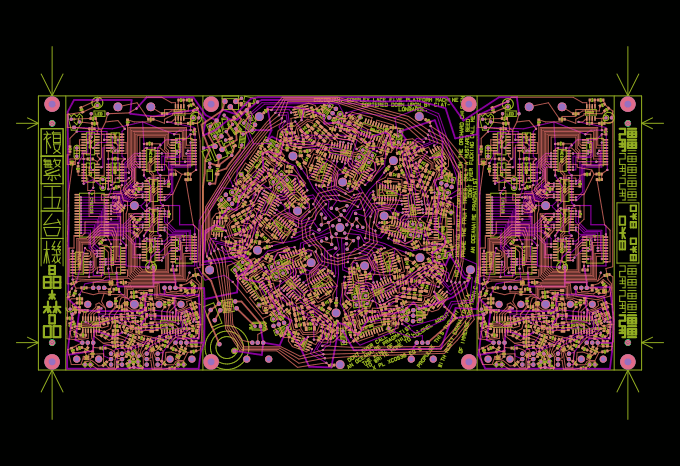
The circuit boards are works of art in themselves. Here’s a Reddit Inquiry into the artsy-hipster side of Synthesis, and an ilovefuzz.com thread with a number of videos of these instruments in action.

Modular Diary – 054

After yesterday’s look at the striking Ciat-Lonbarde instruments, I got to thinking of Rob Hordijk’s Benjolin and Blippoo boxes, and specifically a comment of his about their potential status as objets d’art:

…a little device called the Blippoo box, and that type of instrument I always call a ‘patch in a box’ because it is sort of like a concoction of certain electronics that have a certain specific character of its own, …it should be playable of course, it can also be seen as maybe an objet d’art, what the French call an objet d’art, an ‘object of art’, instead of an instrument, but that is basically free for the people that have one to interpret whether you want to use it as an actual musical instrument on stage, or if you just want to have it in your room as something special next to your paintings and your other stuff…
—Rob Hordijk at Basic Electricity #15, Berlin

Modular Diary – 055

The Din Datin Dudero – ‘the original, esoteric analog synth for babies’ – something that caught my eye amongst all the unusual on the Ciat Lonbarde site. There’s also the Nobsrine:

It is for babies of DJs and noise musicians, who want to introduce their children to strange sounds, chaos magic, the idea of infinite degrees of relationship between tones, without the more complicated techniques involved in uper crust CIAT INSTRUMENTS.

I was wondering about the relationship between all these instruments and Rob Hordijk’s ‘patches in a box’, and sure enough, looking though the images for the Din Datin Dudero I stumble across:

Stuber shall have two knobs, a philter mechanism for audio and also for gesture, with Q control. The binary matrix reinterprets resonances, as a “Rungler.”

Here’s a video of their creator Peter B. explaining his Plumbutter.

Modular Diary – 056

A little side-note on the Turing/Quantussy/Rungler Audulus implementations: Something that I did notice while playing around with STS’s Copier and Turing Machine was that patches would open in exactly the same state as last, something that Richard Brewster also draws attention to in the post on his Audulus Quantussy.

One very interesting feature of an Audulus patch is that it will start off playing in the exact state in which it was saved. So, very much unlike the analog Quantussy, I think that the sequence of events created by the software Quantussy may be able to repeat exactly.

Following on that, Rob Hordijk’s thoughts on the differences between digital and analogue implementations of these kinds of cicuits:

Imho a rungler circuit works best in an analog electronics implementation. It is definitively more alive and surprising due to the slight instabilities in the analog circuitry. I did digital implementations, but they can’t beat the ‘organic behaviour’ of the analog versions. But this is just personal taste…

Modular Diary – 057

Thinking further on the difference between analogue circuits and digital implementations of them, and how experiments in one form of technology can be carried over into another, I found it fascinating to hear Rob Hordijk tell a little about the origins of the Blippoo/Benjolin type circuits in a video that I hadn’t come across before:

…around the year 1980 we had these EMS Putney synthesizers and we had these Revox R-77 tape recorders and with with the Putney synthesizer you could make a really nice, always changing patch, by routing, by using two of the oscillators of the Putney and using the Revox as a delay, because the Revox had three heads, a recording head and a playback head and you could record and a little while later on the playback heads you could get a signal back and because it had two tracks you could make two delays, so what you would do you would feed the output of one oscillator in the left input of the of the tape deck, then the output of that left channel on the tape deck would go into the frequency modulation input of the second oscillator, the output of the second oscillator would go into the second track of the of the Revox and the output of the second track of the Revox would go back into the frequency modulation of the first oscillator, so you would have a cross modulation system and the Revox would introduce some time delay, so the cross feedback would be delayed, and this delay sort of makes the system completely chaotic and totally unpredictable and it could just go on for hours and constantly do different things, so I remembered that and I thought that is something interesting to do in the Benjolin…

Modular Diary – 058

Mark Boyd has posted an Audulus Digital-Analog Hybrid Guide on allthesynths.info with some thoughts on the advantages of mixing the limitlessness of software with the focus and sound that hardware might offer.

Interestingly Darwin Grosse recently interviewed Make Noise Music’s Walker Farrell on a recent episode of his Art + Music + Technology podcast, also discussing, amongst other things, what it is that computers might offer in modular contexts.

Modular Diary – 059

Mark Boyd started a µModular Collection (tiny modules that are simple to use and as light as possible on CPU) on the Audulus forum a few days ago and the thread has exploded with the addition of more than 100 modules within the space of a few days. I think it might be a real game changer, especially when using Audulus on an iPad where space is limited (focussed). Robert Syrett’s comment in the thread that the little modules made him think of Sushi got me thinking of an iA Writer post a few weeks ago describing the raw and the cooked aspects of developing their app over the course of the seven years since it was first introduced. With the Audulus µModules the space and processing constraints seem to have sparked a process of creative distillation of many of the inspiring modules that having been appearing on the forum recently.

That also got me thinking back to another aspect of the Rob Hordijk video that I recently came across – how he attempted to reduce the number of controls on his Benjolin as much as possible while still maintaining a high degree of functionality and variation.

Modular Diary – 60

The Rob Hordijk Benjolin Workshop video that I’ve referred to in recent posts also helps clarify the lineage of the Rungler and his Blippoo/Benjolin ‘patches in a box’. At the end of the video he explains how it was the Blippoo Box that was an attempt to most closely recreate the Revox–Putney (VSC3) cross-modulation setup:

…in the analog modular system there’s also a Rungler module that actually has five different modes and there’s different sort of things because you can make all sorts of variations on this shift register idea… this [the Benjolin] is basically the simplest that you can get, it is basically also just one delay, actually when I built the Blippoo Box before this one, the Blippoo Box has two shift registers because that was really sort of a copy of that Putney Revox idea, but for the Benjolin I thought well if I can do it with one chip and and the amount of op amps and transistors and the potmeters on the board and you should be able to build it in an afternoon, …let’s try to do the simplest and most interesting thing.

One thing that comes across in this and other of Rob Hordijk’s workshops is his enthusiasm for the elegance of a particular cicuit. How a simple setup can open up for a rich palette of results. The impetus for the form of his cicuits is often closely tied to their analogue implementions, and many of those forming factors may no longer binding when creating digital versions, beautiful as they may be.

Modular Diary – 061

I’ve been working my way through the µModular thread on the Audulus forum, trying to catch up with all that’s been added during the last few days. It’s wonderful to have so many modules available in a single, easy to overview, patch and be able to pick out a filter or an amp as one would colours on a palette.

One little detail the caught my eye was STSchoen’s novel approach to a set of µQuantizer ‘presets’ in which a decimal number is converted to a binary representation of a scale. I had to look up how those conversions work – fortunately there are some online converters.

Modular Diary – 062

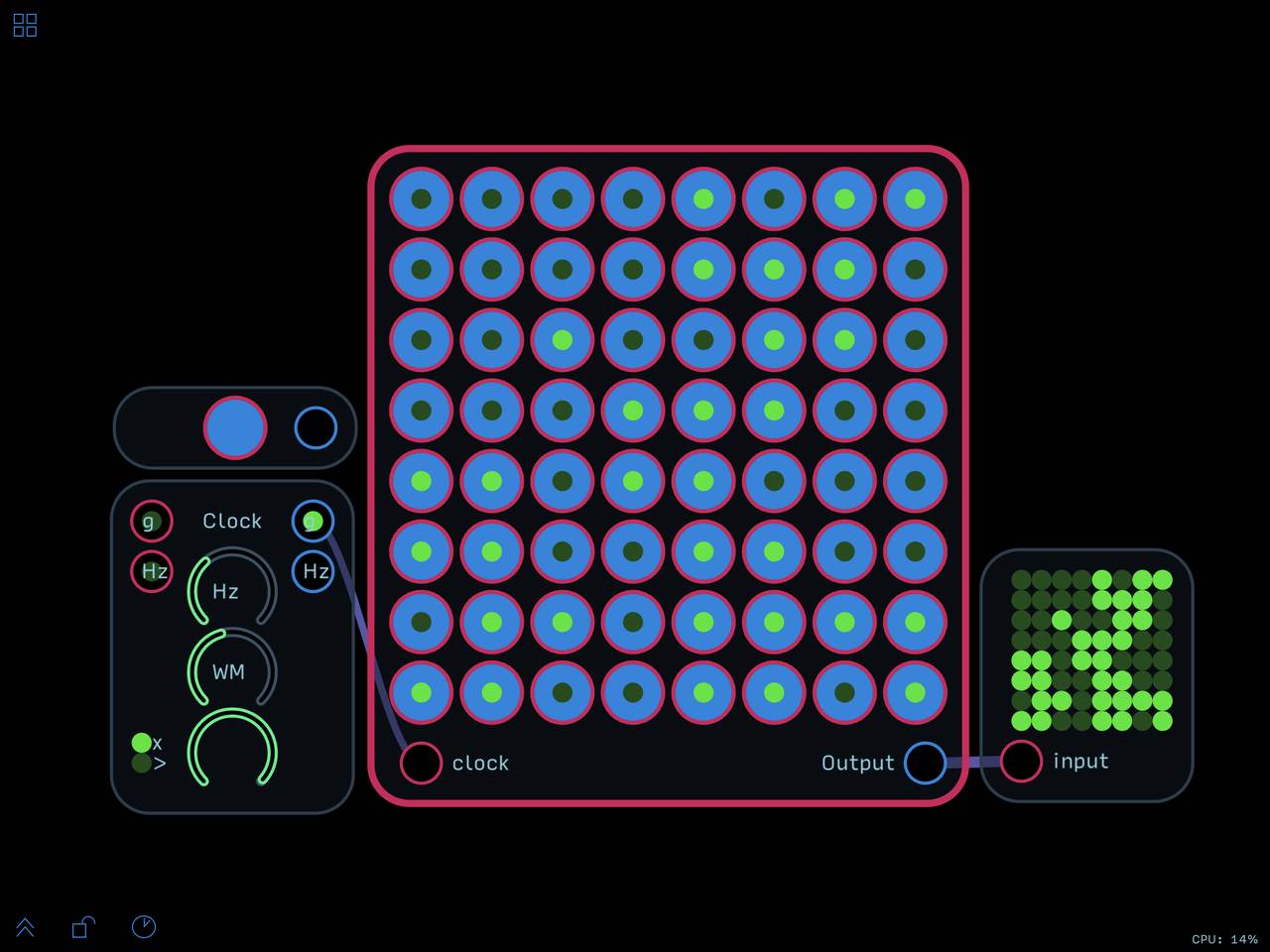
A Sunday side-track: Conway’s Game of Life on Audulus.

There’s a good Wikipedia article on the Game of Life, a cellular automaton devised by John Horton Conway in 1970, in which one creates an initial pattern and watches how it evolves according to a set of basic rules governing transitions for each step in time:

  1. Any live cell with fewer than two live neighbours dies, as if caused by underpopulation.
  2. Any live cell with two or three live neighbours lives on to the next generation.
  3. Any live cell with more than three live neighbours dies, as if by overpopulation.
  4. Any dead cell with exactly three live neighbours becomes a live cell, as if by reproduction.

Depending on the pattern that one uses to seed the game, the transformations fall into an number of categories: The most basic are static Still Lives, Oscillators (with different periods), and gliding Spaceships, all of which can be combined to form more complex patterns, while others might be chaotic in nature. Certain patterns reach a static state or cease entirely after a specific number of transformations, while others evolve continuously.

Jjthrash has been working on an Audulus patch of the game and while he hasn’t yet implemented a form of output I’ve found it fun to tryout different patterns and watch their evolution.

A number of musical applications of the game have already been made, some of them covered in a few articles on Synthtopia. Quincy is one of them with some good video introductions on how the patterns can be put to musical use. I’m looking forward to having these generative sequencing possibilities available within the Audulus sound world.

Modular Diary – 063

I finally got round to a first take on creating a micro version of my Audulus Scale Bender. The main idea was to have the set of ratio inputs readily available under the hood – that one could open up the module and quickly change the configuration should one want to.

Choosing what to include on the front panel and how to set it up in a way that’s both compact and clear turns out to be quite a challenge though and I’m not sure if I’ve found the most elegant solution, but at least it’s a start.

The general absence of text in the µModule UIs paradoxically means that there’s a need for some explanatory text along with (or inside) them. A clear set of general conventions for the collection helps balance that out though.

Modular Diary – 064

The unlabelled look of the ever growing Audulus µModular collection got me thinking of the early Serge modular synthesizers.

Originally, the module configuration for Serge systems could be selected by the user. …These were originally arranged by applying paper graphics to the metal panel… Early systems could have custom graphics—or no graphics—depending upon the whims of the artist.

Serge adopted a series of geometric designs denoting signal types, input, outputs, and triggers. Colored 4 mm sockets were used for most connections - blue, black, and red jacks for (unipolar) control voltages, bipolar signals (NOT necessarily AC coupled) and pulse/gate signals respectively, although these were not rigidly enforced. Later, other colors were introduced, e.g. yellow for triggers.
—Wikipedia

Ben Edwards (aka Benge) used one of these early ‘paper’ systems for his Works On Paper, the second track of which is a favourite among the modular pieces that I’ve come across during the last few months. Here are are some images of his system. And here some images of someone getting creative with theirs.

Modular Diary – 065

A little further down the Serge paper-trail: Yesterday while looking for images of the early ‘paperface’ systems I came across the serge.synth.net site which collects a wide range of documentation including an early 1976 manual which I found particularly interesting, partly because of the graphic symbols that help to clarify the various functions on the modules, and partly because of the wealth of information it offers on modular synthesis in general. As with the Buchla Easel manual that I mentioned a few posts back, both a fascinating insight into the early years of modular synthesis, as well as a fine, still relevant, way to learn about the basic principles today.

I’m not sure of what other sources that might be at play, but looking at the current Make Noise graphics I see a trace of the early Serge systems. Not only visually but also in the move towards treating elements in terms of function – an envelope used as an oscillator or viewed as a waveform, for example – rather than parameter.

Modular Diary – 066

Sitting in a room, somewhere in the world, making something.

After looking through some of the snapshots documenting the early days of building Serge systems, I for some reason got to thinking of the Orthogonal Devices website that I bookmarked a few months ago. Perhaps it’s the picture of the tree on the about page that helped establish it in my mind as a place where someone is quietly going about making something with a very particular character and focus.

Mantra: To create tools (as in pencils and violins) for self-expression.

Looking at the videos on the page for the ER-101: Indexed Quad Sequencer is an exercise in what at first seems like excruciating patience. But while taking a look at How far can I get in 10 minutes? I found that my attention remained very much on what I was hearing as I watched the programming actions on the screen and gradually got accustomed to the world of hardware and sound as it unfolded.

Modular Diary – 067

Jjthrash on the Audulus forum:

Since I’ve been able to generate Audulus patches with code, I figured I would wire up some mux nodes and phase through them very fast to make a wavetable of sorts.

Audulus is a visual programming environment, but since the format is basically a human readable plain text file,1 it is in principle possible to program Audulus patches without using the Audulus app. Which is exactly what jjthrash has done – both with his version of Conway’s Game of Life and the wavetable tryout mentioned above.

Audulus’ beautiful visual programming UI is perfectly suited to creating modular synthesis type patches, but there are situations in which certain tasks which can be achieved far more easily with conventional programming. It seems as if the two can exist alongside one another to some degree.


  1. The human readable format has recently been condensed. Opening up older patches in a text editor reveals a friendly layout with space and indentations, all of which have been removed in the newer version – with the advantage of much smaller file sizes. Patches tend to be small enough on their own, but when downloading entire patch collections the kilobytes start to add up. ↩