↬ Twenty-six – 08: Black Boxes, Cybernetics
Hi, I’m Rudiger Meyer, and this is my monthly newsletter covering what I’ve been up to and what’s been catching my attention.
I came across a great episode on the Other Minds podcast with Ted Gordon, around the idea of ‘The Composer’s Black Box’ – which helped put a few things into perspective for me:
The black box is a really common engineering concept and figure and metaphor. It emerged in electrical engineering in the 1940s, and people like Norbert Wiener and other early cyberneticians use it in various ways. … in engineering, the black box comes to be used to describe any kind of system, whether that’s like an electrical system or a biological system or a physical system, where you can observe what it does, its behavior, you can observe its inputs and its outputs, but you can’t know what is inside of it.
It’s a very basic idea, and it’s kind of deceptively simple because the consequence of that metaphor is that you focus on the behavior of a system, and you really start to think about, well, okay, I don’t really care how it works, but I just want to know what it does, you know, and like what happens when I behave in certain ways with it. And it encourages a certain kind of experimentation.
While Subotnik used the emerging technology to explore new ways of making music, Pauline Oliveros used it to explore perception, consciousness, and the body.
…she told this anecdote over and over again of this kind of foundational moment where she got this cheap tape recorder as a gift. She put the microphone out of her window and hit record and then listened back to the feedback from that recording device and realized there were all these sounds that existed that she hadn’t been attending to.
…And then she took from that kind of a lesson, which was, if I treat my attention and my, the kind of sensory apparatuses of my body, as a system, as an informational system, I can do more with it, I can attend to more things with it, and I can change my consciousness very radically.
And because of that, she was really interested in improvisation and really interested in kind of these intuitive or automatic processes and improvisation. So it was less about more complete control and more about a kind of a sense of self-exploration.
Alvin Lucier, Buchla, and Sun Ra are covered along the way, but the path inevitably leads to AI:
it goes without saying that the fundamental concepts behind current AI all emerge out of the cybernetics moment in the 40s, 50s, and 60s, they just didn’t have the computational power back then, right, to do it.
So we still see the kind of a shared sense of fantasy that gets normalized and scales really quickly… it’s a very basic fantasy:
Every individual person can do something that’s de-skilled and fun and beautiful…
* * *
* * *
How can a sequence be linear and non-linear at the same time?
I finally got my Klee Sequencer finished up and rounded off, with full documentation and some final touches.
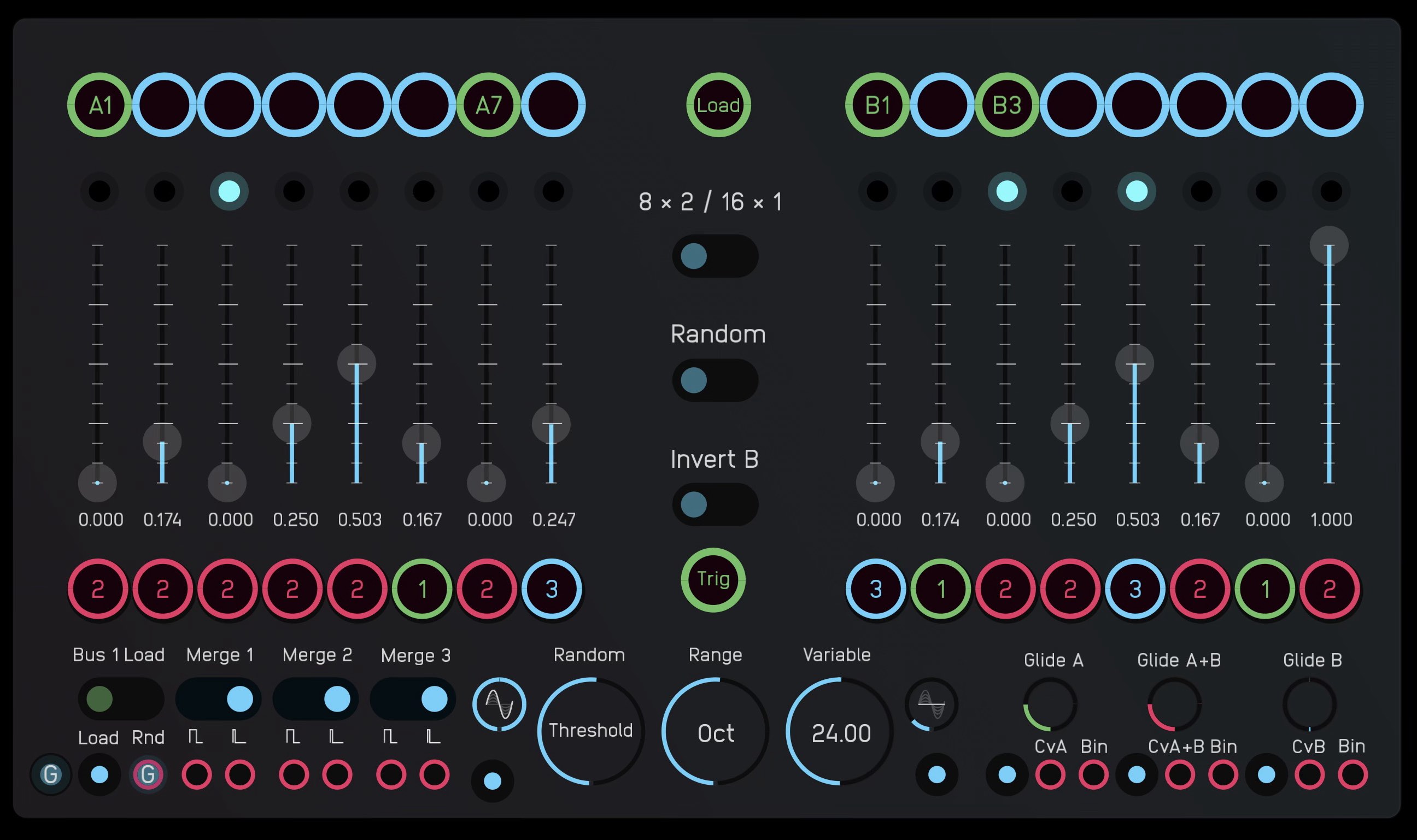
Not quite a black box, but similar in that it spits out stuff that one can’t keep track of, forcing a state of play and exploration.
It’s on my website and the Audulus Forum.
(Also, perhaps worth pointing out that Audulus is now free, has been since the beginning of the year.)
* * *
Here’s a nice video on Drum, a “unique photobook shot in one evening” by the Danish photographer Krass Clement.
Even though I continue to take a lot of photographs myself, Hockney’s complaints about photography have always held with me: the reduction of space to a one-eyed perspective at a single moment in time. Essentially freezing the viewer in both space and time, rather than moving about, going for a walk. A voyeur rather than a participant. But this video opens up another way of considering it (an alternative perspective, one might say). Makes it more about providing a mirror to an inner world, than a window to a reality “out there”, on the other side of the lens (be that of one’s eye, or the camera):
Photography is a difficult process,
precisely because you don’t just go out and snap away.
You have in reality a series of experiences,
and a consciousness,
and in reality your task is, or goal is,
to connect some of these experiences
and consciousness with that you see,
i.e. that you try to reveal something in reality that harmonises with whom you are.
* * *
As I mentioned in my June newsletter, I’ve also been wrapping up a new version of the Lydfabet, one that will be presented in podcast form on poetiskpodcast.dk, starting 1 September, with 30 seconds for each letter (short, the length of an ad insert!) presented each day. Kind of fun that the number of letters in the (Danish) alphabet is so close to the number of days in a month. It’ll be kicked off with a little introduction on 31 August.
It was yesterday that Vagn passed on 10 years ago, and knowing that we were approaching that date was one of the things that prompted me to get the old files out and give them a fresh polish. It’s collected in the form of an Ableton Live ‘Set’ and the old version from 2009 needed some fixing to get it working with the latest version of the software. It was originally intended as a structure to be improvised with, and it’s been fun to revisit and play with again – make a fresh set of vignettes with the old material. Taking up old things can also be somewhat tricky though, and it’s taken a lot longer (surprise, surprise) than I anticipated.
Looking back at the beginnings of that project, and the programming computer cards that Vagn used for random selections in some of his poems from the sixties, also got me thinking of those techniques in terms of where we’ve landed with modern LLMs, and how different our relation to that kind of language manipulation is now.
See also Robin Rendle’s post on Italo Calvino’s 1967 take on the possibility of a writing machine.
* * *
And finally here’s Design Docs, a wonderful YouTube channel covering various design topics. How Italy Beat America to the Personal Computer, and Lost It covers the rise and fall of Olivetti, “a company from a town called Ivrea in the foothills of the Italian Alps”. While Olivetti didn’t mange to sustain its social vision, some of that idealism lives on in the spiritual community of Damanhur, who took over one of the former Olivetti factories in the nearby town of Vidracco, where they set up the Damanhur Crea, a large multifunctional center that I got to visit along with the Temples of Humankind many years ago.
All the best,
↬ Rudiger