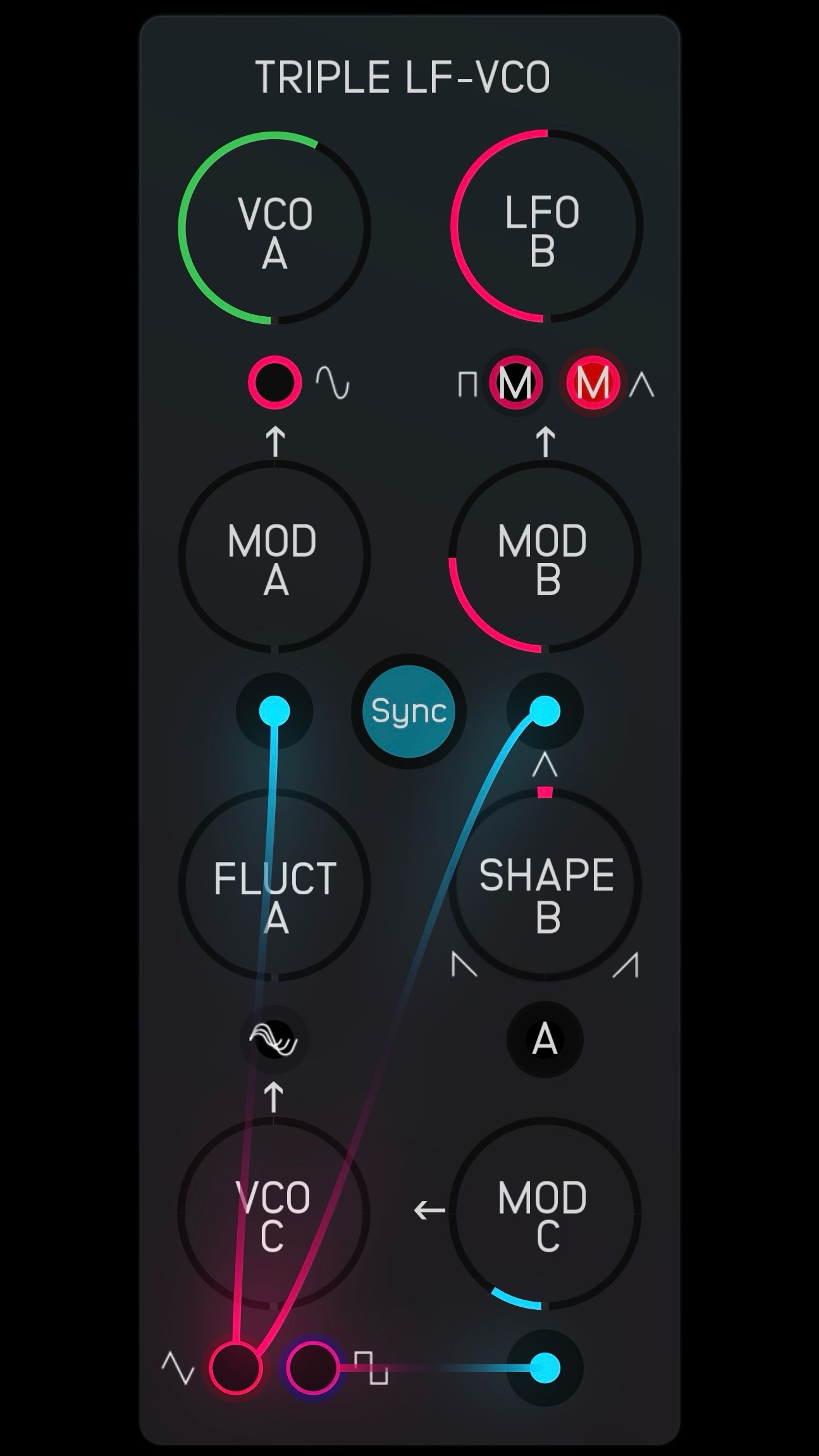
A LFO/Modulation Module featuring three oscillators:
- VCOs A and C are bipolar (and suitable as audio-rate oscillators in their own right).
- VCO A can be modulated by VCO C with a special ‘fluctuation’ modulation.
- LFO B is unipolar and offers various sync possibilities (suitable for envelope-like modulations, for example).
VCO A, the first of the three VCOs, taking the 3rd oscillator of the EMS Synthi as a point of inspiration, has a range from around a minute extending all the way up to over 4 kHz (C8), well into the audio range. Its special feature is a rounded triangle ‘parabol’ waveform (very close to a sine) and the fluctuation modulation that can be applied to it with LFO C as the modulation source. Fluctuation, a combination of frequency and amplitude modulation, makes for a gentler, more natural-sounding vibrato than is possible with regular frequency modulation, and since the amplitude varies, enables interesting timbres when combined with a waveshaper. When VCO C is higher in pitch than VCO A, a special kind of ‘sub sync’ comes into play, with oscillator A reversing direction and locking in on a subharmonic series (in relation to the pitch of oscillator C) when its frequency approaches the relevant points.
In Hordijk’s original, VCO C is closer to a more standard LFO with a range from around 60 seconds to 100 Hz. In this Audulous version, I’ve extended that range to 1000.83 Hz (C6) to make it easier to play with the sub-sync ‘fluctuation’ on oscillator A, though this can easily be adjusted back internally. Both oscillators A and C have bipolar audio outputs, and this, in combination with the wide range of oscillator A, makes them useful in combination with the modulation inputs on the recreations of Hordijk’s other modules, many of which can be used with bipolar signals well into the audio range.
In this version of the Triple LF-VCO, VCO C has a self-modulation feature in which the downward part of the triangle wave can be self-modulated by the pulse wave that runs parallel with it. This means that the upward slope maintains the set frequency while the downward slope can be slowed down, allowing for the creation of something approaching an inverted sawtooth wave. The pulse width of the accompanying pulse wave is coupled to the upward slope of the triangle and maintains its width, while the time between the pulses (the downward slope) can be stretched to as much as half an hour!
(In the hardware version, the LFO C pulse wave is normalised to the modulation input of LFO C – in my Audulus version, this ‘internal’ connection needs to be reconnected manually if broken when connecting an external modulation/sync source.)
LFO B differs from oscillators A and C in that it generates a unipolar signal, making it suitable for creating envelope-like modulations. Inspired by the modulation generator on the KORG MS-20, it has a range from around 10 seconds to 100 Hz, and its triangle wave can be skewed to gradually approach an inverted or regular sawtooth shape. As with VCO C, the accompanying pulse wave follows the rising slope of the triangle wave, meaning that skewing the triangle also adjusts the width of the pulse wave.
LFO B can be synced via a switch with VCO C. This makes it possible to easily generate irregular or shuffle-like rhythms. The switch can also be set to a ‘hold’ position so that on each downward slope of LFO C, the pitch of LFO B is frozen until the point at which LFO C changes to an upward slope, at which point LFO B continues from the point at which it left off, making it possible to create interesting step-like modulations. (The transient of the inverted saw, when the triangle is skewed in that direction, and the pulse wave correspond to the beginning of a new sync cycle.)
Controls
- VCO A Rate – VCO A frequency
- VCO A Mod – amount of frequency modulation applied to VCO A
- VCO A Fluct – amount of ‘fluctuation’ modulation applied to VCO A (internally ‘normalised’ to VCO C)
- LFO B Rate – LF-VCO B frequency
- LFO B Mod – amount of frequency modulation applied to VCO B
- LFO B Shape – alter shape from inverted sawtooth to triangle to sawtooth
- VCO C Rate – VCO C frequency
- VCO C Mod – amount of (self) modulation applied to VCO C
- Sync Button (see explanation above)
- Free
- Sync
- Halt
Inputs
- VCO A Rate (Bipolar)
- VCO A Mod (Bipolar)
- VCO A Fluct (internally ‘normalised’ to VCO C)
- LFO B Mod (Bipolar)
- LFO B Shape (Bipolar)
- VCO C Mod (Bipolar)
Outputs
- VCO A ‘Parabol’ Sine (Bipolar)
- LFO B Pulse (Unipolar)
- LFO B Triangle (Unipolar)
- VCO C Triangle (Bipolar)
- VCO C Pulse (Bipolar)
Links
For further demos, downloads, and discussions, see the Audulus Forum and Discord.
The module can also be downloaded here.
For schematics and further information, see: thehordijkmodular.blogspot.com
Hordijk #14:Triple LF VCO ⧸⧸ Hordijk Modular Workshop @NOVARS
