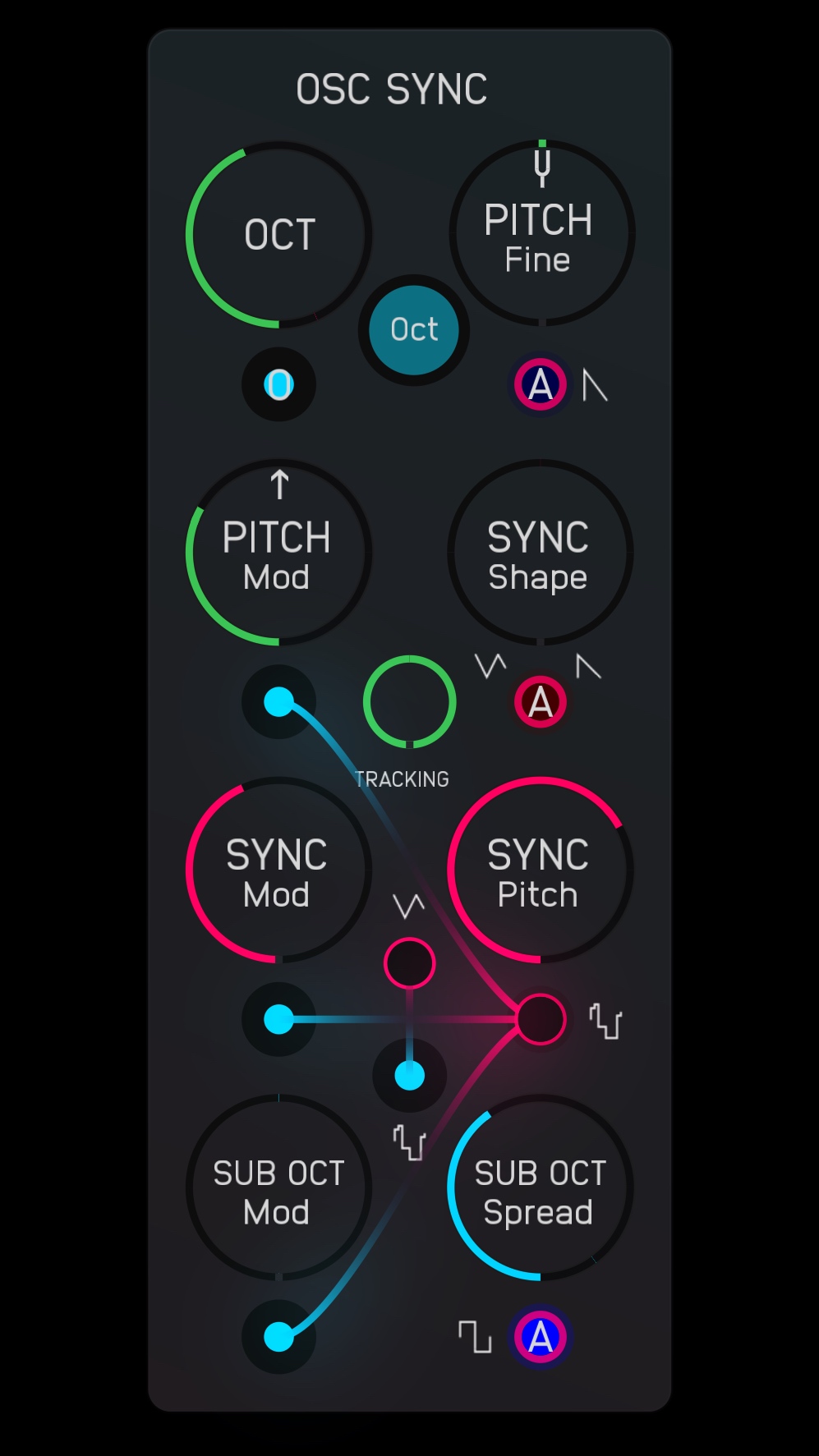
Hordijk’s Sync Oscillator introduces two innovative features to the classic sync-oscillator setup in which one oscillator resets the starting point of another, in this case a sawtooth oscillator (with downward slope) resetting a triangle wave oscillator (that can be morphed into a sawtooth).
The first feature is suppression of the transient that occurs as the synced wave is reset. Since the strength of this transient can be different at the point of each reset, a synced ‘sweep’ across the frequency range can introduce a lot of (unwanted) noise into the synced signal. In Hordijk’s design a smooth sweep is achieved by using the downward sawtooth shape of the syncing oscillator as an envelope that is placed over the synced signal, i.e. the amplitude of the signal is at a point close to zero at the moment it is synced and the transient is introduced.
The second feature makes use of the ever changing level of this suppressed transient to create a random waveform, one that can in turn be used to self modulate either the pitch of the sync or synced oscillators, the modulation level of an additional sub-square waveform derived from the main sync oscillator, or external modules via a dedicated output.
At high clock rates this (true) random signal also provides a wide-ranging (gnarly) noise source, comparable in some ways to that of the Rungler.
Controls
- OCT/FREQ: Sawtooth, 0.42–7038 KHz
- Oct/Freq Button: Switch between octave or free frequency control of the main sync oscillator.
- PITCH Fine: Fine-tune control of the main sync oscillator, +/- 50 cents.
- PITCH Mod: Pitch modulation amount for the main sync oscillator.
- SYNC Shape: Morphs the shape of the synced oscillator from a triangle to a sawtooth wave.
- Tracking: Controls the amount (0–1) by which the synced oscillator tracks the pitch of the main sync oscillator. (At zero the pitch control of the synced oscillator is disengaged, but the synced pitch can still be altered by the sub-octave spread control.)
- SYNC Mod: Controls the amount of modulation applied to the pitch of the synced oscillator.
- SYNC Pitch: Controls the pitch of the synced oscillator (0–4 octaves above the main sync oscillator).
- SUB OCT Mod: Controls the amount of modulation applied to the level of the sub-octave divider (SUB OCT Spread).
- SUB OCT Spread: Controls the level of the sub-octave divider that is applied to the pitch of the synced oscillator. (Useful for creating vowel-like effects.)
Inputs
- 1v/Oct: External input for the main sync oscillator.
- PITCH Mod: 1v/O pitch modulation input for the main sync oscillator that can be attenuated by the Pitch Mod knob.
- SYNC Mod: Bipolar modulation input for controlling the pitch of the synced oscillator.
- S&H: Sample & Hold input. This is normally driven by the triangle wave output, or synced output (for finer control), but can also be used in conjunction with an external oscillator (to create bit-crushing effects, for example).
- SUB OCT Mod: Bipolar modulation input for controlling the modulation level of the sub-octave divider.
Outputs
- Sawtooth: Sawtooth wave output of the main sync oscillator. (Audio)
- Triangle→Sawtooth: Synced oscillator output (with transient supression). Morphs between a triangle and a sawtooth wave. (Audio)
- Triangle: Triangle wave output (without transient supression). By default connected to the input of the sample and hold.
- Sub-octave Square: A square wave derived from the main sync sawtooth and sounding an octave below it.
Nerdy Considerations
In Hordijk’s original design the triangle wave starts/resets from zero and it is the difference between the point on the triangle wave slope and zero that determines the level of the transient. In my implementation the triangle wave resets from it’s top peak since the Audulus oscillator node resets either from the top or bottom peak. It is possible to create a triangle wave that resets from zero using the phasor node, but this involves a few extra hoops to jump through and doesn’t include the built in anti-aliasing of the oscillator node. With the reset from the top point to the triangle wave one achieves a consistent full strength transient the is closer to the energy of the sawtooth, and in any case matches the transient of the downward slope sawtooth envelope that is applied to the synced wave.
A second consideration is how close to the transient one captures the level of the synced wave. The sample and hold needs to be triggered slightly before the transient of the syncing sawtooth since if it triggered exactly on it, the sampled value would always be the top peak of the triangle wave. This offset could be done following the amplitude of the sawtooth, but since the full amplitude of the oscillator node is slightly lower in the top octaves (mostly likely due to aliasing) this proves to be unreliable in this range. In the interests of preferably robust implementation I’ve included a separate phasor dedicated to this task, with a value set to pi*1.6 in order to move closer to the end of the syncing sawtooth cycle, but not so close as to cease working at very high frequencies. Hordijk is probably doing something similar, see (hear) the slight glitches that are apparent at very low frequencies in this NOVARS video at around 8:40.
Links & Download
Demos and discussions can be found on the Audulus Forum and Discord.
The module can also be downloaded here.
Hordijk #07 osc sync oscillator hordijk modular workshop @novars
Hordijk #07a the sync osc1 hordijk modular workshop @novars
Hordijk #07b: The SYNC OSC2 ⧸⧸ Hordijk Modular Workshop @NOVARS
thehordijkmodular.blogspot.com/search/label/OscSync
