Modular Diary – 029

I’ve touched on my interest in alternate tunings in some previous posts. While taking a look at Keith Robert Murray’s site after coming across his explanation of linear FM, I discovered that he has a Eurorack arpeggiator module that also enables custom tunings. Equal divisions of the octave from 2–60 can be defined, and it is also possible to specify a custom tuning for each semitone.1 He explains it all in this video as well as demonstrating the fun one can have when combining alternate tunings with an arpeggiator.

Now all that would be missing for my taste would be the ability to define tunings according to ratio, and perhaps being able to combine the custom settings for individual notes with the ratios (or divisions other than EDO-12) as a starting point. Nevertheless some inspiration for creating something along similar lines in Audulus.


  1. Originally intended for making adjustments for non-standard or uncalibrated oscillators. ↩
Modular Diary – 030

Interesting post on Synthtopia today on a web implementation of the 1971 Triadex Muse – a digital algorithmic sequencer. Donald Tillman, who implemented the sequencer in HTML5 and JavaScript, explains on his site that it includes a 31-bit shift register fed by the unusual ‘theme switches’ on the sequencer.

Shift registers are something that I first learned about via Rob Hordijk telling about the workings of his Rungler. In a masterclass on noise generators he explains the basic shift register principles and usage (at around 6′ in the video) before going on to tell a little about the history of how he first came to make use of it in a musical context (from around 10′50″ onwards) – and how a happy accident in that first encounter laid the ground for his Rungler, Benjolin, and Blippoo circuits.

The Audulus forum has also, once again, proved a fertile learning ground with an interesting discussion and example patches in the Rungler thread.

Modular Diary – 031

Having made a start on recreating Rob Hordijk’s fluctuation waveform I’ve now been trying to clarify for myself the sync aspect of this type of modulation – the way the modulated signal syncs with the modulating signal.

Hard sync is fairly easy to understand but soft sync, which is what is at play in Hordijk’s fluctuation can have many different forms. The Hordijk info site explains the fluctuation soft sync as follows:

The “fluctuation” modulation is a combination of AM and FM which soft syncs to the harmonics of the modulating signal.

Hordijk himself provides a little more detail in his Waveshaping & Fluctuation masterclass:

…when you come to the extreme points then it sort of forces it to zero again, but only if it is within a certain distance and that means that it basically tries to sync on harmonics, but traditional soft sync in an oscillator actually syncs on higher harmonics, but this actually syncs, soft syncs on subharmonics, so the modulating oscillator needs to be higher than the fluctuated modulator, oscillator, which with normal soft sync would be the other way around, so it’s not really soft sync, so I cannot call it soft sync, so I had to give it another name and I thought well maybe Fluctuation is a nice name, and so I call it Fluctuation…

Hordijk’s explanation brings up something else that I’ve had to clarify for myself – what exactly it is he means by subharmonics. The possible definition of subharmonics as “integral submultiples of the fundamental (driving) frequency” offered by the Wikipedia article seems to help here. I simply take it to mean that since the modulating oscillator is higher than the one it is causing to fluctuate, the modulated oscillator syncs at subdivisions of the modulating frequency, rather than multiples.

Now how does one do that in Audulus?

Modular Diary – 032

It’s interesting how one can keep circling around a topic, slowly covering all it’s aspects and letting them sink in.

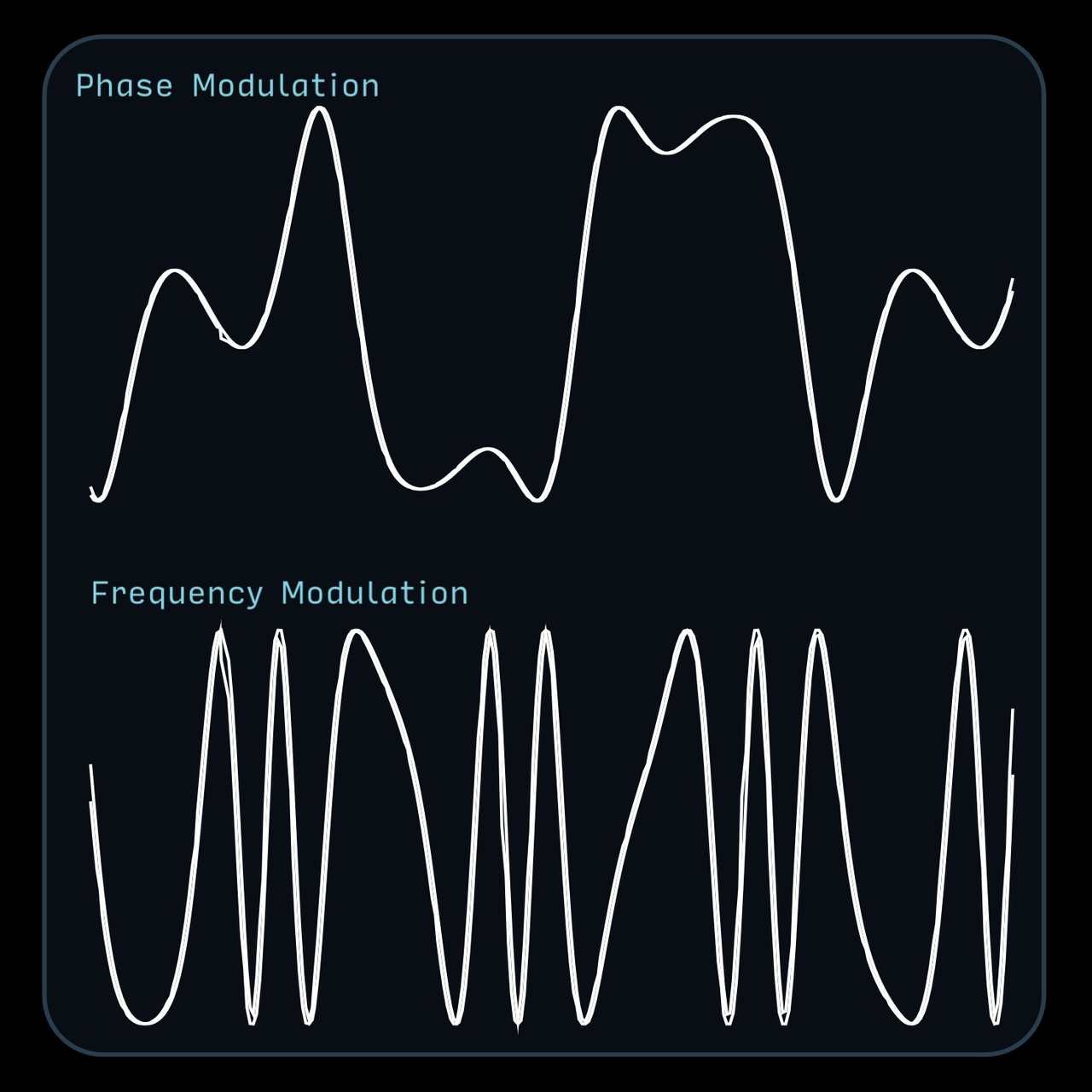
I’ve been taking a look at frequency modulation again – specifically the difference between phase and frequency modulation that I touched on in a previous post. Phase modulation (as used in the Yamaha DX synthesizers) has the same (linear) effect as linear frequency modulation, but while mathematically equivalent, the two sound very different. I came across a thread in the Audulus forum that I’d somehow overlooked before, in which Robert Syrett provides an example patch that helps clarify the differences.

Here’s my own slightly altered version of his patch that I’ve been playing around with. I haven’t quite managed to match the nice phase gif from the Wikipedia phase modulation article, but that can be explored further on another day.

Modular Diary – 033

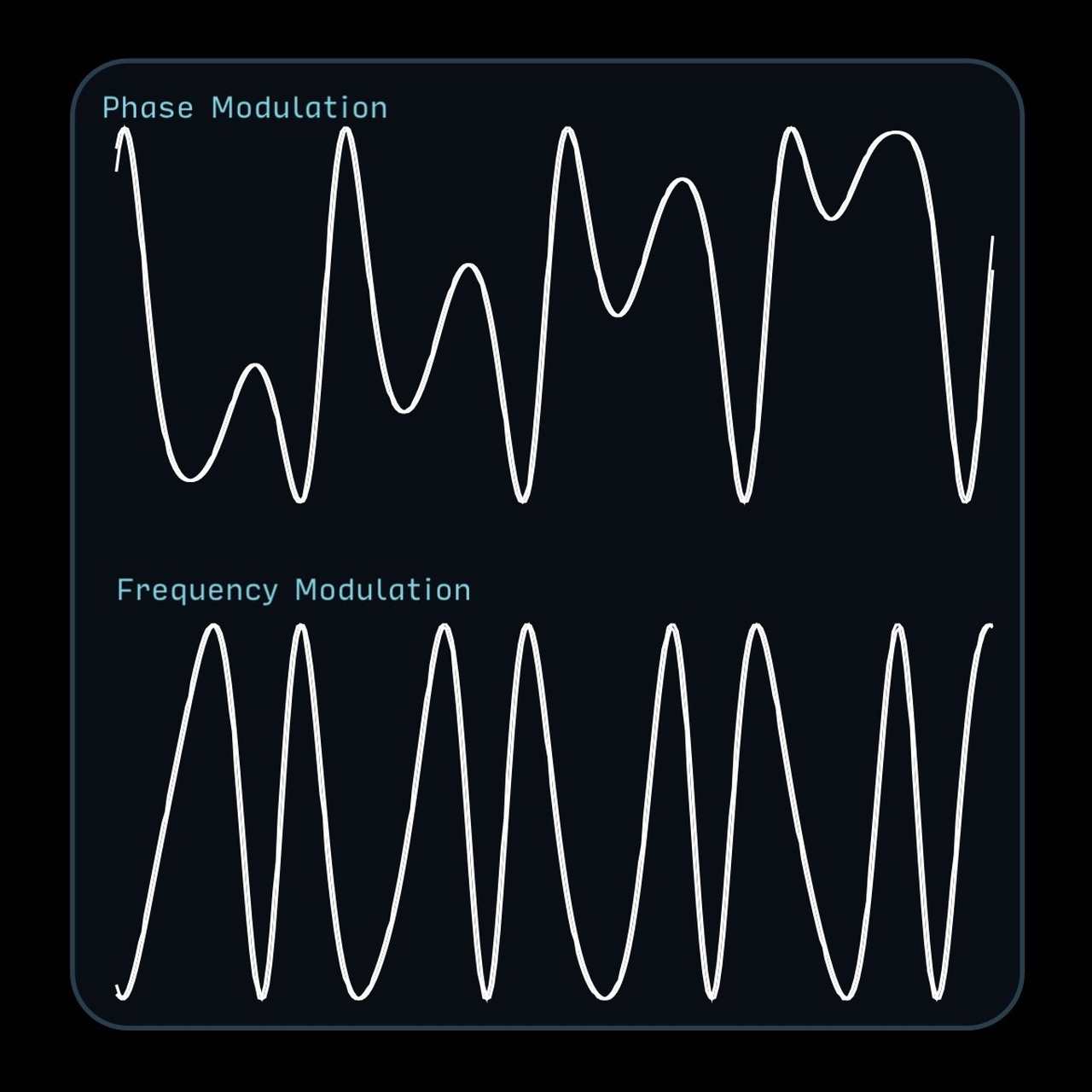
Further down the phase/frequency modulation rabbit hole: I’ve played around a little more with the PM vs FM patch (uploaded to the Audulus forum) and got the levels set to recreate the Wikipedia phase modulation gif. The Audulus LFO waveforms are unipolar and I experimented at little, comparing the results with using a bipolar modulating waveform on the linear1 and exponential FM inputs.

I’ve also been looking at how the shapes change depending on whether the modulating frequency is higher or lower than the one it is modulating. The characteristic phase shapes (with amplitude sub-peaks within them) appear when the modulating wave is higher than the carrier, having a much stronger effect in this area than linear or exponential frequency modulation.


  1. This results in a folding effect similar to the phase modulation amplitude sub-peaks in the picture above. ↩

Modular Diary – 034

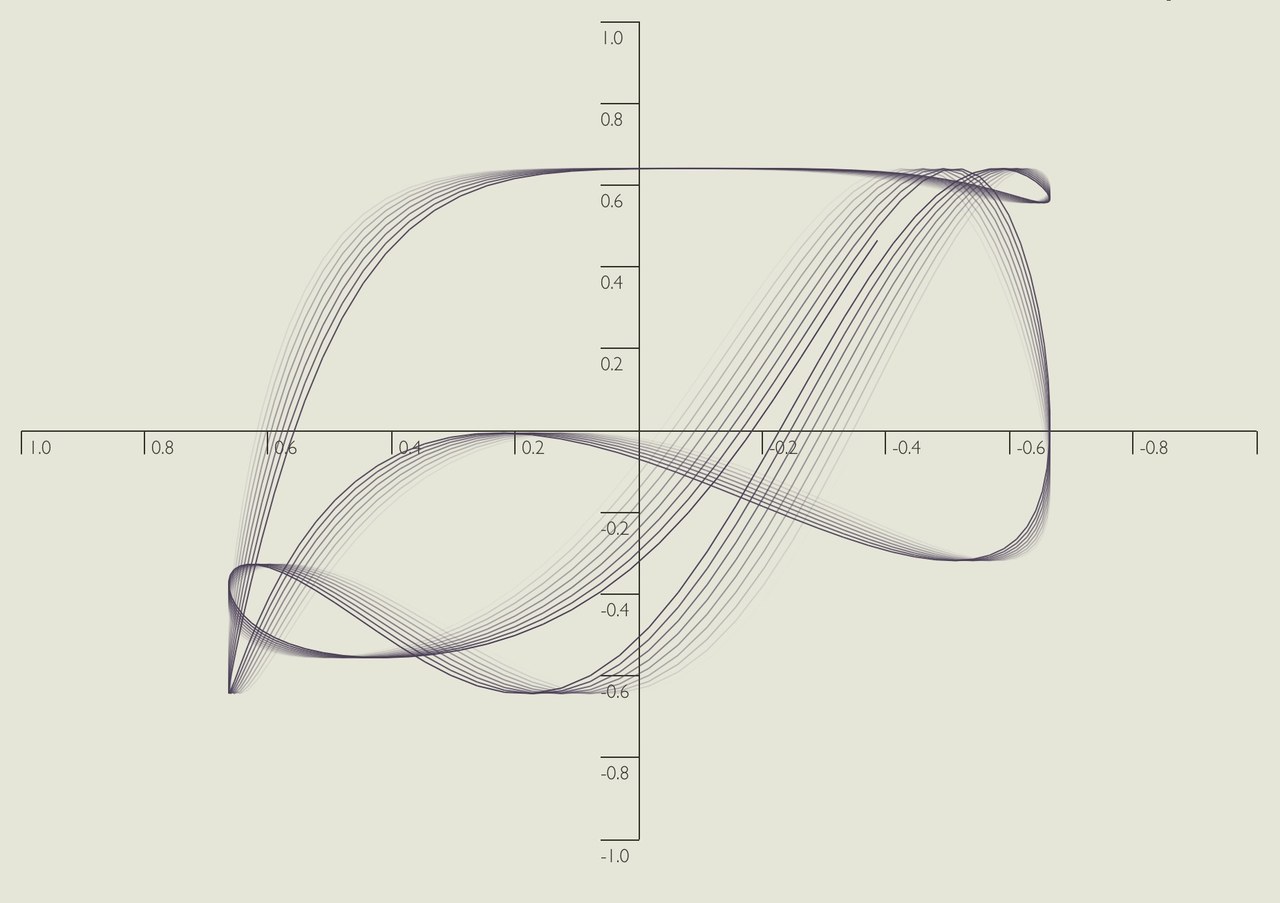
Phase Art: The picture above is of the Wikipedia 3:2 phase modulation example 1 and corresponding comparison with frequency modulation as displayed by an oscilloscope in X-Y mode.2 This is a mode typically used for testing phase relationships between signals and is well known as the method for displaying Lissajous curves – a sine wave on the X axis and a cosine wave on the Y creates a perfect circle, for example.

What I hadn’t realized is that a phase modulated signal against the same (unmodulated) reference frequency could create the kinds of shapes above. (The frequency modulated signal against the same unmodulated reference frequency produces a rotating oval.3) In this case the phase and (linear) frequency modulated signals are presented simultaneously, resulting in the bands of lines that look something like a staff in music notation.


  1. In this case 750:500 Hz ↩

  2. In this case the Goniometer in the MC Studio app.  ↩

  3. Playing with the linear frequency index (the degree to which it approaches exponential frequency modulation) alters the number of lines present and their proximity. The more exponential the curve, the more one approaches familiar Lissajous territory. ↩

Modular Diary – 035

Following on Hordijk’s fluctuation modulation, here’s a demo that I saw a while ago that’s been popping into my head, on how to program the lead sound for Vangelis’ Blade Runner theme. There’s a section on vibrato that starts around 4′23″.

I also took another look at the effects of uni and bipolar waveforms on linear FM in Robert Syrett’s Audulus Bahama oscillators – unipolar FM alters the perceived pitch (which makes sense for audible frequencies 1 since the modulation is only in an upward direction) while bipolar waveforms keep it centered. I noticed that the Moog Model 15 App has AC and DC frequency modulation inputs as well. In that case it’s simply a question of how strong the (exponential) effect is.

I was also curious to take a look at how the Model 15 App handles sync. Hard sync is as one would expect, but the weak (soft) sync is quite sublte and beautiful in the way that it gradually matches up the phase of the waveform while attempting to preserve its shape.

And finally a look at the Make Noise DPO which very much takes both linear and exponential FM into timbral texture territory. Robert Syrett has made an Audulus version of that as well.


  1. For LFOs I guess this isn’t a problem. ↩