rss

100 Days of Something: 7

Frankenstein’s Lab partnered up with Dansehallerne for a special lab on The Choreography of Sound this evening. A chance for composers and choreographers to meet and discuss the relation of sound and movement.

Special guest Gerhard Eckel (who happens to consider himself neither composer nor choreographer) presented a fascinating talk covering some of his work in this field. (I’m pleased I got to experience it since his work isn’t all that well documented online). I’ll write a more in depth post on the Frankenstein site covering some the gems of his presentation and those that followed. There was however one comment that particularly caught my attention: “Sharing prompts research”. That resonates with my experience of writing these posts – both this year and last.
100 Days of Something: 8

“It’s Frankie’s night tonight.” That’s the phrase that runs through my head whenever it’s time for the next Frankenstein’s Lab. It comes from “Sharkey’s Night”, the closing track on Laurie Anderson’s 1984 Mister Heartbreak – an album that I listened to repeatedly as a teenager. The text, I later discovered, is by William S. Burroughs, and it’s also him reading it:

Sun’s going down. Like a big bald head. Disappearing behind the boulevard. It’s Sharkey’s night. Yeah. It’s Sharkey’s night tonight.

And the manager says: Sharkey? He’s not at his desk right now. Could I take a message?

And Sharkey says: Hey, Kemosabe! Long time no see. He says: Hey sport. You connect the dots. You pick up the pieces. He says: You know, I can see two tiny pictures of myself and there’s one in each of your eyes.

And they’re doin’ everything I do. Every time I light a cigarette, they light up theirs. I take a drink and I look in and they’re drinkin’ too. It’s drivin’ me crazy. It’s drivin’ me nuts.

And Sharkey says: Deep in the heart of darkest America. Home of the brave. He says: Listen to my heart beat.

Paging Mr. Sharkey. Wife courtesy telephone please.

Another time and place.

100 Days of Something: 9

“Well, I’ve always thought it’s worth a little temporary discomfort to get to do something remarkable.”

That’s the lesson that Eric Meyer learnt from his grandfather and the lesson that he shares in the latest issue of the beautiful online publication that is The Manual.

Discomfort is something we often come up against when creating art, but push on through with the hopes of reaching that remarkable something. Sometimes the temporary discomfort is stretched, and then stretched again. It starts to look more like a constant state. You get used to living with it – at some point you’ll get to the something.

And that’s not really the point.

100 Days of Something: 10

Last night, while collecting the words on “temporary discomforts” that might grow into something else, a Chris Newman poem popped into my mind: The Black Balloon. It’s a black balloon that bursts. It’s about Darmstadt (in the 80s). I can’t remember much of the text though, nor have I been able to find it online. I originally came across it in Kevin Volans’ Summer Gardeners: Conversations With Composers, Summer 1984 – one of the many collections of interviews I read during the 90s in my eagerness to learn about composition.

If you’re not familiar with Chris Newman, take a listen to this excerpt of him singing one of his songs.

100 Days of Something: 11

I sometimes wonder about these posts. If anyone reads them, that is. My stats indicate not many – unless everyone has opted out or is blocking tracking. Which is unlikely. There’s a little notification that goes out on Twitter each time, but who’s going to click on those links?

There’s a freedom in that of course. And there are occasional signs of appreciation. Facebook would be the biggest driver of traffic, but I got a little creeped out with all the privacy stuff and left. That’s already two years ago.

Who looks at websites anymore? Is there still a place for them in the age of Facebook, Twitter, Medium, and Snapchat? Rich Ziade And Paul Ford (who wrote the article on Brutalist websites I referred to a week ago) talk about this, and more, on the latest episode of their Track Changes podcast.

100 Days of Something: 12

I first considered no longer making use of SoundCloud almost two years ago. At the time I shifted to using self-hosted stats for my website (with Piwik), and it bothered me that as soon as I embedded something from SoundCloud (or Vimeo for that matter), a whole lot of tracking came along to the party. I began to see the charm of simply using the HTML5 audio element.*

I haven’t completely made that transition yet. I still have about ten hours of audio up there – a lot of it is material used to share with musicians when preparing pieces, or sound-files needed for performance purposes. I also have two web things that make use the SoundCloud API, but they could potentially be realised in other ways.

The reason I mention all of this is the recent rumblings of trouble on the SoundCloud horizon – but perhaps that’s for another post.


* Not quite as radical as those Brutalist websites, but perhaps a small step in that direction.

100 Days of Something: 13

“What Would Happen if We Just Gave People Money?” That’s the title of a FiveThirtyEight article on basic income included in this week’s Instapaper summary. A fine introduction to the topic, framed by a look at the upcoming Swiss referendum on it.

That reminded me of the blog post Thomas Basbøll published on this day precisely a year ago. A thought provoking look at the relation between surveillance, privacy, and leisure. And a call to join those wishing to reframe this day as Basic Income Day.

How might we make use of our time given a future of such freedom? Some interesting thoughts on the role of art in this regard from Brian Eno in his John Peel Lecture.

100 Days of Something: 14

The trouble with SoundCloud:

And then:

And where does that leave us?

SoundCloud started as a service by musicians, for musicians. As such it served a valuable role. It also took on a social aspect – it was a place for communities. Now, with everything ending up as a streaming service, the composers and musicians with Pro accounts find themselves in a strange position. As Dave Wiskus of the band Airplane Mode explains: “So not only are you getting our music for free and paying us nothing, we’re actually paying you to take it.”

With SoundCloud stretching so far from its roots, many are beginning to consider exit strategies – but perhaps that’s for another post.

100 Days of Something: 15

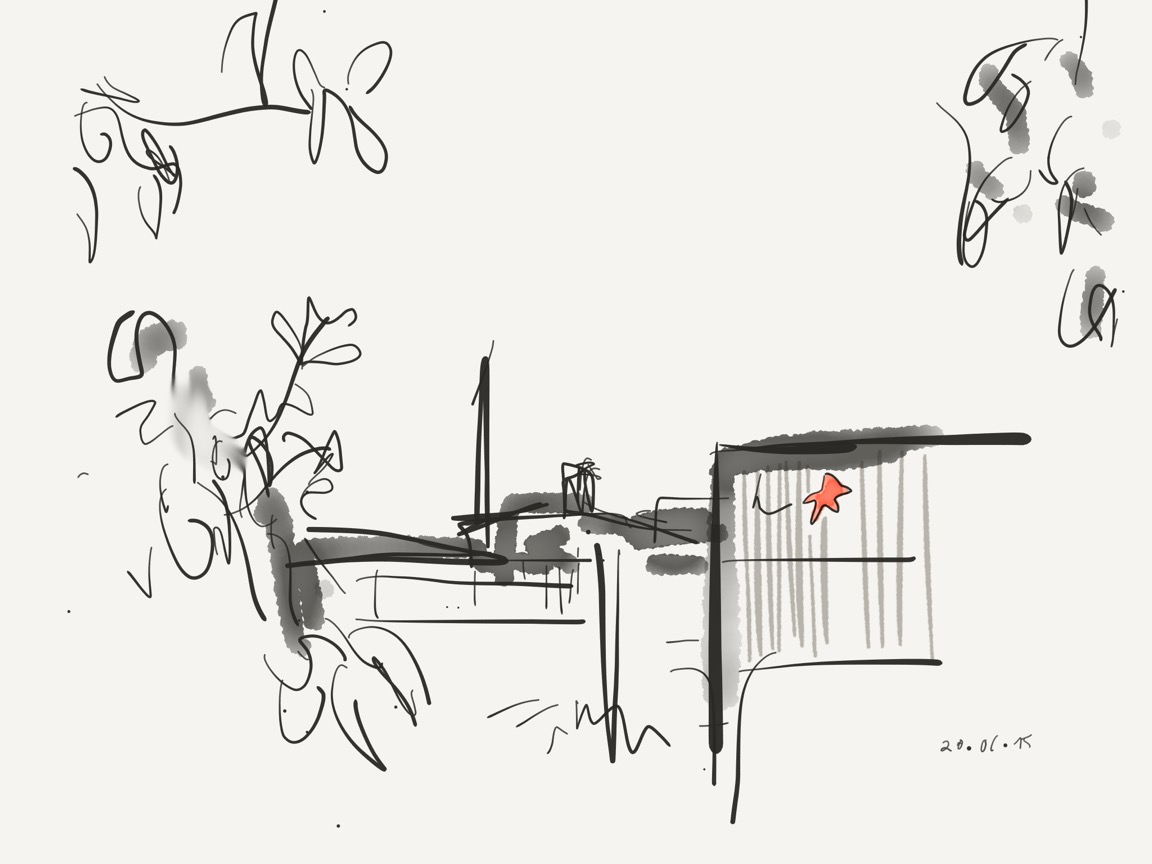
Each morning I walk through a small park near our apartment that stretches alongside the facilities of a large pharmaceutical concern. This morning it occurred to me that their logo, a five pointed star, might in fact relate to the starfish.

In the 1880s the Russian zoologist Élie Metchnikoff conducted an experiment in which he placed thorns into starfish larvae. Certain cells, the presence of which he had been puzzled by, congregated around these intrusions, and these observations led to the development of a defensive model of immunity. “Cell Wars”. A recent article on Aeon traces the history of this model and argues for a disarming of the military metaphor of the body as a battleground.

The company, whose logo includes lettering by Victor Vasarely, mentions nothing of this. The red starfish logo adorns some quite monolithic buildings in a fenced off facility covering a large part of the block. Not the most welcoming presence, but perhaps fitting given the defensive metaphor on which this approach to medicine is typically based. At some point the expansive facilities will probably become too expensive given their proximity to the city, and they too will eventually be ejected.

100 Days of Something: 16

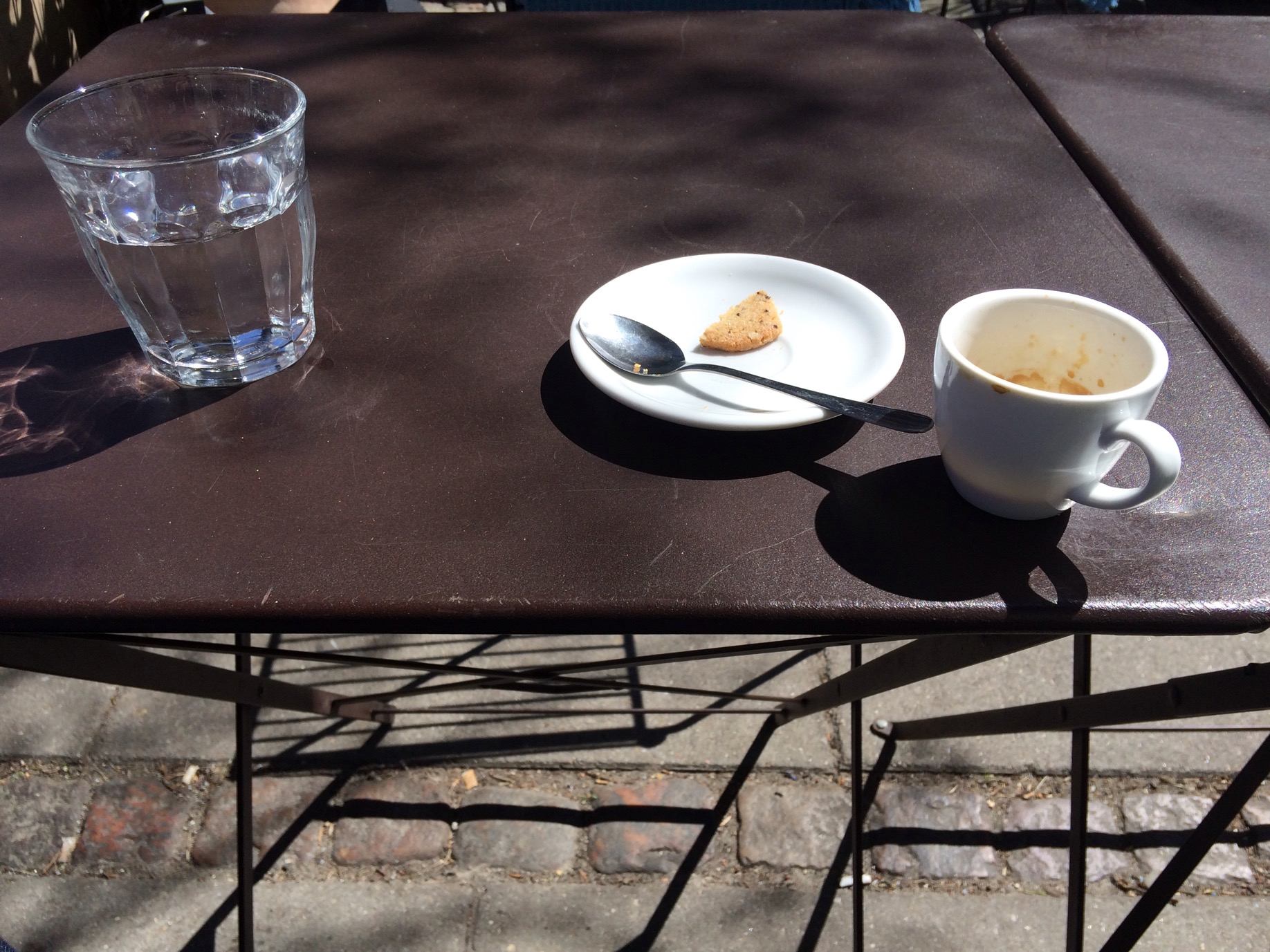
Finally got the chance to take a little time out today. A few stolen moments in the sun.

Of the various Copenhagen espressos Meyer’s are my favourite. They have a certain sweetness and aren’t too heavy. I’m a great fan of The Coffee Collective, but when it comes to espresso I prefer Meyer’s. Sort Kaffe & Vinyl on Vesterbro do a pretty good ristretto, but I haven’t gotten round to that neck of the woods in quite some time.

The photograph was taken with Obscura. It’s not quite as foolproof as the standard camera app on iOS, and it can be a little slow to get going on my aging 5s, but it’s nice to use and can give some great results. In this case the perspective is a little skewed. I tried correcting it with VSCO’s fine set of tools, but eventually went back to the original.

100 Days of Something: 18

Mindfulness is the ability to know what’s going on in your mind without being carried away by it.

That’s the phrase that jumped out at me from a podcast I was listening to this morning. And part of not being carried away by whatever it is you’re caught up in, is being able to tolerate the discomfort of the moment for long enough to see what’s going on. That ties in a little with Eric Meyer’s lesson from a few days ago.

Another aspect of being able to discern what is going on, is being able to put aside the stories that we inevitably wrap everything up in. Easier said than done. Putting aside those stories is hard. I guess that’s a story too.

100 Days of Something: 19

IndieWebCamp:

IndieWebCamp is a gathering of web creators building & sharing open web technologies to advance the state of the indie web. We get together for a weekend to discuss how we can empower people to own their identities and data, then spend a day hacking & creating.

There’s an IndieWebCamp in Düsseldorf this weekend. I didn’t get to go last year and I’d love to have been there this year, but circumstances have dictated otherwise. Kevin Marks has fortunately posted a collection of live notes from this morning’s demos on his site.

Your content is yours, you are better connected, and you are in control.

What appeals to me about the IndieWeb approach is that it doesn’t aim to create an alternate Facebook or Twitter, but rather builds on the principle of each person having their own website. IndieWeb technologies such as webmentions make it possible to communicate with other websites as well as the social media platforms. The webcamps are about developing those technologies and helping people implement them.

100 Days of Something: 21

SoundCloud – Part Three: Exit Strategies

I recently wrote about (slowly) making the transition to hosting all my audio on my own site. That’s in principle simple enough – there aren’t any great technical hurdles. It’s more a question of getting round to doing it.

One thing I will miss though, is the social aspect. SoundCloud remains a good way of keeping track of some of the people creating the far-from-mainstream music that I’m interested in. I’m not so much looking for an alternative SoundCloud as a way of keeping those contacts alive.

100 Days of Something: 22

Wrapping up the thread on mindfulness.

Normally I think of mindfulness in terms of attention and presence, but on a podcast I was listening to last week it was framed as “knowing what’s going on in one’s mind without being carried away by it”.

That could also be put as “being able to hold out on discomfort in order to see what’s going on”. Eric Meyer’s lesson in The Manual touched on something similar – putting aside temporary discomfort in order to do something remarkable. I was wondering about what happens when that temporary discomfort slides into becoming a somewhat permanent state.1

I guess the thing is to make sure to reach the point of insight before being numbed by the discomfort.


  1. Joni Mitchell once compared her use of unresolved chords to unresolved emotional states that might last for several days. ↩

100 Days of Something: 23

Alongside the daily festival of articles that flow in on my RSS readers (Unread on my iPhone and iPad, Reeder on my Mac) I’ve gotten heavily into listening to podcasts during the last few years. RSS is the technology that makes it all possible, and the great thing about it is that it’s an open format. I can choose exactly which feeds to subscribe to and easily change to another set of apps should I wish.

Overcast is the app I use for listening to podcasts. Marco Arment, it’s creator, recently published a response to an article on the New York Times in which he takes a strong stance against wishes in certain circles to turn podcasts into something more proprietary – read: data, tracking, monetization. Frederico Viticci sums up some of what’s at stake in his follow-up on MacStories:

I want podcasting to be a spoken extension of the written web – available to everyone, indexed with an open format, unbound by agreement terms and proprietary file formats. I want to know that, 30 years from now, I’ll be able to look up one of my podcast episodes from 2016 like I can look up a 2009 blog post on my server today.

And Jason Snell and Myke Hurley, holding similar views, discuss the whole kerfuffle in the podcast medium itself.

100 Days of Something: 24

After yesterday’s look at the issues surrounding podcasts and proprietary formats, today a listen to Cory Doctorow’s concerns regarding the future of the open web. While one can choose which (indie) software to use when subscribing to RSS feeds (be they of web pages or podcasts) Cory is concerned that when it comes to web browsers the options are shrinking. He’s concerned that with the new W3C proposal to add DRM as a web standard only the handful of big browser players have a future, not to mention the bunch of security vulnerabilities that come with the DRM can of worms. He spells it all out on the O’Reilly Hardware Podcast.

100 Days of Something: 26

Last week I missed out on IndieWebCamp, this week it’s SPOR Festival I won’t be attending.

I can however follow the Misheardpedia live stream: a work created for the festival in which Wikipedia articles are (machine) translated from text to speech and then back again, gradually building up a new archive of (misheard) knowledge with all the artefacts the process entails. Sound-art, net-art, and hacktivism is how it’s creators describe it.

Mandy Brown recently published an article on our age of bots interpreting speech and text – one way or the other. She considers current trends in replacing graphical interfaces with language-based ones as a kind of manifestation of Walter Ong’s secondary orality:

…text that works like spoken language, even though it’s written, made ever more strange by being filtered through the uncanny valley of a bot’s impression of that language. Maybe this is a tertiary orality, even—an orality removed first by text, then by bots.